Supply and Demand Worksheet
This supply and demand worksheet gives Grade 8 and Grade 9 students 30 marks of practice on how prices are set.
This supply and demand worksheet gives Grade 8 and Grade 9 students 30 marks of practice on how prices get set, and on what a shortage or a surplus is actually telling you.
What the supply and demand worksheet covers
Everything people trade is limited. There is never enough of everything for everyone to have as much as they would like, which economists call scarcity, and prices are how a market decides who gets what. That framing comes first on the sheet because without it supply and demand look like arbitrary curves on a graph.
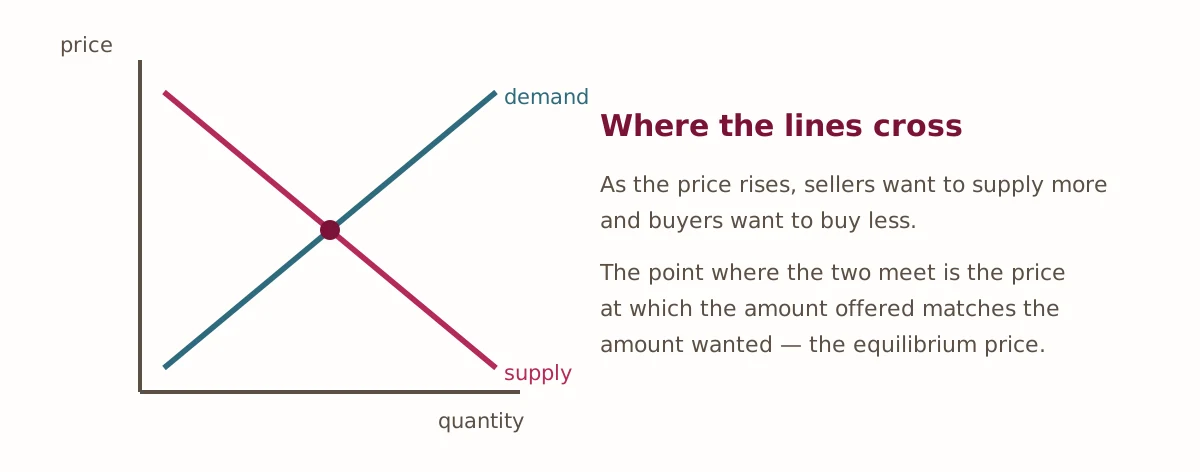
Two forces set a price. Demand is how much buyers are willing to buy, and it usually falls as the price rises. Supply is how much sellers are willing to offer, and it usually rises as the price rises, because selling becomes more worthwhile. The two pull in opposite directions, and where they meet is the equilibrium price: the point at which the amount offered matches the amount wanted.
Above that point goods go unsold and there is a surplus. Below it buyers want more than exists and there is a shortage. Prices tend to move toward the meeting point, which is why a shortage that lasts usually means something is preventing the price from moving.
The mistake almost every class makes
Part C gives six situations and asks what happens to supply or demand, and then to the price. A frost destroys half a coffee harvest. A study reports that a fruit is very healthy. Three new bakeries open on one street. A cheaper substitute appears.
The common error is treating every change as a change in demand. A frost does not alter how much coffee people want; it alters how much coffee exists. The answer key gives the test explicitly: ask first whether the event happened to the buyers or to the sellers. Students who adopt that habit get the whole table right, and those who do not tend to get half of it wrong in a consistent and diagnosable way.
Price controls
Part D ends with a question that has no tidy answer, and is meant not to. A government might stop a price rising to keep an essential affordable — food, fuel, rent. The problem is that at the lower price less is supplied, so shortages, queues, rationing and unofficial selling tend to follow. Holding a price down does not create more of the thing.
That is a genuinely contested area of policy, and the key accepts any sensible pair of reason and consequence. The aim is for students to see a trade-off rather than a right answer, which is a better preparation for economics than memorising curves.
How to use this worksheet
The sheet prints on standard letter paper and needs only a pencil. The answer key explains the reasoning for every item, including the buyers-or-sellers test. In a classroom Part C works as a paired exercise with a whole-class check; for homeschool use the whole sheet runs about forty-five minutes.
For related material, our social studies worksheets cover the Industrial Revolution, globalization and migration across the grades. The Federal Reserve Education site keeps short explanations of market concepts written for school use.
Practise supply and demand online
Answer these five questions and check them instantly. They use the same ideas as the printable sheet.
- As price rises, the quantity buyers want usually does what?
- The price where supply and demand meet is called the what price?
- Goods left unsold because the price is too high are called a what?
- When buyers want more than is available there is a what?
- The problem that wants exceed resources is called what?