Age of Exploration Worksheet
This age of exploration worksheet gives Grade 7 and Grade 8 students 26 marks of practice on why long ocean voyages began when they did.
This age of exploration worksheet gives Grade 7 and Grade 8 students 26 marks of practice on why long ocean voyages began when they did, and on what moved between continents once they had.
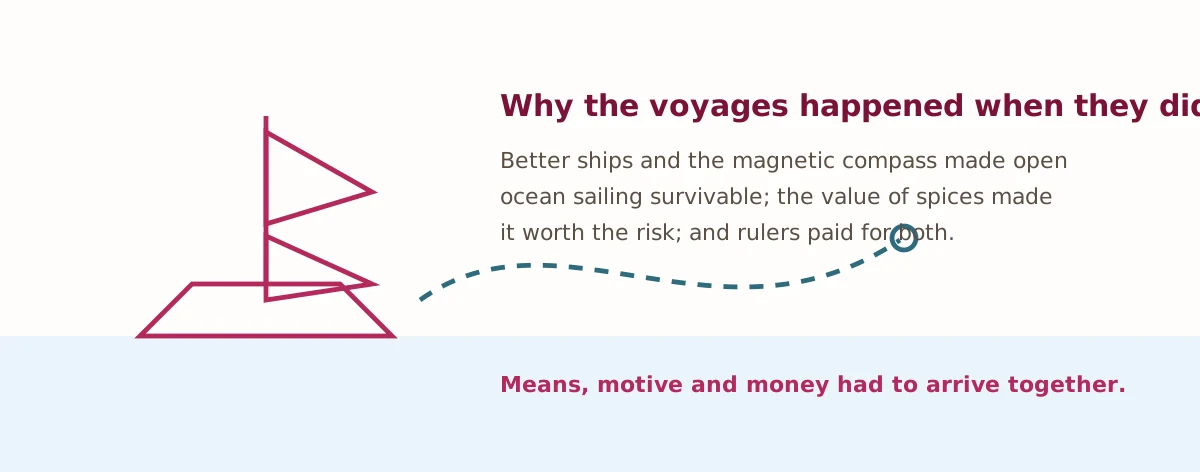
What the age of exploration worksheet covers
Long-distance sea voyages did not begin in the fifteenth century because people suddenly became curious. They began because three separate things arrived at roughly the same moment, and the sheet is organised around that idea rather than around a list of explorers.
The means came first: better ships, above all the caravel, which could sail against the wind rather than waiting for it, together with the magnetic compass and the astrolabe for holding a course and fixing latitude out of sight of land. The motive was money — spices, silk and gold commanded enormous prices in Europe, and the overland routes were long and controlled by others. And the money itself came from rulers willing to fund voyages in exchange for a share of whatever returned.
Students who grasp that pattern can apply it elsewhere. A technology on its own changes nothing until someone has a reason to use it and someone else will pay.
The Columbian Exchange
What followed was not only exploration. Continents separated for thousands of years were suddenly in contact, and crops, animals and diseases moved in both directions. Potatoes and maize transformed European diets and populations. Horses transformed life on the American plains. Wheat went west, tomatoes came east.
Part C asks students to sort six items by direction of travel, and the answer key says plainly what the table alone does not: the exchange was not even. Crops moved both ways, but the diseases travelled almost entirely in one direction, and smallpox and the illnesses alongside it killed a large share of the population of the Americas within a century. That is not a detail to leave to inference.
Reading Columbus as a source
Part D gives students a short passage from Columbus's journal of October 1492. He describes the people he has met as generous and unarmed, and in the next breath observes that fifty men could subjugate them all. The two sentences sit side by side in the original.
The first question asks what he notices and what he concludes. The second asks how the fact that he was writing for the monarchs funding him might have shaped what he wrote. That is the skill worth building at this grade: asking who made a source, for whom, and with what reason to be persuasive. A student who learns to ask it here will ask it of every source afterwards.
How to use this worksheet
The sheet prints on standard letter paper and needs only a pencil, though a world map helps with Part C. The answer key explains the reasoning for each item rather than listing answers. In a classroom the source works well as a paired discussion before a whole-class comparison; for homeschool use the whole sheet runs about forty-five minutes.
For related material, our social studies worksheets cover early civilizations, medieval Europe and migration across the grades. The Library of Congress keeps digitised maps and documents from the period, and comparing two maps drawn fifty years apart shows the change faster than any summary.
Practise the age of exploration online
Answer these five questions and check them instantly. They use the same ideas as the printable sheet.
- Which ship could sail against the wind?
- Which instrument measured latitude from the sun or stars?
- European traders wanted a sea route to Asia to buy what?
- To sail all the way around the world is to do what?
- What was by far the deadliest thing carried to the Americas?