Causes of World War 1 Worksheet
This causes of World War 1 worksheet gives Grade 9 and Grade 10 students 26 marks of practice on why one assassination became a world war.
This causes of world war 1 worksheet gives Grade 9 and Grade 10 students 26 marks of practice on why one assassination in June 1914 became a war involving most of Europe within six weeks.
What the causes of World War 1 worksheet covers
In June 1914 Archduke Franz Ferdinand was assassinated in Sarajevo, and within six weeks most of Europe was at war. Assassinations were not rare in that period. The question historians actually ask is why this one had that effect, and the sheet is built around answering it rather than around listing dates.
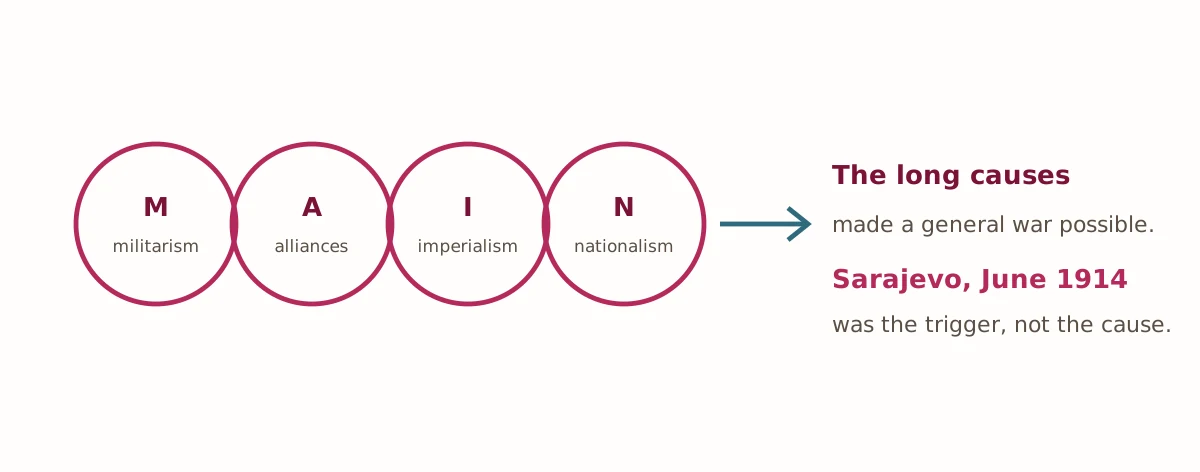
Four long-running pressures had left Europe ready to ignite, usually taught as MAIN. Militarism: armies had grown enormously and war was widely treated as a legitimate instrument of policy. Alliances: rival groups of states had promised to defend one another, so a local quarrel drew in distant powers automatically. Imperialism: the same states were competing for colonies, markets and raw materials. Nationalism: ethnic groups inside large empires wanted states of their own, and the empires intended to prevent it.
Part C gives six descriptions and asks students to sort them into those four. Two of the six map to militarism and two to alliances, which stops the exercise being a simple one-to-one matching and forces students to read each description properly.
Trigger and cause
The distinction the sheet works hardest on is between a trigger and an underlying cause. Sarajevo was the trigger. Without decades of militarism, entangling alliances, imperial rivalry and nationalist pressure behind it, the assassination would have been a serious crime and nothing more.
This is one of the most transferable ideas in the history curriculum. Students who learn it here apply it to revolutions, to economic crises and to conflicts they read about in the news. The second question extends it by asking how alliances, which were intended to prevent war by making it too costly, ended up spreading one instead — deterrence works only until it fails, and then the same promises guarantee that everybody is involved.
A question with no fixed answer
The final question asks which of the four causes mattered most, and tells students plainly that there is no single correct answer and that they are marked on the reasoning. The key sets out the strongest case for each: alliances best explain how fast the war spread, nationalism why the Balkans were volatile, militarism why armies could move within weeks, imperialism the rivalry underneath it all.
Marking reasoning rather than conclusions is the point. Historical judgement is a skill students are expected to demonstrate at this level, and it cannot be practised on questions that have one right answer.
How to use this worksheet
The sheet prints on standard letter paper. The answer key explains the reasoning for every item, including all four defensible positions on the final question. In a classroom that question works well as a short written argument followed by a debate; for homeschool use the whole sheet runs about forty-five minutes.
For related material, our social studies worksheets cover the Industrial Revolution, human rights and twentieth-century history across the grades. The Imperial War Museum keeps photographs, letters and objects from the period online.
Practise the causes of World War 1 online
Answer these five questions and check them instantly. They use the same ideas as the printable sheet.
- The four long-term causes are remembered by which acronym?
- In which year did the First World War begin?
- Building up armed forces and valuing military strength is called what?
- The assassination at Sarajevo was the cause or the trigger?
- Calling up and moving armies into position is called what?