Industrial Revolution Worksheet
This Industrial Revolution worksheet gives Grade 8 and Grade 9 students 26 marks of practice on the shift from handwork to factory production.
This industrial revolution worksheet gives Grade 8 and Grade 9 students 26 marks of practice on the century that moved work out of the home and into the factory, and on who paid for the change.
What the Industrial Revolution worksheet covers
For most of human history goods were made by hand, in homes and small workshops, close to the people who used them. Within roughly a century that stopped being true of much of Europe and North America. This sheet is about how that happened and what it cost.
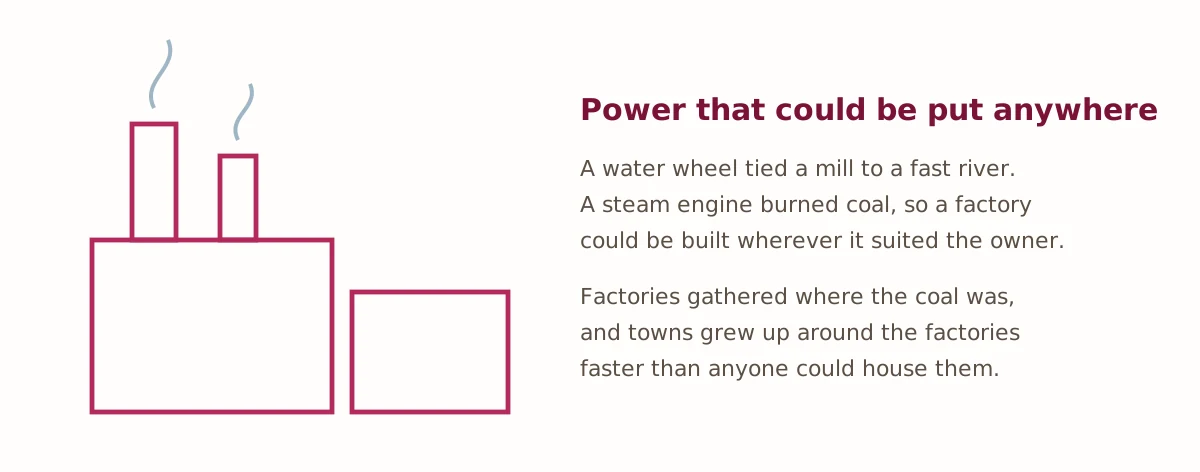
The key was power that could be placed anywhere. A water wheel tied a mill to a fast-flowing river, which meant the geography decided where industry could exist. A steam engine burned coal instead, so a factory could be built wherever its owner chose — and owners chose to build where the coal was. Textiles mechanised first, then iron, then nearly everything else.
People followed the work. Towns grew far faster than anyone could house them, and urbanisation brought overcrowding, contaminated water and epidemics alongside the wages. The work itself was long, loud and dangerous, and a great deal of it was done by children, who were cheap and small enough to reach under running machinery. Trade unions and the Factory Acts both grew out of those conditions, and neither arrived quickly.
Benefits and costs, and who got which
Part C asks students to sort six consequences into benefits and costs: cheaper goods, polluted rivers, new jobs, long hours and unguarded machines, faster rail travel, overcrowded housing. Most students sort them correctly without much difficulty.
The answer key then adds the point the table cannot make on its own, and it is worth reading aloud: the benefits and the costs did not land on the same people. Cheaper goods and railway shares went largely to those who already had capital. The sixteen-hour days, the bad water and the unguarded machines went to those who did not. A student who leaves this topic thinking of industrialisation as simply good or simply bad has missed the more useful question, which is who bore which part of it.
Reading testimony
Part D gives students evidence from a parliamentary committee on child labour in 1832: a worker who began at eight years old, working from five in the morning until nine at night, whose sister lost three fingers to the machinery. It is short and deliberately plain.
The second question asks why lawmakers would want to hear from workers rather than only from mill owners. Owners had a direct interest in describing conditions as acceptable; the people on the floor knew what the hours and the machines were actually like. Testimony of exactly this kind is what produced the Factory Acts, so the source is not only evidence about conditions but evidence about how reform happened.
How to use this worksheet
The sheet prints on standard letter paper and needs only a pencil. The answer key explains the reasoning for each item rather than listing answers. In a classroom Part C works well as a paired sort followed by a whole-class discussion of who gained and who paid; for homeschool use the whole sheet runs about forty-five minutes.
For related material, our social studies worksheets cover exploration, migration and economics across the grades. The Science Museum publishes photographs and short histories of the machines themselves, which make the scale of a spinning mill much easier to picture.
Practise the Industrial Revolution online
Answer these five questions and check them instantly. They use the same ideas as the printable sheet.
- Which engine freed factories from sitting beside rivers?
- Which fuel powered the engines and furnaces?
- Which industry was mechanised first?
- The movement of people from countryside to city is called what?
- Workers joined together in a trade what?