Feudal System Worksheet
This feudal system worksheet gives Grade 7 and Grade 8 students 26 marks of practice on how medieval Europe traded land for loyalty.
This feudal system worksheet gives Grade 7 and Grade 8 students 26 marks of practice on the arrangement that organised much of medieval Europe: land granted downward, service and food owed upward.
What the feudal system worksheet covers
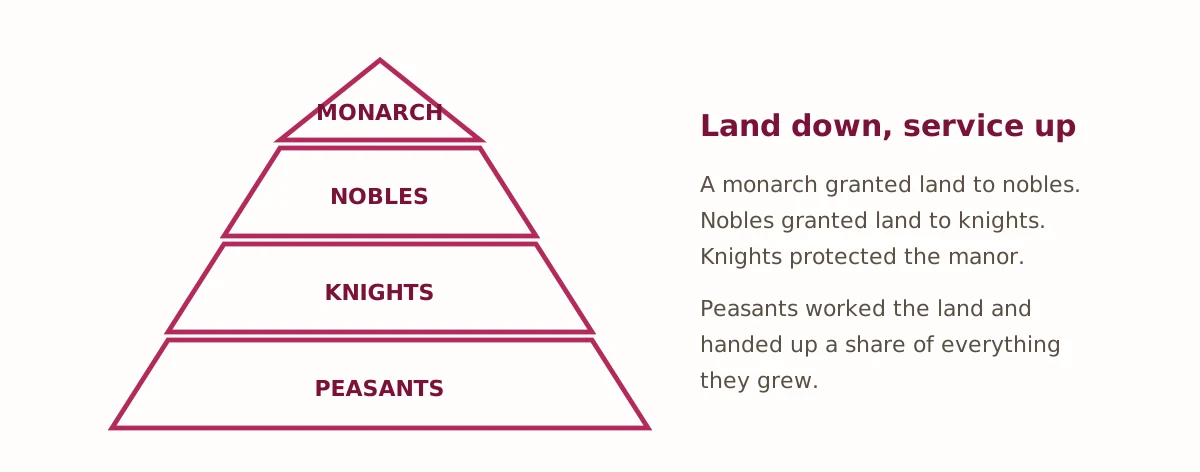
For several centuries across much of Europe, land and loyalty were traded for one another. A monarch granted estates to nobles. Nobles granted smaller estates to knights. In return each man owed his lord military service and support. The estate was a fief, the man who held it a vassal, and the ceremony where he swore loyalty was homage.
The reason is more interesting than the vocabulary. There were no police forces and no standing national armies. A ruler who wanted soldiers had to pay for them somehow, and the one thing he possessed in quantity was land. So he paid in land, and the men he paid did the same thing one rung down. The whole structure is a single bargain repeated at every level.
At the bottom were the peasants, who did none of the granting and all of the work. Many were serfs, bound to the manor and not free to leave it. They farmed the lord's fields as well as their own, handed up a share of what they grew, and paid a tithe to the church besides. Protection flowed down the ranks and food flowed up.
Reading an oath of homage
Part D gives students a twelfth-century oath: a promise of faithfulness, made by someone who has already received land. Two questions follow. The first is comprehension. The second asks why a lord would want the promise spoken aloud before witnesses rather than written privately, which opens up something students rarely consider — most people could not read, courts as we would recognise them did not exist, and a public ceremony everyone remembered was the most reliable record available.
That question does more work than it looks. It moves students from treating a historical source as information to treating it as an object with a purpose, made by someone with reasons.
Why the system ended
Part E asks why the return of coinage undermined feudalism. A lord who can pay wages no longer needs to give away land, and land given away is gone permanently. Paid soldiers can also be hired for a single campaign and dismissed afterwards, which gives a ruler far more control than a vassal holding an estate for life. Students who work that out have understood feudalism as a solution to a practical problem rather than as a fixed social order, which is the whole point of teaching it.
The final question asks who had the least choice, and what that says about whose interests the system served. Answers that notice obligations ran upward while protection was the only thing flowing down are getting it right.
How to use this worksheet
The sheet prints on standard letter paper and needs only a pencil. The answer key explains the reasoning for each item rather than listing answers, so it suits self-marking or a parent teaching the period for the first time. In a classroom the vocabulary works as a starter and the oath as a paired discussion; for homeschool use the whole sheet runs about forty-five minutes.
For related material, our social studies worksheets cover early civilizations, exploration and government across the grades. The British Library holds Magna Carta and explains its background, which pairs naturally with this sheet for students asking what finally limited a monarch's power.
Practise the feudal system online
Answer these five questions and check them instantly. They use the same ideas as the printable sheet.
- An estate granted in return for service was called a what?
- Someone who held land from a lord and owed service was a what?
- A peasant not free to leave the land was called a what?
- The ceremony where a vassal swore loyalty was called what?
- The share of produce paid to the church was called the what?