Primary and Secondary Sources
This primary and secondary sources worksheet gives Grade 11 students 26 marks of practice on source analysis.
This primary and secondary sources worksheet gives Grade 11 students 26 marks of practice on source analysis, ending with two documents written by the same officer in the same week that flatly contradict each other.
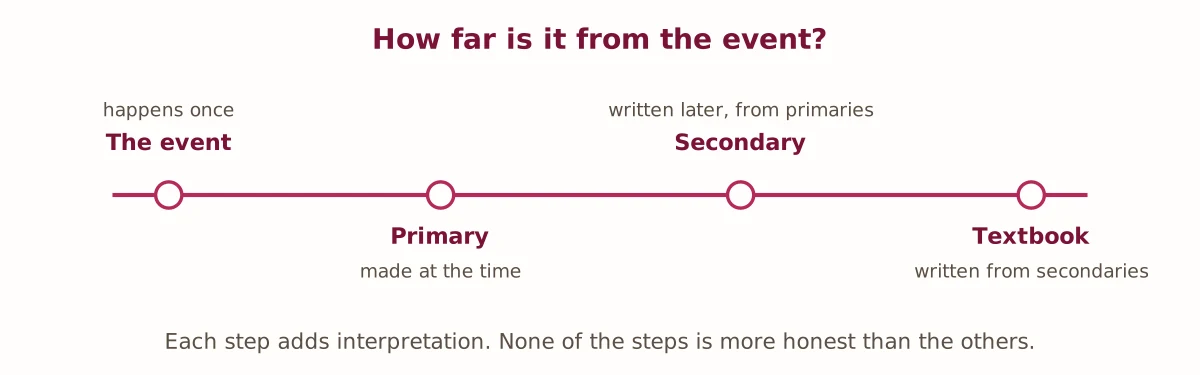
What the primary and secondary sources worksheet covers
A primary source was created at the time, by someone present or involved. A secondary source was written later, built from primary material. The difference is distance from the event, not honesty, and that distinction is the one students most often get backwards. A diary can lie. A historian writing a century later can be scrupulously fair.
Part B gives eight sources to sort — a soldier's letter, a census return, a wage ledger, a documentary, a journal article — and the sorting is deliberately straightforward, because the difficult work comes next. Part A and Part C establish the vocabulary a senior student needs: provenance, corroboration, bias, audience, reliability and silence.
The question that actually works
Students are often taught to ask whether a source is biased. It is a dead end, because everything is. The productive question is what a source can be trusted to tell you. A recruitment poster is poor evidence of conditions at the front and excellent evidence of what a government wanted its population to believe. The poster has not changed; the question has.
Three habits do most of the work in practice. Check the provenance: who made this, when, and for whom. Look for corroboration from a source that had no reason to agree. And notice the silences, because what a document carefully avoids mentioning is often the most informative thing about it.
Two primary sources that contradict each other
Part D is the heart of the sheet. Students read two extracts, both primary, both written by the same officer in the same week of October 1917. One is a letter to a soldier's family saying the men are in excellent spirits and rations are ample. The other is his private notebook recording trench foot, rations two days late, and the line "I have told no one at home."
The first question asks why they disagree. The answer is audience. The letter was written for a worried family and probably passed a censor, so it reassures. The notebook was written for nobody. Neither is a lie exactly; each does the job it was made for.
The second question is harder: a historian can use only one, so which? The honest answer is either, depending on the question being asked. For conditions at the front, the notebook, because it had no one to reassure. For how the war was presented to families at home, the letter — and the notebook then becomes the proof that the letter was managed. Students who reach that second pairing have understood source analysis rather than memorised a rule about it.
How to use this worksheet
The sheet prints on standard letter paper and runs about forty minutes. Part D works particularly well read aloud, with the second extract withheld until students have committed to a reading of the first. The answer key gives marking notes for both open questions, where several answers are defensible.
For related material, our social studies worksheets cover the causes of the First World War, the Cold War and decolonization. The Library of Congress teacher pages hold thousands of digitised primary documents with analysis prompts, which makes a natural follow-up once students have the vocabulary.
Practise source analysis online
Answer these five questions and check them instantly. They use the same ideas as the printable sheet.
- A soldier’s 1917 letter home is a primary or secondary source?
- Where a source came from and who made it is called its what?
- Checking a claim against an independent second source is called what?
- The people a source was made for are its what?
- A history book published in 1998 about 1917 is which kind of source?