Climate Policy Worksheet
This climate policy worksheet gives Grade 12 students 26 marks of practice on why emissions are hard to cut and what governments can actually do.
This climate policy worksheet gives Grade 12 students 26 marks of practice on why emissions are hard to cut, what the available tools actually do, and what each one costs.
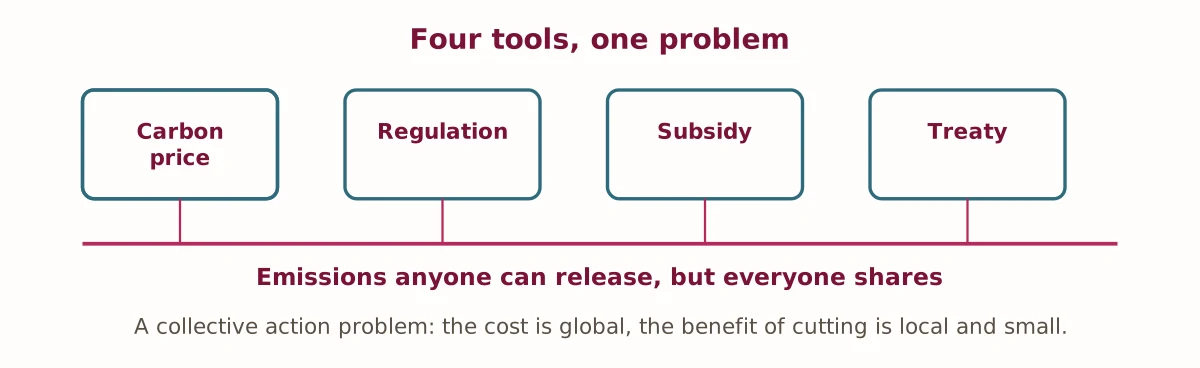
What the climate policy worksheet covers
Climate change is the textbook collective action problem, and that structure is where this sheet starts. The benefit of cutting emissions is shared by everyone on the planet; the cost falls on whoever does the cutting. So every actor, considered alone, does better by letting someone else cut. Students who understand that sentence can explain why the problem has outlasted three decades of agreements, which is more useful than memorising the agreements.
Part A and Part B establish the vocabulary: mitigation, adaptation, carbon pricing, cap and trade, free riding, carbon leakage and just transition. These are the words a senior student needs to read any serious document on the subject.
Five tools, each with a real cost
Part C gives five policy tools and asks for one strength and one weakness of each. A carbon price gets the cheapest cuts first because firms with low-cost options take them, but the cost is visible on bills and therefore politically hard. Regulation on a specific product is certain and easy to explain, but it may force an expensive cut before a cheap one elsewhere. Subsidies are popular but spend public money and sometimes fund what would have happened anyway.
Treaties are the only tool that reaches a genuinely global problem, and their enforcement is the weakest of the five. Adaptation spending protects people now but does nothing about the eventual total. Asking for a weakness alongside every strength stops the exercise becoming advocacy, and it reflects how the choices actually look to a government with a fixed budget.
Leakage and enforcement
Part D works through two consequences students rarely anticipate. The first: a country introduces a carbon price and a steel plant closes and reopens where there is none. Emissions did not fall, they moved, and the first country lost the plant too. That is carbon leakage, and the responses include a border carbon adjustment, free permits for trade-exposed industry, or coordinating the price with trading partners.
The second asks why a treaty is both necessary and hard to enforce. Necessary because the atmosphere is shared and a country cutting alone bears the full cost for a fraction of the benefit. Hard because treaties rest on reporting, reputation and trade pressure rather than any authority that can compel a sovereign state, and because a state can simply leave.
A question with no safe answer
Part E gives a government funding for one measure only: a carbon price or sea defences for a coastal city. Students argue for one and state the strongest objection to their own choice. Both sides are defensible, and the key marks the quality of the objection rather than the position taken. This is the right standard for a contested policy question in a senior course.
How to use this worksheet
The sheet prints on standard letter paper and runs about fifty minutes. The diagram at the top supports the collective action discussion and works well built up on a board first. Part E makes a good structured debate if you have a full period.
For related material, our social studies worksheets cover globalization, supply and demand and climate zones. The IPCC assessment reports include summaries written for policymakers that senior students can read directly.
Practise climate policy terms online
Answer these five questions and check them instantly. They use the same ideas as the printable sheet.
- Reducing emissions to limit warming is called what?
- Coping with warming already underway is called what?
- A fixed total of tradable permits is called cap and what?
- Emissions moving to a country with weaker rules is called carbon what?
- An actor taking the benefit of others’ effort without contributing is a free what?