Cold War Worksheet
This cold war worksheet gives Grade 11 students 26 marks of practice on the rivalry that armed two blocs for forty years without a direct war between them.
This cold war worksheet gives Grade 11 students 26 marks of practice on the rivalry that armed two blocs for forty years without either side fighting the other directly.
What the cold war worksheet covers
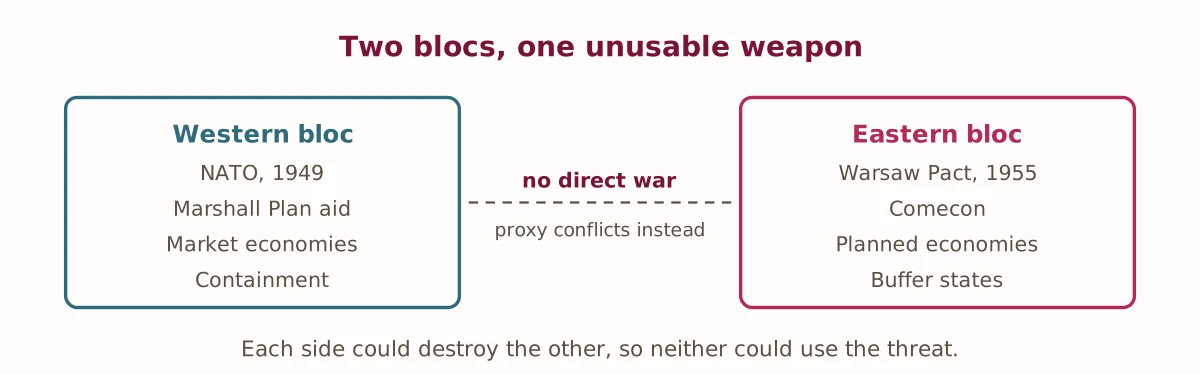
The central fact a student has to explain, rather than simply remember, is that two blocs armed heavily against each other for four decades and never fought each other directly. Everything else on this sheet is built around answering that.
The usual answer is deterrence. Once both sides held enough nuclear weapons to destroy the other even after absorbing a first strike, direct war stopped being a usable option. The threat still shaped every decision taken on either side, but acting on it would have ended both states. Part A establishes the vocabulary for that idea — containment, deterrence, arms race, détente — and Part C checks it.
Where the rivalry actually went
Blocked from fighting each other, the competition moved elsewhere: into proxy wars fought with superpower weapons and local soldiers, into aid and loans, into space programmes, sport and propaganda. Part D asks students to explain the significance of five episodes along that path. The Berlin airlift supplied a blockaded city by air rather than forcing the road, which avoided a shooting war over a convoy. The Cuban missile crisis brought both sides as close as they came and produced a hotline and the first arms talks.
Korea and Vietnam showed the proxy pattern plainly. SALT capped arsenals without resolving anything, buying predictability instead of peace. And the Eastern bloc dissolved between 1989 and 1991 without the direct war both sides had spent forty years planning for.
That last point is worth dwelling on. A great deal of military and economic planning on both sides assumed a conflict that never came, and students who grasp how the rivalry ended also understand why so many predictions made during it were wrong.
Reading a speech by a man out of office
Part E gives the Fulton extract from March 1946 and asks why Churchill being out of office makes the speech both less authoritative and more useful to a historian. Both halves are needed. He held no office, bound no government and could be disowned, so the speech is not policy. But a man with his experience and no official constraints says plainly what serving ministers were still saying only in private, and he names the division of Europe years before either government did publicly.
This is a transferable skill rather than a fact about 1946. Students who can weigh what a source's position does to its value will handle any document they are given later.
How to use this worksheet
The sheet prints on standard letter paper and runs about fifty minutes. The two-bloc diagram at the top supports Part A and makes a useful board sketch to build up before students start. The answer key gives marking notes for the timeline reasoning question and for Part E, where several answers are defensible.
For related material, our social studies worksheets cover the Second World War, decolonization and globalization. The US National Archives Cold War collection holds declassified documents that pair well with Part E for students who want to work from originals.
Practise cold war terms online
Answer these five questions and check them instantly. They use the same ideas as the printable sheet.
- Preventing the spread of a rival system is a policy of what?
- In which year was NATO founded?
- A conflict where rivals back opposing sides is called what kind of war?
- Which 1962 crisis came closest to direct nuclear war?
- What word describes a state that joined neither bloc?