World War 2 Turning Points
This world war 2 turning points worksheet gives Grade 10 students 26 marks of practice on the events that changed the likely outcome of the war.
This world war 2 turning points worksheet gives Grade 10 students 26 marks of practice on the events that changed the likely outcome of the war, and on the harder question of what makes an event a turning point at all.
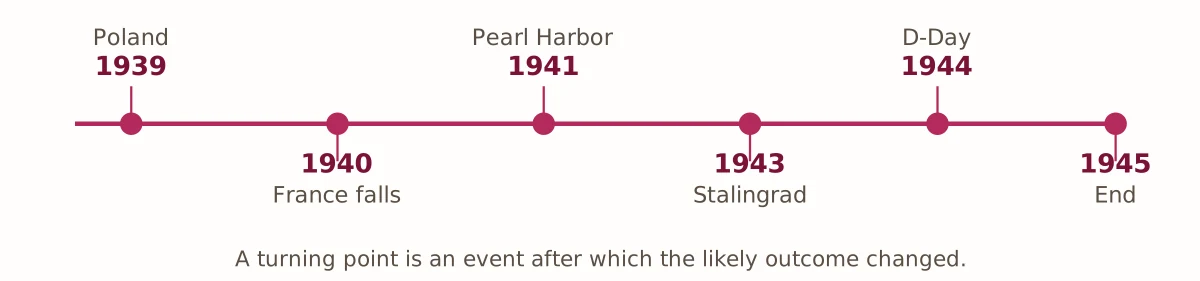
What the world war 2 turning points worksheet covers
Historians call an event a turning point when the likely outcome of a war changed because of it. That is a stricter test than being large or famous, and it is the idea this sheet is built around. A battle can cost hundreds of thousands of lives and change nothing strategic; a decision taken in a single week can determine everything that follows.
Part D gives students five candidate turning points and asks for the strategic consequence of each rather than a description of the fighting. Pearl Harbor brought in an industrial base the Axis could not match. Operation Barbarossa opened a second front that consumed most of the German army for four years. Stalingrad destroyed an entire army and ended the eastern advance for good. Midway cost Japan four carriers it had no way to replace. D-Day forced Germany to defend in three directions at once.
The arithmetic behind the battles
The thread running through all five answers is replaceability. Students are asked to notice that the decisive question is usually not who won a given engagement but whether the loser could replace what it lost. By 1944 the Allies were producing more aircraft than the Axis could shoot down and more merchant shipping than its submarines could sink. Once that gap opened, individual battles mattered less than the production figures behind them.
This is worth teaching because it is the part students usually miss. A course that treats the war as a sequence of battles leaves them unable to explain why the outcome looked settled well before the fighting stopped.
Timeline and source work
Part B is a six-event timeline from the invasion of Poland to the end of the war. The spacing is deliberate: the gap between the fall of France and the D-Day landings is four years, and students who have only seen a list of dates are often surprised by how long Britain and the Soviet Union fought without a western front.
Part E gives an extract from Churchill's June 1940 speech to the Commons, made days after France fell. The question asks what the speech was trying to achieve and who the intended audience was beyond the room. The answer involves two audiences: a government in which some members wanted negotiated terms, and a neutral United States that needed to believe Britain would hold out long enough to be worth supporting. Students who find both audiences have understood something about how wartime speeches work.
How to use this worksheet
The sheet prints on standard letter paper and runs about forty-five minutes. The answer key includes marking notes for the two open questions, where several answers are defensible. Part D works well as a small-group debate before marking, since students often disagree about which of the five mattered most.
For related material, our social studies worksheets cover the causes of the First World War, the Cold War and decolonization. The Imperial War Museums history section holds photographs and first-hand accounts that pair well with Part E.
Practise world war 2 turning points online
Answer these five questions and check them instantly. They use the same ideas as the printable sheet.
- Which 1941 attack brought the United States into the war?
- A fast combined attack by tanks and aircraft was called what?
- Which battle destroyed a whole German army in the winter of 1942-43?
- How many Japanese carriers were lost at Midway?
- A foothold held on a defended coast is called a what?