Mesopotamia Worksheet
This Mesopotamia worksheet gives Grade 6 and Grade 7 students 26 marks of practice on the civilization between the Tigris and Euphrates.
This mesopotamia worksheet gives Grade 6 and Grade 7 students 26 marks of practice on the land between the Tigris and Euphrates, where irrigation produced the first cities, the first writing and the first written laws.
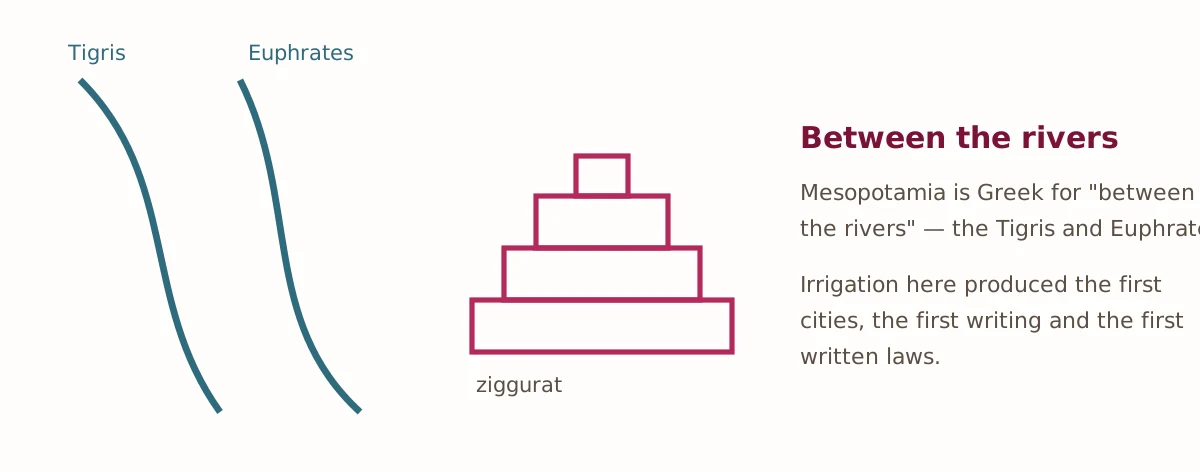
What the Mesopotamia worksheet covers
Southern Mesopotamia had rich soil and almost no rain. The Tigris and Euphrates carried water in abundance, but it ran where the rivers ran, not where anyone wanted to grow barley. So people dug channels and moved it. That decision, repeated and extended over centuries, is where this sheet begins, because almost everything else follows from it.
Irrigated fields produced a surplus. More grain than the farmers themselves ate had to be stored, counted, guarded and divided, and that needs records. The oldest writing anyone has found is not poetry or scripture. It is lists: so many measures of barley, so many sheep, so many workers. Part E asks students to explain why that would be, and it is the question on the sheet most likely to produce a genuinely good answer.
Digging and maintaining channels needed organisation too. Someone had to decide where a channel ran, who dug it, and who received the water when there was not enough for everyone. Out of those decisions came rulers, temples, taxes and eventually written law. The city-state grew out of a water problem.
Reading the Code of Hammurabi
Part D gives students one law from the Code of Hammurabi, carved around 1750 BCE: a builder whose house collapses and kills the owner is put to death. It is short, blunt and immediately discussable. Two questions follow, one on who was held responsible and one on why carving laws into a public pillar mattered rather than keeping them in a palace.
That second question is the important one. Written, public law means people know the rules in advance, officials cannot invent penalties, and the ruler is bound by the same text as everyone else. Students usually arrive at some version of that on their own once they are asked why the stone was public, and it sets up the rule of law long before they meet the phrase in a civics course.
City-states, not an empire
One point worth drawing out while marking: Mesopotamia was not a single country. Ur, Uruk, Lagash and Babylon were separate city-states, each with its own ruler, its own patron god and its own stretch of canal. They traded with one another, fought one another over water rights, and were periodically conquered and welded together by whoever was strongest that century. Students who picture a map coloured in one shade, the way they might picture Egypt, miss why the region produced so much law so early. Neighbours who share a river and do not share a government need written rules.
How to use this worksheet
The sheet prints on standard letter paper and needs nothing but a pencil. The answer key explains the reasoning rather than only listing answers, and sets out the causal chain in Part C explicitly: irrigation leads to surplus, surplus leads to cities and specialised work, and that leads to writing. Students who see that as a chain rather than four separate facts carry it forward to Egypt, the Indus Valley and ancient China.
In a classroom the vocabulary works as a starter and the source as a paired discussion. For homeschool use the whole sheet is about forty-five minutes. The interactive questions below cover the same ground and mark themselves, so they suit a quick check afterwards.
For related material, our social studies worksheets cover early civilizations, map skills and government across the grades. The British Museum holds a large collection of cuneiform tablets photographed online, and seeing a real one makes the point about accounting faster than any explanation.
Practise Mesopotamia online
Answer these five questions and check them instantly. They use the same ideas as the printable sheet.
- Mesopotamia means "between the" what?
- Name the eastern of the two rivers.
- What is the wedge-shaped writing of Mesopotamia called?
- What was the stepped temple tower called?
- Which Babylonian king had his laws carved in stone?