Decolonization Worksheet
This decolonization worksheet gives Grade 11 students 26 marks of practice on how colonies became independent states after 1945.
This decolonization worksheet gives Grade 11 students 26 marks of practice on how colonies became independent states after 1945, and on why some transfers were negotiated while others took a war.
What the decolonization worksheet covers
Most of decolonization happened in the thirty years after 1945, and the usual mistake students make is to explain it with a single cause. This sheet is built to prevent that. Part C gives six factors and asks students to sort them into pressures that pushed empires out and resistance that held them in.
Several pressures arrived together. European powers came out of the Second World War financially exhausted and unable to fund long colonial wars. Colonial soldiers had fought for empires that denied them a vote at home, and said so loudly on return. Both Cold War superpowers opposed formal European empire, each for its own reasons. And mass nationalist parties had become capable of organizing strikes and boycotts that made a colony expensive and embarrassing to hold.
The variable that explains most cases
What differed between colonies was the resistance, and one factor does most of the work: settlers. Where a ruling power had few permanent settlers and little property to defend, transfers were negotiated within a few years. Where a large settler population held land and regarded the colony as home, or where military bases and resources mattered enough, independence took a war.
Part E puts this as a direct comparison. Ghana became independent in 1957 after strikes, elections and negotiation. Algeria took an eight-year war. The difference is not that one nationalist movement was more determined than the other; it is that around a million settlers in Algeria had both the motive and the political weight to block any transfer. Students who find that explanation have a tool that works across most of the other cases too.
Outcomes that were not all alike
Part E also looks at what independence actually delivered. India and Pakistan gained it in 1947 with a partition that displaced millions and left a border disputed to this day. Congo was handed over in 1960 with very few trained administrators, and collapsed into intervention within weeks. And across many new states, political independence arrived while trade terms, debt, currency arrangements and resource ownership stayed under outside control — the situation the term neocolonialism was coined to describe.
The key notes that students may reasonably challenge that term, and credits a well-argued objection as long as the claim itself is stated accurately first. That is the right standard for a contested concept in a history course.
How to use this worksheet
In a classroom, Part C works well as a short sort in pairs before the written questions, because two of the six factors can be argued either way and the disagreement is productive. For a senior class, the Ghana and Algeria comparison in Part E will carry a full period of discussion on its own if you let it.
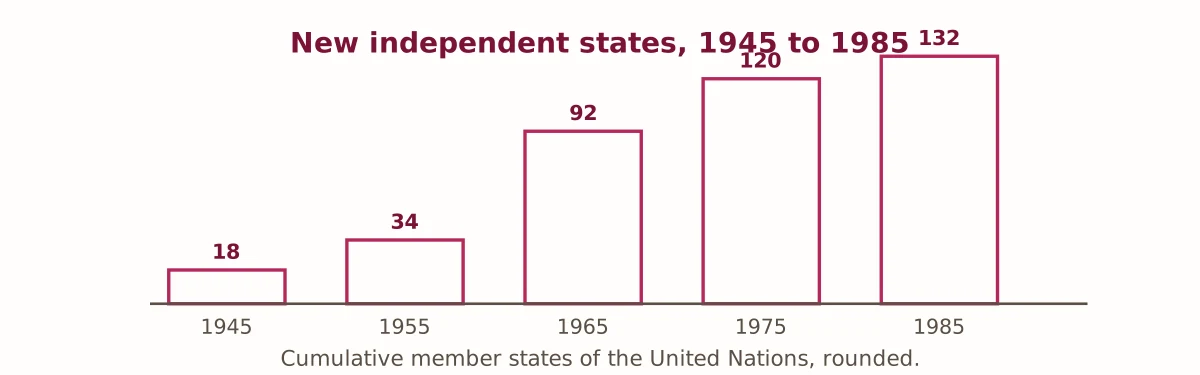
The sheet prints on standard letter paper and runs about fifty minutes. The bar graph at the top supports Part D, where students read the steepest rise, between 1955 and 1965, and explain why the pace slowed after 1975. The answer key gives marking notes for both open questions.
For related material, our social studies worksheets cover the Cold War, globalization and the age of exploration. The United Nations decolonization history pages hold the membership figures behind the graph in Part D.
Practise decolonization terms online
Answer these five questions and check them instantly. They use the same ideas as the printable sheet.
- The principle that a people should choose its own government is self-what?
- In which year did Ghana become independent?
- Dividing a territory along claimed communal lines is called what?
- How many years did the Algerian war of independence last?
- Continued economic control over an independent state is called what?