Where Energy Comes From Worksheet
Nearly all our energy starts at the Sun, and this sheet follows that line.
This where energy comes from worksheet follows one line all the way back: nearly all of it starts at the Sun.
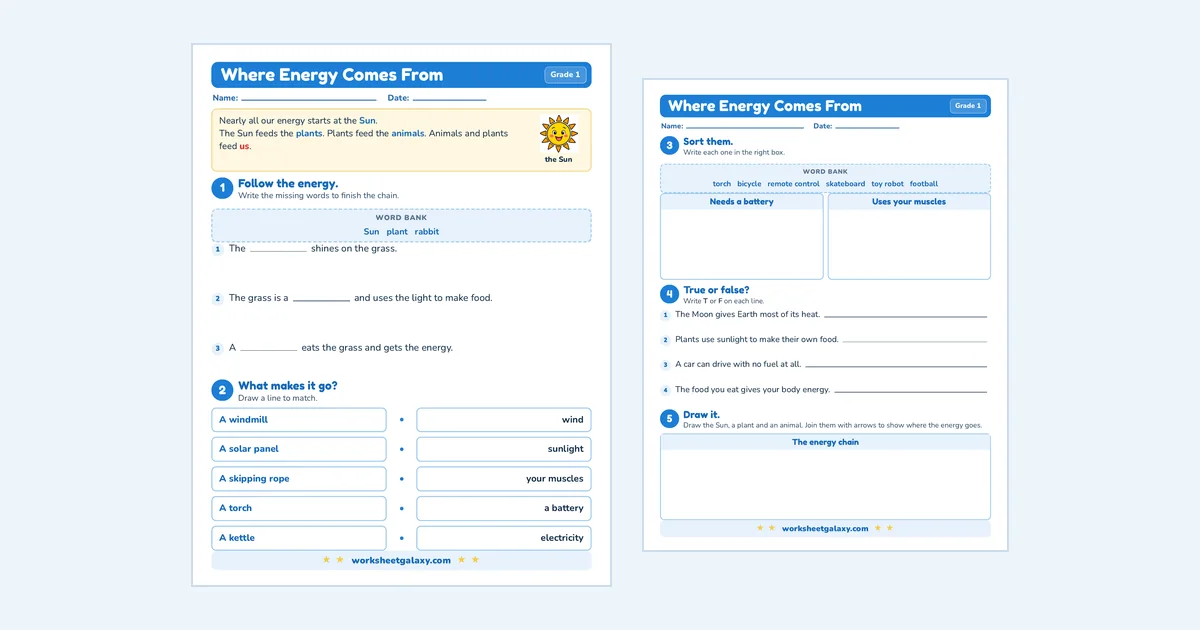
What is on this worksheet
Five parts and an answer key. Children complete the Sun to plant to animal chain, match a torch, a bicycle, a remote control and a robot to what makes each one go, sort objects by battery or muscles, decide four true-or-false claims, and draw the chain with arrows.
One chain, said three ways
The Sun feeds the plants. Plants feed the animals. Animals and plants feed us. The sheet states it, then has the child write the missing words, then has them draw it with arrows.
Saying the same thing in three formats is deliberate. A child who can fill a blank has possibly matched a shape; a child who can draw the arrows in the right direction has the idea.
Battery or muscles
The sorting activity splits objects into needs-a-battery and uses-your-muscles. A torch and a remote control sit on one side; a skipping rope and a football on the other.
The follow-up question is the good one: where do your muscles get their energy? Back to food, and from food back to plants, and from plants back to the Sun. The chain closes.
The true-or-false statements
Four claims, two of them tempting. The Moon gives Earth most of its heat is false and is frequently ticked true, because the Moon is bright and bright suggests hot.
A car can drive with no fuel is the other one worth discussing, particularly with children who have been in an electric car and will tell you it does not use fuel. They are nearly right, and the conversation about where the electricity came from is better than the worksheet.
What it sets up
This sheet is the reason the saving-energy sheet is not simply a list of rules. A child who knows energy comes from somewhere has a reason not to waste it.
It also plants the food-chain idea a long way before it is formally taught, using arrows that point the same direction they will in Grade 4.
Printing and what you need
Two activity pages and an answer key. The energy chain in part one and the arrows in part five both run left to right, so a single-sided print keeps them in view together.
Nothing to gather. The true-or-false section is the part to read aloud rather than leave silent, because the Moon statement and the electric-car statement both tend to need a conversation.
Check what stuck
Four questions from the sheet, answered here. Type an answer and press Check — useful on a tablet when the printer is not to hand.
- Where does nearly all our energy start?
- A torch gets its energy from a what?
- A skipping rope is powered by your what?
- Do plants make their own food? Yes or no.