Structures Around Us Worksheet
A structure holds something up or keeps its shape, and a wide base and triangles make it strong.
This structures worksheet for Grade 1 ends with a paper tower the class builds three times and measures, which is where the idea actually lands.
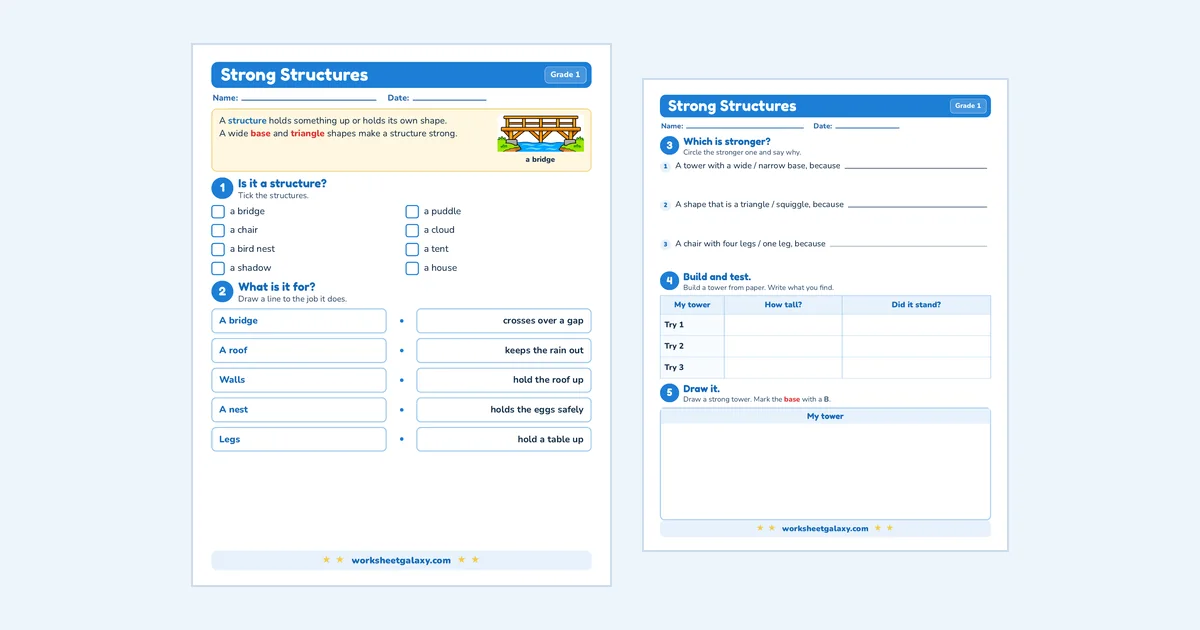
What is on this worksheet
Five parts and an answer key. Children tick which things are structures, match a bridge, a roof, walls, a nest and legs to the job each does, choose the stronger of two shapes and say why, build and test a paper tower over three tries, then draw a strong tower and mark its base.
What counts as a structure
A structure holds something up or keeps its shape. A bridge, a chair, a bird's nest and a tent are structures; a puddle, a cloud and a shadow are not.
The non-examples are chosen to be things that have a shape without holding it. A cloud looks solid and changes constantly, which makes it a better test than a word children have never met.
Two rules about strength
A wide base and triangle shapes. That is the whole of the Grade 1 content, and the sheet repeats both in the comparison questions: a bridge beats a chair for crossing a gap, a wide base beats a narrow one, a triangle beats a squiggle, four legs beat three.
Each comparison asks for a reason as well as a circle. The reason is the part to read.
The paper tower
Build a tower from paper, record how tall it was and whether it stood, three times. The table is on the sheet.
A sheet of newspaper and some tape is all it needs. Most first attempts are tall and fall; most third attempts are shorter, wider at the bottom, and stand. That is the lesson arriving on its own, which is worth far more than being told it.
Marking the base
The last part asks for a drawing of a strong tower with the base marked B. It takes a minute and it is the quickest check you will get.
A child who marks the bottom of a wide, tapering tower has understood. A child who draws a rectangle and puts B anywhere on it has not, and one more go with the paper usually fixes it.
Printing and what you need
Two activity pages and an answer key. Part four is a build: a sheet of newspaper per child or per pair, a little tape, and a ruler or a tape measure to record the height.
Allow twenty minutes for three attempts. Most first towers are tall and fall over, most third towers are shorter and wider at the base and stand, and watching that happen is the lesson.
Check what stuck
Four questions from the sheet, answered here. Type an answer and press Check — useful on a tablet when the printer is not to hand.
- Which is stronger: a wide base or a narrow base?
- Which shape is stronger: a triangle or a squiggle?
- What job does a bridge do?
- What do we call the bottom part of a tower?