Animal Body Parts and Their Jobs Worksheet
Every body part has a job, and this sheet keeps asking what the job is.
This animal body parts worksheet never asks for a part on its own. Every question asks what the part is for, which is the Grade 1 expectation.
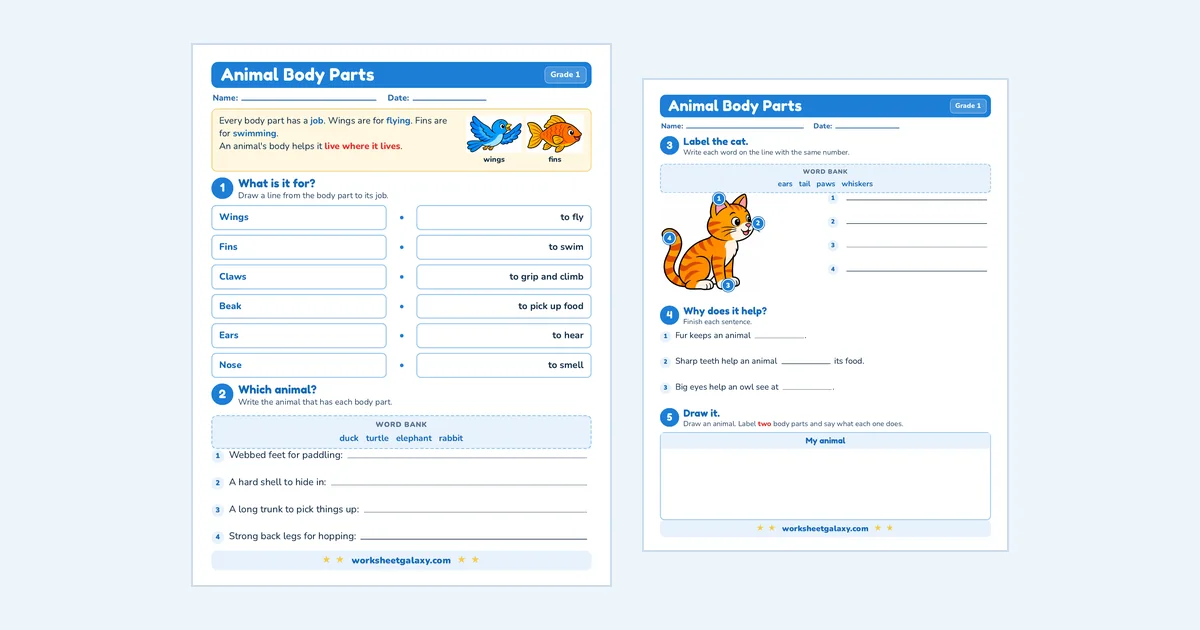
What is on this worksheet
Five parts across two pages and an answer key. Children match six body parts to their jobs, name the animal from a described part, label a numbered cat diagram from a word bank, finish three sentences about why a part helps, and draw an animal with two parts labelled and explained.
Part, then job, every time
Wings are for flying, fins for swimming, claws for gripping and climbing, a beak for picking up food, ears for hearing, a nose for smelling. Six pairs, and none of them is a guess.
Naming parts is memory work. Saying what each one does is the beginning of the idea that living things are built to suit where they live, which is where this strand is heading.
The "which animal" questions run backwards
Part two gives the body part and asks for the animal: webbed feet for paddling, a hard shell to hide in, a long trunk to pick things up, strong back legs for hopping.
Going in that direction is harder, and it is the better check. A child can match two columns by elimination; naming the animal from a function cannot be done that way.
The labelled diagram
The cat carries four numbered markers, and children write ears, tail, paws and whiskers on the matching lines. It is the first diagram many of them will label, so the convention that a number points at one specific thing is worth saying out loud.
Children who finish early can add their own markers to the drawing in part five, which is the same skill with the scaffolding removed.
Finishing with their own animal
Part five asks for any animal, two labelled parts, and what each part does. Made-up animals are fine as long as the parts have honest jobs.
That constraint is the whole assessment. A dragon with wings for flying shows the idea has landed; a dragon with wings because dragons have wings has not.
Printing and what you need
Two activity pages and an answer key. Colour is worth it here: the cat diagram in part three carries four numbered markers, and they read more clearly printed in colour than in grey.
Pencil crayons for part five. Children who are drawing their own animal and labelling two parts take longer than the rest of the sheet put together, which is the right way round.
Check what stuck
Four questions from the sheet, answered here. Type an answer and press Check — useful on a tablet when the printer is not to hand.
- What are wings for?
- Which animal has a hard shell to hide in?
- Fur keeps an animal what?
- Big eyes help an owl see at what time?