What Is It Made Of? Materials Worksheet
Objects are made of a material chosen for a reason, and this sheet works through both halves.
This materials worksheet for Grade 1 asks two questions about every object: what is it made of, and why that material and not another.
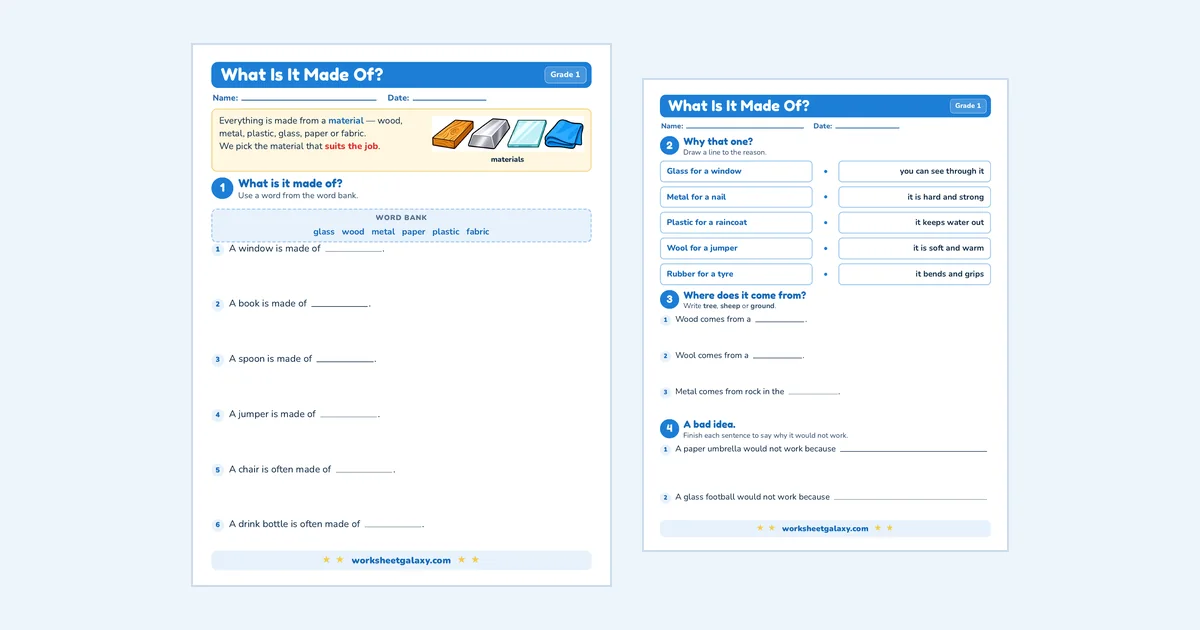
What is on this worksheet
Four parts with an answer key. Children name the material six objects are made from, match each choice to the reason behind it, say whether wood, wool and metal come from a tree, a sheep or the ground, and finish two sentences explaining why a bad material choice would fail.
Naming is the easy half
A window is glass, a book is paper, a spoon is metal, a jumper is wool, a chair is often wood, a drink bottle is often plastic. Most children manage that list with little trouble.
The second half is where the learning is: glass for a window because you can see through it, metal for a nail because it is hard and strong, plastic for a raincoat because it keeps water out, wool for a jumper because it is soft and warm.
Materials come from somewhere
Part three traces three materials back: wood from a tree, wool from a sheep, metal from rock in the ground.
It is a short activity and it changes how children talk about objects. Once wool is from a sheep, a jumper stops being a thing from a shop, and the question of where plastic comes from usually arrives within the minute.
The bad-idea sentences
Why would a paper umbrella not work? Why would a glass football be a problem? Children finish both sentences themselves.
Stating why something fails is harder than stating why something works, and the answers show you whether the property is understood or the phrase has been memorised. Paper soaks up water and tears; glass is hard and would smash.
Pairing it with the properties sheet
This sheet names materials and their uses. The properties sheet tests what they are like — hard or soft, rough or smooth, waterproof or not — with objects children handle themselves.
Together they cover the Grade 1 materials expectations. Doing this one first gives the vocabulary the second one leans on.
Printing and what you need
Two activity pages and an answer key, Letter portrait, black and white throughout.
A tray of real objects makes part one much quicker: a metal spoon, a plastic bottle, a wooden brick, a woollen sock. Children who can hold the thing name the material without hesitating, and the hesitation is usually about the word rather than the idea.
Check what stuck
Four questions from the sheet, answered here. Type an answer and press Check — useful on a tablet when the printer is not to hand.
- A window is made of what?
- Where does wool come from?
- Why is a raincoat made of plastic?
- Where does wood come from?