The Four Seasons Worksheet
Six clues about leaves, snow, buds, heat, migration and hibernation, each needing a season named.
This four seasons worksheet never shows a labelled picture to copy from. Every answer has to come from a clue about what actually happens.
What is on this worksheet
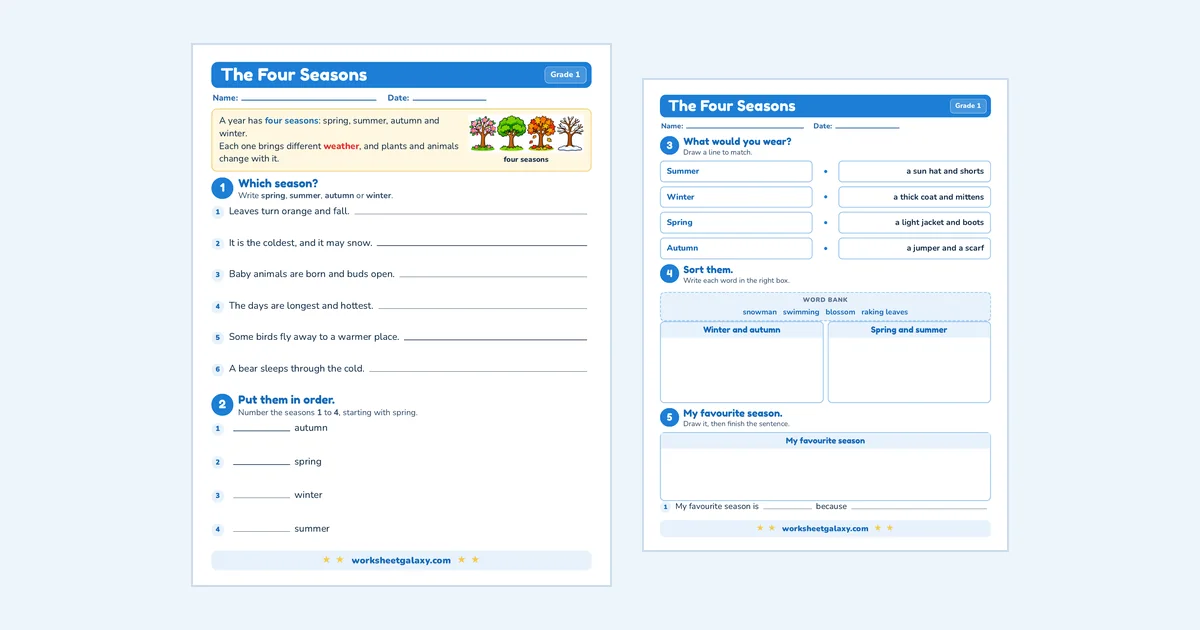
Five parts and an answer key. Children name the season from six clues, number the four in order starting with spring, match what you would wear in each, sort seasonal activities into two columns, then draw and write about their favourite.
Clues, not pictures
Leaves turn orange and fall. It is the coldest, and it may snow. Baby animals are born and buds open. The days are longest and hottest. Some birds fly away to a warmer place. A bear sleeps through the cold.
Four of those are the obvious ones. The last two — migration and hibernation — are the Grade 1 content that usually gets skipped, and they are on the sheet without the words being used.
Why the ordering question is harder than it looks
Children know the four seasons. Putting them in order from spring catches a surprising number, because the year is a loop and a loop has no start until you are told where to begin.
If a child writes summer, autumn, winter, spring, they have the cycle right and the instruction wrong. That is worth marking differently from a child who has them genuinely jumbled.
Clothing is the practical check
Matching a sun hat and shorts to summer, a thick coat and mittens to winter, a light jacket and boots to spring, a jumper and a scarf to autumn.
It is also the part that needs local judgement. Spring and autumn clothing overlap almost completely in much of Canada, and a child who swaps those two has a defensible answer. The key notes it.
Using it beside the weather sheet
Seasons are the long pattern; weather is what is happening today. Children routinely blur the two, and a warm day in February is enough to convince a six-year-old that spring has arrived.
Running this sheet and the weather chart in the same week, and pointing at the difference once, does more than either on its own.
Printing and what you need
Two activity pages and an answer key, Letter portrait. The four-season header prints well in grey, so black and white is fine.
Nothing to gather. Part five asks for a drawing of a favourite season and a reason, and it is the part to read rather than tick — the reasons children give are usually about an event rather than the weather, which is worth knowing before you teach the weather sheet.
Check what stuck
Four questions from the sheet, answered here. Type an answer and press Check — useful on a tablet when the printer is not to hand.
- Which season comes straight after spring?
- In which season do leaves turn orange and fall?
- Which season is the coldest?
- How many seasons are there in a year?