What Living Things Need Worksheet
Separates a need from a want, which is the part children find hardest.
This needs of living things worksheet spends most of its space on the one distinction children get wrong: a need is not the same as something you want a lot.
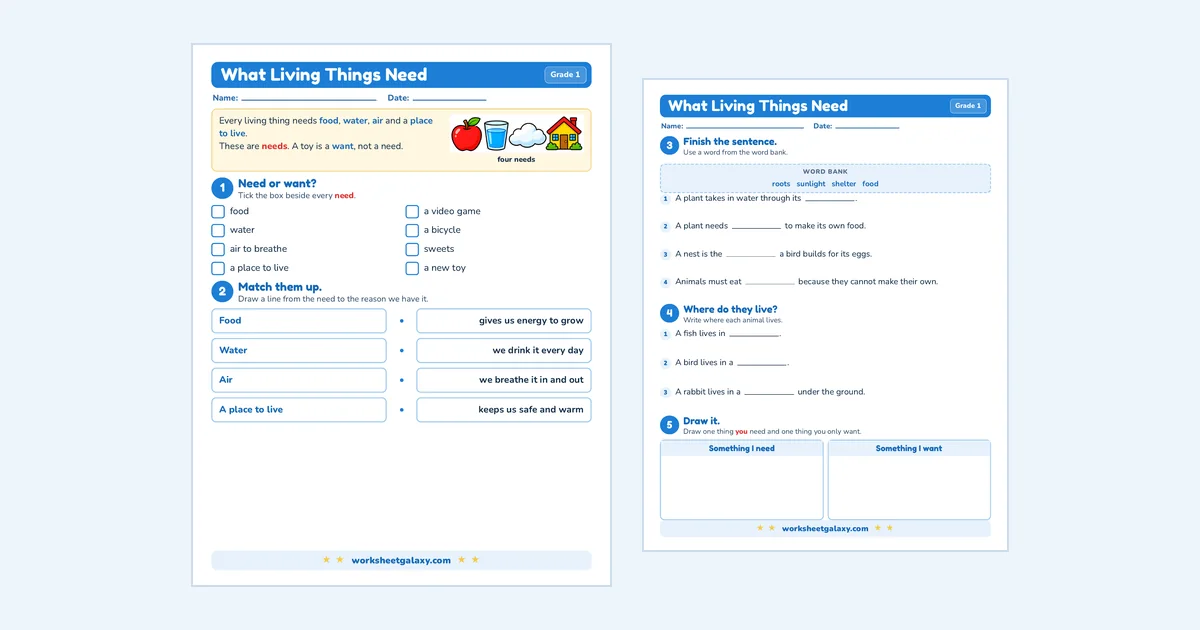
What is on this worksheet
Five parts with an answer key. Children tick the needs in a list mixed with wants, draw a line from each need to the reason we have it, finish four sentences about roots, sunlight, nests and food, name where a fish, a bird and a rabbit live, then draw one thing they need beside one thing they only want.
Need or want is the whole lesson
The four needs are food, water, air and a place to live. Everything else on the list is a want, however much the child would argue otherwise.
The test that works at this age is simple and a bit stark: without it, would you stop living? A video game, a bicycle and a new toy all fail that test. Saying it that plainly once saves a long argument about whether a pet counts.
Plants need the same four things, differently
Children accept that animals need food and generally assume someone feeds plants too. The sentences on this sheet correct that: a plant takes in water through its roots, and it uses sunlight to make its own food.
That is the single most useful fact in Grade 1 biology, because it is what the energy strand later hangs on. A plant makes food; an animal has to go and find it.
Where they live is a need, not a bonus
A nest, a burrow and water are shelter, and the sheet treats them as the fourth need rather than an extra topic. Children fill in that a fish lives in water, a bird in a nest, and a rabbit in a burrow under the ground.
If your class has pets or a local park, swap in animals they have actually seen. The answer key accepts any sensible home, because the idea matters more than the word.
Using it with the living things sheet
This follows naturally from sorting living and non-living things: once a child can tell what is alive, the next question is what keeps it that way.
Run them a few days apart rather than back to back. The second sheet is noticeably easier for a child who has already settled the first, and that gap is worth seeing.
Printing and what you need
Two activity pages and an answer key, Letter portrait, fine in black and white. The tick boxes and writing lines are sized for a six-year-old's pencil rather than squeezed to fit more questions on.
If you have a class plant or a class pet, have it on the table. Part one argues itself out much faster when there is something in the room that is visibly doing the things on the list.
Check what stuck
Four questions from the sheet, answered here. Type an answer and press Check — useful on a tablet when the printer is not to hand.
- Is a bicycle a need or a want?
- What do plants use to make their own food?
- Where does a rabbit live?
- Name one thing both plants and animals need to drink.