Saving Energy at Home Worksheet
Turns energy from a topic into a decision.
This saving energy worksheet asks children to judge six real habits, then go home and check one room against a list.
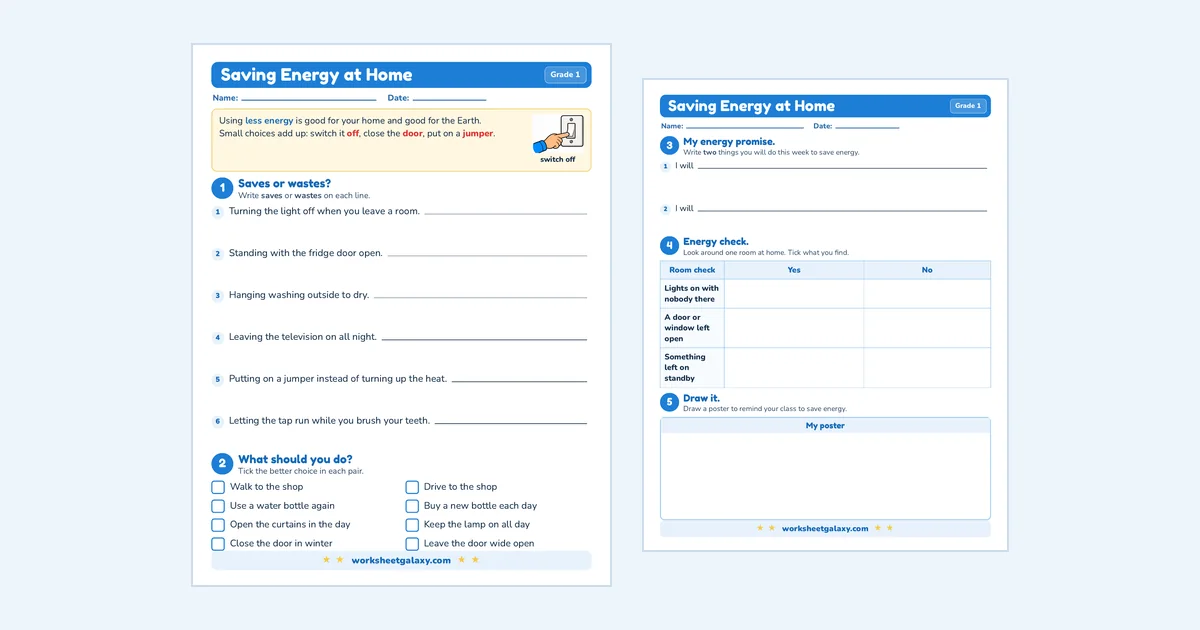
What is on this worksheet
Five parts and an answer key. Children mark six household habits as saving or wasting, pick the better of two choices four times, write two promises for the week, carry out a short room check at home, and draw a poster for the class.
Judgements, not rules
Every item in part one is something a six-year-old does or sees daily: lights left on in an empty room, standing with the fridge door open, hanging washing outside to dry, leaving the tap running while brushing teeth.
Asking saves or wastes puts the child in the deciding seat. A list of rules to follow does not, and children who are told rules at this age obey them in the classroom and nowhere else.
The pairs where both options sound fine
Part two gives two reasonable-looking choices: drive to the shop or walk to the shop, buy a new bottle each day or use a water bottle again, open the curtains in the day or leave the lamp on.
Neither option is naughty, which is what makes it a real decision. The jumper-instead-of-turning-up-the-heat pair tends to generate the most argument, and it is the one most worth having.
The room check is the part that works
Part four sends the child to look at one room at home: lights on with nobody there, a door or window left open, something left on standby. Three yes-or-no boxes.
It is the only part of the sheet with no right answer, and it is the part that comes back with stories. Whatever they find is data about their own house, which is harder to ignore than a picture of someone else's.
The promise, and the week after
Two promises, in the child's own words. Keep the sheets and read them out the following week, which turns the promise into something that was noticed.
The poster in part five is the part to display. A corridor of them does more for a school's energy use than an assembly about it.
Printing and what you need
Two activity pages and an answer key. Part four is a room check at home, so send the sheet home on a Monday and collect it later in the week rather than finishing it in one lesson.
Colour for the poster in part five if you are going to put them up. A corridor of thirty hand-drawn reminders does more for a school's energy use than an assembly about it.
Check what stuck
Four questions from the sheet, answered here. Type an answer and press Check — useful on a tablet when the printer is not to hand.
- Lights left on in an empty room: saves or wastes?
- Closing the door to keep the heat in: saves or wastes?
- Turning the tap off while you brush your teeth: saves or wastes?
- Standing with the fridge door open: saves or wastes?