Properties of Materials Worksheet
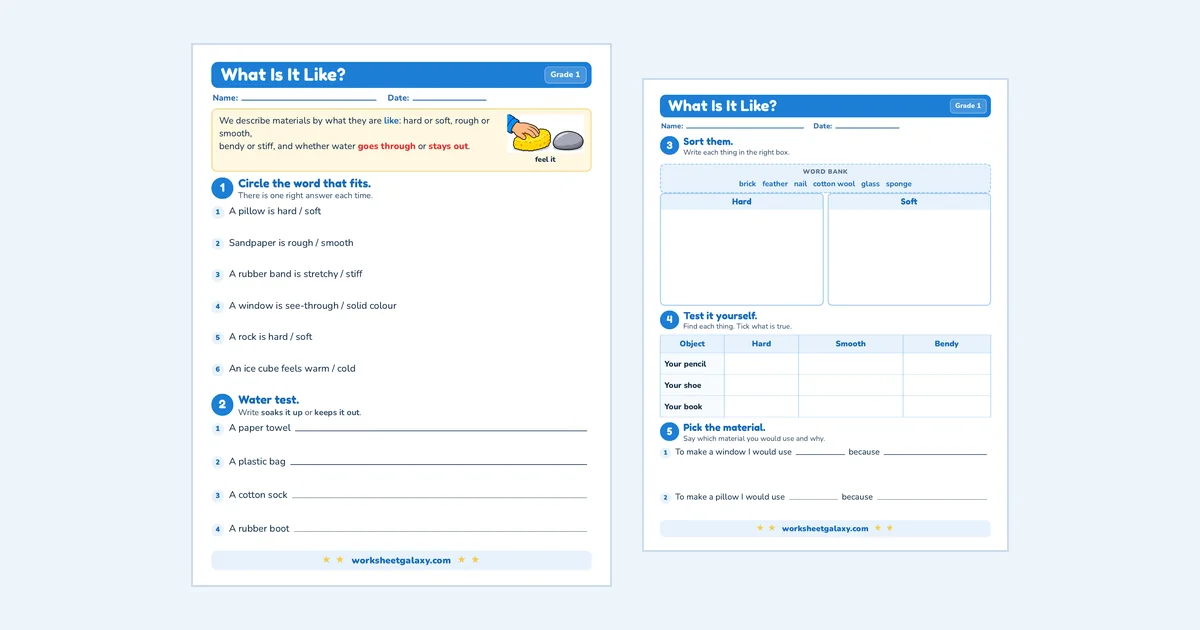
Materials are described by what they are like, so children circle the word that fits for six familiar objects, decide which things soak water up and which keep it out, sort by hard and soft, then test a pencil, a shoe and a book themselves and record what they find.
This properties of materials worksheet gives children the describing words, then sends them to test three real objects and write down what happened.
What is on this worksheet
Five parts and an answer key. Children circle the word that fits for six objects, decide which four things soak water up and which keep it out, sort objects into hard and soft, test a pencil, a shoe and a book themselves and tick what is true, then name a material for a window and a pillow and say why.
The four pairs worth having
Hard or soft, rough or smooth, bendy or stiff, see-through or solid, warm or cold. These are the describing words the Ontario Grade 1 materials strand asks for, and the sheet uses them consistently rather than drifting into synonyms.
A pillow is soft, sandpaper is rough, a rubber band is bendy, a window is see-through, a rock is hard, an ice cube is cold. One right answer each time, which keeps part one quick.
The water test
Four objects, two behaviours: a paper towel and a cotton sock soak water up, a plastic bag and a rubber boot keep it out.
It takes a jug of water and a tray to do for real, and it is worth the five minutes. Children predict first, then test, then correct their sheet — and a wrong prediction that they fix themselves sticks better than a right one they wrote down straight away.
Part four is an investigation, not a question
The table asks children to find their own pencil, their own shoe and their own book, and tick whether each is hard, smooth or bendy. There is no answer key for it, deliberately.
Two children will disagree about whether a shoe is bendy, and they will both be right about their own shoe. That disagreement is the most useful thing on the page: properties belong to the object in your hand, not to a word in a book.
Choosing a material for a job
The last part turns it around: name the material you would use to make a window, and the one you would use for a pillow, and say why.
Answers vary and that is fine. What you are looking for is a reason that matches a property — glass because you can see through it, something soft because you put your head on it — rather than a material named with no reason attached.
Printing and what you need
Two activity pages and an answer key. Part two is a real test, so you will want a jug of water, a tray, and the four things it names: a paper towel, a plastic bag, a cotton sock and a rubber boot. Any waterproof and any absorbent object will do instead.
Part four asks children to handle their own pencil, shoe and book, so it needs no preparation at all. Have them predict before they test; the prediction is what makes the result worth something.
Check what stuck
Four questions from the sheet, answered here. Type an answer and press Check — useful on a tablet when the printer is not to hand.
- Is a pillow hard or soft?
- Does a paper towel soak water up or keep it out?
- Is sandpaper rough or smooth?
- Is a rubber band bendy or stiff?