Living and Non-Living Things Worksheet
Four activities that build one idea - living things grow, need food and water, and make young.
This living and non-living things worksheet gives children a three-part rule, then puts in front of them the objects that rule is hardest on.
What is on this worksheet
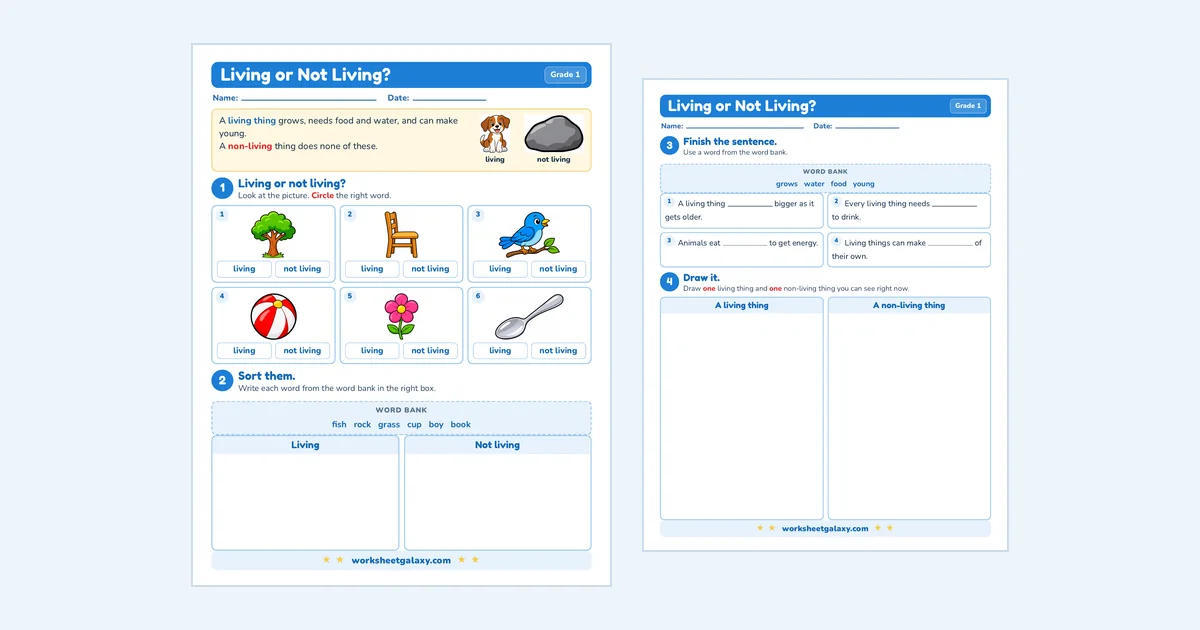
Four parts, over two pages and an answer key. Children circle living or not living under six pictures, write six word-bank words into two columns, complete four sentences about growing, drinking, eating and young, then draw one living and one non-living thing they can see from where they are sitting.
The pictures are a tree, a chair, a bird, a ball, a flower and a spoon. Two of those are chosen to be awkward, which is the point.
The rule a six-year-old can actually use
The definition on the sheet is three things: it grows, it needs food and water, and it can make young. Nothing else.
The usual classroom list includes "it moves", and that one does more harm than good at this age. A car moves, a river moves, a cloud moves, and none of them is alive. Leaving movement out of the rule removes the commonest wrong answer before it is made.
The chair is on the sheet on purpose
A wooden chair came from a tree. Children who have grasped that wood is from trees often conclude the chair must be living, and that is a better mistake than a careless one.
The useful sentence is that it was part of a living thing and is not one now: a chair does not grow, does not drink and does not make young. The same conversation covers paper, a wooden spoon, a cotton shirt and a leather shoe, which is most of a Grade 1 classroom.
What the sorting column is really testing
The word bank is fish, rock, grass, cup, boy and book. Circling a picture can be done on appearance; writing a word into a column cannot, because there is no picture to read.
Watch for grass. Children who think of living things as things with faces will put it in the wrong column, and that tells you the lesson on plants has not landed yet.
The drawing box is the assessment
Part four asks for one living and one non-living thing the child can see right now. It is the only part of the sheet with no options supplied, so it is the only part that shows whether the idea transfers off the page.
A child who draws their own hand, a classmate or the plant on the windowsill has it. A child who copies the tree from part one has not, and that is worth five minutes before moving on to what living things need.
Printing and what you need
Three pages: two activity pages and the answer key. Letter size, portrait, and it prints edge to edge on a home printer — the blue frame is the margin, so nothing is lost if yours cannot reach the paper edge.
Nothing beyond a pencil. The drawing box in part four wants the room they are sitting in, not a picture from the internet, so it is better done in class than set as homework.
Check what stuck
Four questions from the sheet, answered here. Type an answer and press Check — useful on a tablet when the printer is not to hand.
- Is a tree living or not living?
- A car moves along the road. Is a car living?
- Name the thing every living thing needs to drink.
- A wooden chair came from a tree. Is the chair living?