Energy in Our Lives Worksheet
Introduces the four forms of energy a six-year-old can actually point at - light, heat, sound and movement.
This energy worksheet for Grade 1 keeps energy to four things a child can point at: light, heat, sound and movement.
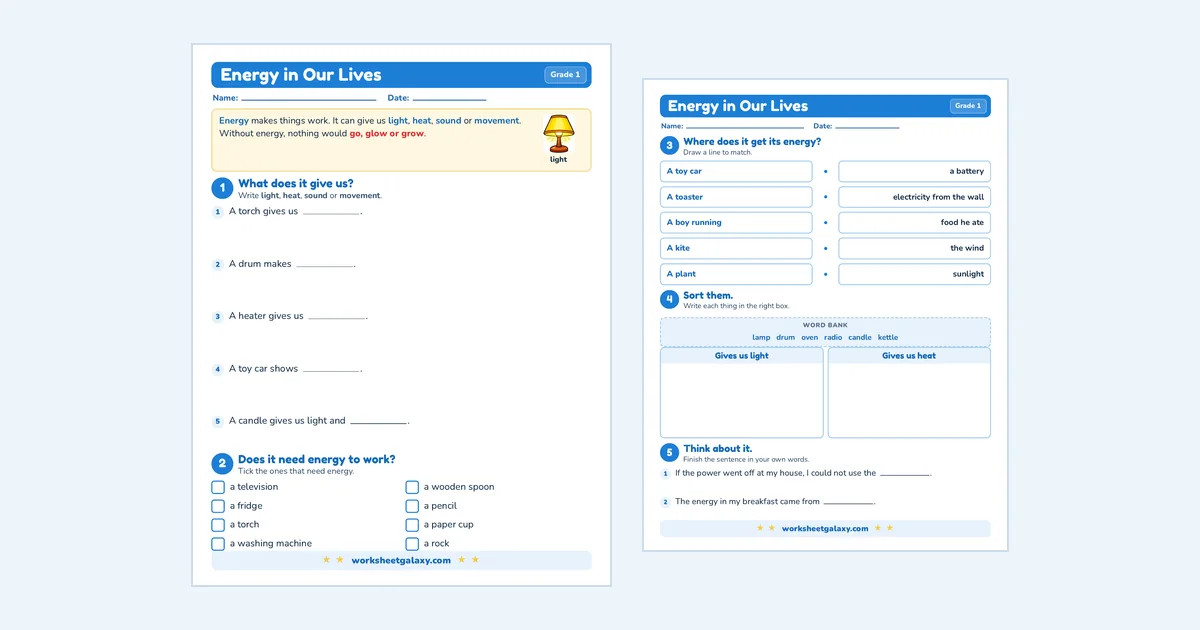
What is on this worksheet
Five parts with an answer key. Children name what a torch, a drum, a heater and a toy car give us, tick the objects that need energy to work, match each object to where it gets its energy, sort things by whether they give light or heat, and finish a sentence about what they could not use if the power went off.
Four forms, no definitions
Energy is hard to define and easy to notice. The sheet never asks what energy is; it asks what each thing gives you, and the four answers are always light, heat, sound or movement.
That is enough for Grade 1 and it is honest. Children leave able to say a lamp gives light and a drum gives sound, which is a real observation, rather than reciting a sentence about the ability to do work.
The candle is the question that sorts the class
One item gives two forms at once: a candle gives light and heat. Most children write light and stop.
It is worth doing out loud. Once a class has noticed one object doing two things, they start finding others — a television, a car, a person — and the four categories stop feeling like four separate boxes.
What does not need energy
Part two mixes a television, a fridge, a torch and a washing machine with a wooden spoon, a pencil, a paper cup and a rock. The second group needs nothing to be what it is.
Children who tick everything are reading "needs energy" as "is useful". The distinction to draw is between a thing that does something and a thing you do something with.
Where it leads
This is the first of three energy sheets. The next one follows energy back to the Sun, and the third turns it into choices at home.
Run this one first. The chain in the second sheet only makes sense to a child who already accepts that a toy car and a plant are both using something.
Printing and what you need
Two activity pages and an answer key, Letter portrait. Black and white loses nothing except the lamp in the header.
No materials. If you want to extend it, carry a torch, a wind-up toy and a small drum round the circle and have the class call out which of the four it gives — the sheet is better after that than before it.
Check what stuck
Four questions from the sheet, answered here. Type an answer and press Check — useful on a tablet when the printer is not to hand.
- What does a drum give us?
- Does a pencil need energy to work? Yes or no.
- A candle gives us light and what else?
- What does a moving toy car show us?