Day and Night Worksheet
The Earth spins once a day, so the side facing the Sun has day.
This day and night worksheet gives the cause in one sentence — the Earth spins — then spends the rest of the page on what that looks like.
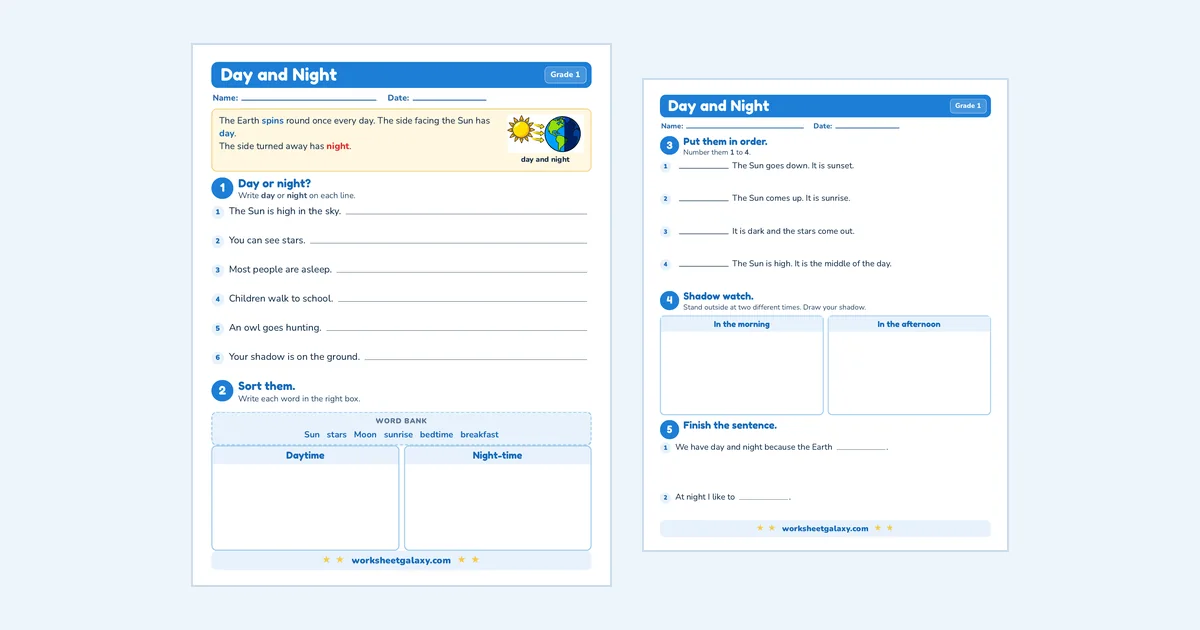
What is on this worksheet
Four parts and an answer key. Children write day or night beside six statements, sort Sun, stars, Moon, sunrise, bedtime and breakfast into daytime and night-time, put four moments in order from sunrise to the middle of the night, and go outside twice to draw their own shadow.
The Earth spins, the Sun does not travel
The sentence at the top is that the Earth spins round once every day, so the side facing the Sun has day and the other side has night.
Children will still say the Sun goes down, and so does the sheet, because that is what you see. Both can be true at once: what it looks like, and what is happening. Saying so directly is better than correcting the phrase every time it is used.
The Moon question
One statement catches nearly everyone: the Moon is sometimes visible by day. It is, often, and a child who has noticed it should be told they are right.
The answer key says so explicitly, because the tidy answer is wrong and a child who has actually looked at the sky deserves better than a cross.
Putting the day in order
Four moments to number: the Sun goes down, it is sunrise, it is dark and the stars come out, the Sun is high in the middle of the day.
Ordering is harder than sorting because it needs two things held at once — what each one is, and where it sits relative to the others. Children who sort perfectly and then order badly are telling you something useful about working memory, not about astronomy.
The shadow activity
Stand outside at two different times, draw your shadow each time. Two boxes, morning and afternoon.
Chalk on the playground works better than the boxes if you have it. The note in the answer key is that the afternoon shadow should point a different way and be a different length — and if a class does it at 10am and 11am and sees almost nothing, that is worth saying rather than hiding.
Printing and what you need
Two activity pages and an answer key. Part four sends children outside twice on the same day, so print it in the morning and keep the afternoon slot free.
It needs sun. On an overcast day there is no shadow to draw, and the honest thing is to postpone that part rather than have children invent one. Playground chalk works better than the boxes on the page if you have it.
Check what stuck
Four questions from the sheet, answered here. Type an answer and press Check — useful on a tablet when the printer is not to hand.
- What makes day and night happen?
- What do we call it when the Sun goes down?
- Do we usually see stars by day or by night?
- Is your shadow the same length all day? Yes or no.