Urbanization Worksheet
This urbanization worksheet gives Grade 10 students 26 marks of practice on why cities grow and what that growth costs.
This urbanization worksheet gives Grade 10 students 26 marks of practice on why cities grow, what the growth costs, and what a city doubling in fifteen years should build first.
What the urbanization worksheet covers
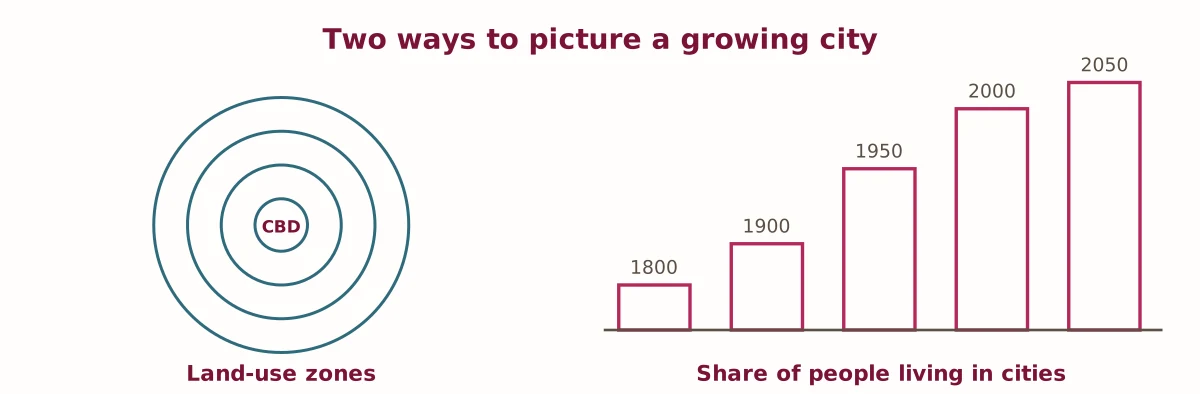
In 1800 roughly one person in twenty lived in a town or city. Today it is more than half, and the share is still rising. Urbanization is the name for that shift, and it is one of the few trends in human geography that has almost never reversed anywhere for long. Part D asks students to read that change off a graph spanning 250 years and to notice that the steepest climb is behind us.
Part C splits the causes into pushes and pulls. Mechanized farming needs fewer hands. Inherited plots get divided between heirs until they can no longer feed a family. A drought or exhausted soil can end a holding in a single season. Pulling the other way, cities concentrate the factory and service jobs, the hospitals and the universities that only exist at scale, and an aunt with a spare room is often the practical reason a particular person moves to a particular city.
The costs that need managing
The consequences are where the geography gets interesting. A city that grows faster than its infrastructure ends up with traffic it cannot clear, water it cannot supply and informal settlements on land nobody planned to build on. A city that grows outward rather than upward consumes farmland and locks in long commutes for decades, because the road pattern laid down during a growth spurt is still there fifty years later.
Part E puts that to students directly: a city of two million is expected to double in fifteen years, so what gets built first? Water and sanitation have the strongest claim, partly because disease spreads fastest where they are missing and partly because both are nearly impossible to retrofit once housing covers the ground. Transit has the second claim for the same reason in reverse. Housing, power and schools are all defensible if the reasoning holds, and the key marks the argument rather than the choice.
Gentrification without the slogan
The final question asks for one way gentrification improves a neighbourhood and one way it harms the people already there. Both halves are needed. Investment, maintenance and returning services are real gains, and owners who stay gain value. Against that, rents and taxes rise faster than existing incomes, and renters are pushed out of a community they built. Asking for both sides keeps the question analytical rather than a prompt to recite a position.
How to use this worksheet
The sheet prints on standard letter paper and runs about forty minutes. The concentric land-use diagram at the top supports Part A and makes a good board sketch to work through first. The answer key carries marking notes for both open questions.
In a classroom, Part C works well as a quick sort done in pairs before the discussion questions, because students argue productively about whether a reason is really a push or really a pull. Several of them are genuinely both, and noticing that is the point. For homeschool use the whole sheet works as a single sitting, with the land-use diagram redrawn for a local town as an optional extension.
For related material, our geography worksheets cover migration, population pyramids and climate zones across the grades. The World Urbanization Prospects dataset holds the real figures behind the graph in Part D, which makes a good extension for students who want the actual numbers.
Practise urbanization online
Answer these five questions and check them instantly. They use the same ideas as the printable sheet.
- A city with more than ten million people is called what?
- What does CBD stand for? (three words)
- Low-density growth outward across farmland is urban what?
- Roughly what percentage of people lived in cities in 1800?
- Housing built without legal title is called what kind of settlement?