Push and Pull Factors Worksheet
This push and pull factors worksheet gives Grade 8 and Grade 9 students 26 marks of practice on why people migrate.
This push and pull factors worksheet gives Grade 8 and Grade 9 students 26 marks of practice on why people migrate, and on the difference between the reasons someone leaves and the reasons they choose one destination over another.
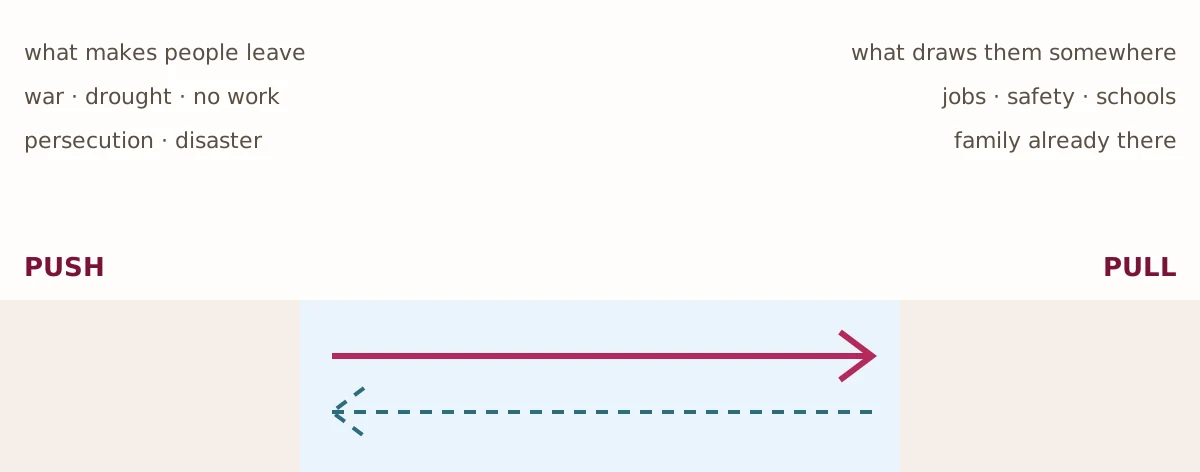
What the push and pull factors worksheet covers
Almost nobody leaves home for a single reason. Migration is nearly always the result of two sets of pressures acting together: what makes somewhere hard to stay in, and what makes somewhere else worth going to. Geographers call these push and pull factors, and separating them is the skill this sheet builds.
Push factors include war, persecution, drought, crop failure, unemployment and natural disaster. Pull factors include work, safety, schools, health care and family who have already made the journey. Part C asks students to sort eight real conditions between the two, and the key gives a simple test to apply: does the condition describe the place being left, or the place being gone to?
The same person is usually both pushed and pulled. A family that leaves after three failed harvests and moves to a city where an uncle has work has experienced both at once — the harvests made staying difficult, the uncle made that particular city the destination rather than any other. Part D uses exactly that example, because students who can pick both factors out of one sentence have understood the model rather than memorised two lists.
Why the word "refugee" is not interchangeable
The distinction that carries real weight is legal rather than geographical. A refugee has been forced out by danger and holds protections under international law: countries that have signed the refugee conventions agree not to return someone to a place where they face persecution. Someone moving mainly for work does not have those protections, however difficult their circumstances may be.
That is why the label is argued over in public debate, and why it is worth teaching precisely. Students who use "refugee" and "migrant" interchangeably are not making a vocabulary error so much as missing what the words decide. The final question on the sheet asks them to explain the difference in their own words.
Written to apply anywhere
None of the examples name a particular country or conflict. That is deliberate for a resource used in several countries, and it also keeps the focus on the model rather than on one case students may already have strong feelings about. A teacher who wants to apply it locally can do so easily — the sheet gives the framework, and current events supply the material.
How to use this worksheet
The sheet prints on standard letter paper and needs only a pencil. The answer key explains the reasoning rather than listing answers, including why most real migration involves push and pull simultaneously. In a classroom Part C works well as a paired sort before a discussion of ambiguous cases; for homeschool use the whole sheet runs about forty minutes.
For related material, our social studies worksheets cover urbanization, climate zones and human rights across the grades. The UN Refugee Agency publishes the legal definition of a refugee in plain language, which is worth reading alongside Part D.
Practise push and pull factors online
Answer these five questions and check them instantly. They use the same ideas as the printable sheet.
- Conditions that make people want to leave are called what factors?
- Conditions that attract people to a place are called what factors?
- To leave your country to settle elsewhere is to do what?
- Someone forced to flee danger in their own country is called a what?
- Moving from countryside to city within one country is what kind of migration?