Latitude and Longitude Worksheet
This latitude and longitude worksheet gives Grade 5 and Grade 6 students 28 marks of practice on the coordinate grid.
This latitude and longitude worksheet gives Grade 5 and Grade 6 students 28 marks of practice on the grid that gives every place on Earth its own address. Students match the vocabulary, complete sentences about how the lines run, read coordinates to name hemispheres, and explain why one number is never enough.
What the latitude and longitude worksheet covers
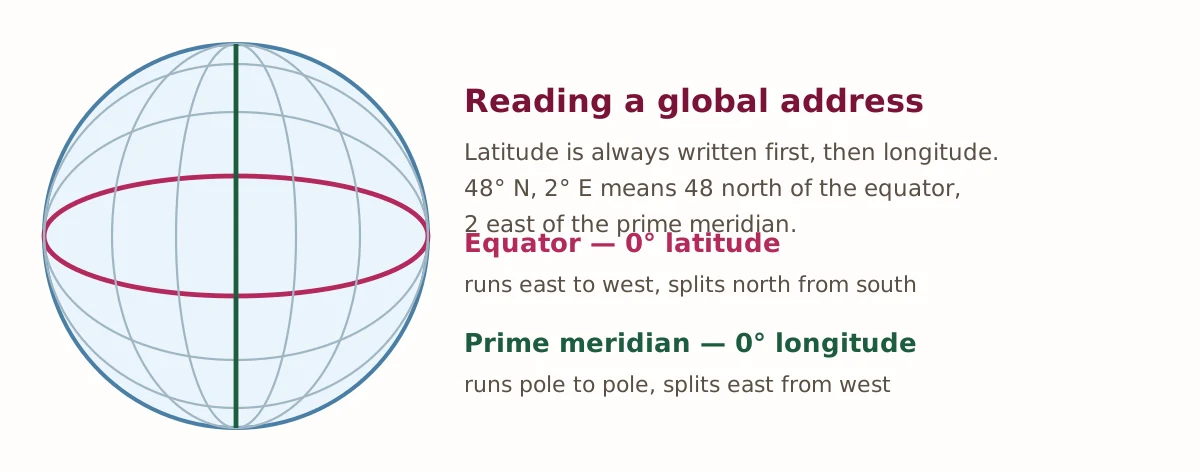
Every place on Earth can be described with two numbers. The first is latitude: how far north or south of the equator that place sits. The second is longitude: how far east or west of the prime meridian it sits. Both are measured in degrees, and together they pick out a single point on a planet of 510 million square kilometres.
Lines of latitude circle the globe from east to west, parallel to the equator. That is why they are also called parallels: they never touch and never cross. The equator sits at 0 degrees, the North Pole at 90 degrees north, and the South Pole at 90 degrees south. Because latitude controls how directly sunlight strikes the surface, two places at the same latitude tend to have similar climates and similar day lengths, even on opposite sides of the world.
Lines of longitude work the other way. They run from pole to pole, so unlike the parallels they all meet at both ends. The prime meridian is 0 degrees longitude and passes through Greenwich in London. From there, longitude is measured up to 180 degrees east and 180 degrees west, where the two meet again on the far side of the planet. Longitude is what determines local time, which is why travelling east or west changes your clock while travelling north or south does not.
Why both numbers are needed
Students often learn the two terms separately and then struggle to use them together. The exercise in Part C is designed for exactly that problem. Given a pair such as 34 degrees south, 151 degrees east, a student has to read the letters as well as the numbers: S places it below the equator, E places it to the right of the prime meridian. Four combinations are possible, and each one names a different quarter of the globe.
Part D pushes further. A ship that radios only its latitude has given rescuers a circle thousands of kilometres around, not a position. Working out why that is useless tends to fix the idea more firmly than any definition, because the student has to picture the parallel rather than recite it.
How to use this worksheet
The sheet prints on standard letter paper and needs no equipment beyond a pencil, though a globe or wall map makes Part C easier for students meeting coordinates for the first time. The answer key explains the reasoning for every item rather than only giving the answer, so it can be handed to a student for self-marking or used by a parent who has not taught the topic before.
For classroom use, the vocabulary matching in Part A works well as a starter, the blanks and hemispheres as the main activity, and the two short-answer questions as a discussion prompt. For homeschool use, the whole sheet is roughly a forty-minute session. The interactive questions below cover the same ground and mark themselves, so they suit a quick check before or after the printable.
If your students need the wider picture first, our social studies worksheets cover map skills, communities and history across the grades. The United States Geological Survey keeps a short, plain explanation of how the system is defined and measured, which is useful if a student asks where the degrees actually come from.
Practise latitude and longitude online
Answer these five questions and check them instantly. They use the same ideas as the printable sheet, so they work as a warm-up or as a quick review afterwards.
- The equator sits at how many degrees latitude?
- Which number is written first in a set of coordinates?
- A place at 12° S is in which hemisphere, north or south?
- Lines of longitude meet at the poles. True or false?
- The prime meridian passes through which London borough?