Branches of Government Worksheet
This branches of government worksheet gives Grade 6 and Grade 7 students 26 marks of practice on how governments divide power.
This branches of government worksheet gives Grade 6 and Grade 7 students 26 marks of practice on how a government divides its power, and on why that division is the thing protecting everyone inside it.
What the branches of government worksheet covers
Every government has to do three different things with a law: decide what it should say, put it into practice, and work out what it means when people disagree. Almost every country gives those three jobs to three separate parts of government, and this sheet is built around the reason why.
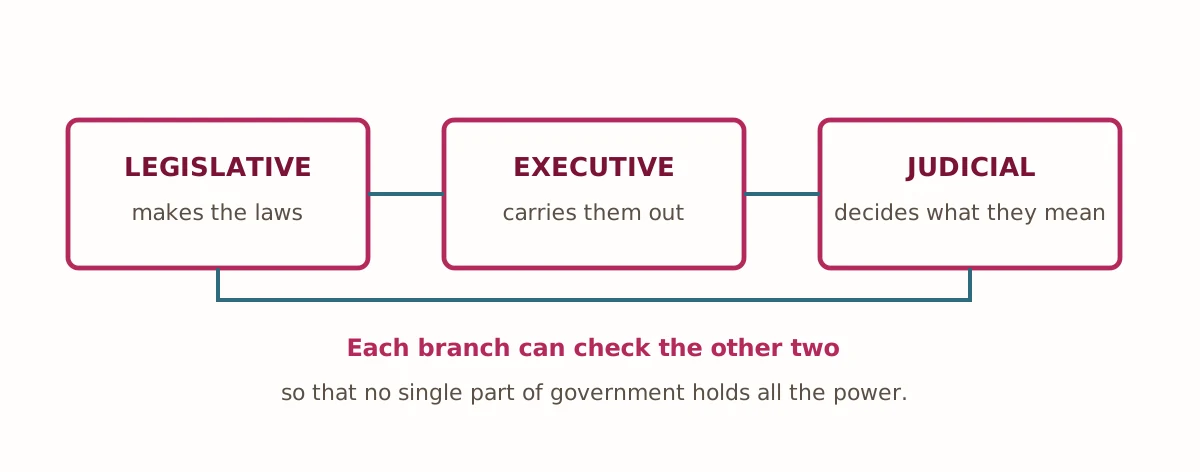
The legislative branch makes the laws — a parliament, a congress, an assembly. The executive branch carries them out day to day, which in practice means the ministries, departments and services most people actually encounter. The judicial branch decides what a law means and whether it has been broken, including on the occasions when the accused is the government itself.
Keeping them apart is the whole point. If a single group wrote the rules, enforced them and judged the cases, there would be nothing to stop it doing exactly as it liked. Because each branch can check the other two, power has to be negotiated rather than simply taken.
Written to apply in any country
This sheet deliberately avoids naming one country's system. Students learn the three functions and then apply them, rather than memorising a particular arrangement of offices that will not transfer. That matters for a free resource used in several countries, and it also matters educationally: a student who knows what a legislature does can recognise one under any name, while a student who has only memorised one country's institutions has to start again when the names change.
Part C is where that pays off. Six real tasks — debating a road safety law, running a health service, sentencing someone for theft, voting a budget, signing an agreement with another country, deciding whether a law breaks the constitution — have to be sorted into the right branch. The key gives the test to apply: is the law being written, applied, or interpreted?
The rule of law
Part D asks what principle a leader breaks by claiming the law does not apply to them because they were elected. The answer is the rule of law, and the follow-up is the part worth discussing: being elected gives a leader authority under the law, not above it. A leader who can ignore the law cannot be held to account between elections, and the courts lose any ability to restrain them.
The last question asks students to name a government service they personally rely on and say which branch is responsible. Answers vary, and that is intended. Schools, roads and hospitals are run by the executive, funded by a legislature's vote, and argued over in the courts. Seeing one familiar thing touched by all three branches is usually the moment the structure stops feeling abstract.
How to use this worksheet
The sheet prints on standard letter paper and needs only a pencil. The answer key explains the reasoning for each item, so it suits self-marking or a parent who has not taught civics before. In a classroom the vocabulary works as a starter and Part D as a discussion; for homeschool use the whole sheet is around forty-five minutes.
For related material, our social studies worksheets cover citizenship, communities and history across the grades. The United Nations publishes the Universal Declaration of Human Rights in full, which pairs well with this sheet for older students.
Practise the branches of government online
Answer these five questions and check them instantly. They use the same ideas as the printable sheet.
- Which branch makes the laws?
- Which branch carries out and enforces the laws?
- Which branch decides what a law means?
- Dividing power between branches is called the separation of what?
- The idea that leaders must obey the law too is the rule of what?