Solution Stoichiometry Worksheet
A free solution stoichiometry worksheet with answers covering the three steps that connect a solution to a product: concentration and volume to moles, the mole ratio from the balanced equation, then moles to mass, volume or concentration.
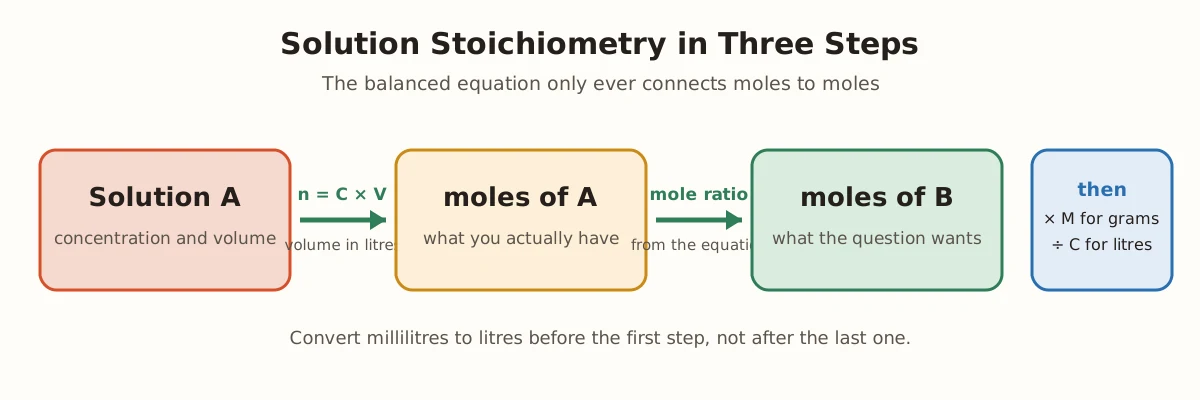
This solution stoichiometry worksheet with answers gives 18 questions that run reactions in solution from start to finish, with a complete worked solution for every one in the printable PDF.
Why solution stoichiometry trips people up
Ordinary stoichiometry starts from a mass. Solution stoichiometry starts from a concentration and a volume, which means there is an extra step at the front and often another at the back. The middle is unchanged: the balanced equation relates moles to moles and nothing else.
Almost every mistake on this topic comes from trying to shortcut that middle. Concentration cannot be multiplied by a mole ratio. Grams cannot be fed into the equation directly. Everything has to arrive at moles first, pass through the ratio, and then be converted into whatever the question asked for.
The other recurring slip is the volume unit. Concentration is moles per litre, so a volume in millilitres has to be divided by a thousand before it multiplies the concentration. Doing that conversion at the start, rather than trying to patch it at the end, removes the problem entirely.
What this solution stoichiometry worksheet with answers covers
Part A checks the route in words before any numbers appear. Part B asks only for moles of product, which isolates the first two steps. Part C adds the molar mass at the end to give the mass of a precipitate, the form this question usually takes on a test.
Part D reverses the final step: instead of a mass you are asked what volume of a second solution is needed, so the last operation is a division by concentration rather than a multiplication by molar mass. Part E removes a concentration altogether and asks you to recover it, which cannot be done by slotting numbers into a remembered pattern.
Working the questions cleanly
Write the three boxes out before calculating: moles of what you have, moles of what you want, then the final conversion. Filling those in order turns a multi-step problem into three single-step ones, and it makes an error easy to find because each box has a value you can check on its own.
Round each displayed intermediate to three significant figures and carry that rounded value into the next line. Carrying full precision internally while printing a rounded figure produces a key whose arithmetic does not check out on a calculator, which is worse than no key at all.
The formal definition of amount concentration is in the IUPAC Gold Book. For the steps either side of this topic, the molarity worksheet covers getting a concentration in the first place, the stoichiometry worksheet covers mass-to-mass problems, and the dilution worksheet handles what happens when a stock solution is diluted before it reacts.
Try a few before you print
Work these out and type the answer. Three significant figures, and convert the millilitres first.
0.250 mol/L, 40.0 mL HCl → mol CO2
0.500 mol/L, 25.0 mL NaOH → mol Na2SO4
0.100 mol/L, 60.0 mL AgNO3 → mol AgCl
0.150 mol/L, 80.0 mL Na2SO4 → g BaSO4
0.250 mol/L, 40.0 mL AgNO3 → g AgCl
0.100 mol/L, 75.0 mL Pb(NO3)2 → g PbI2
0.200 mol/L, 25.0 mL H2SO4 → mL of 0.500 mol/L NaOH
0.400 mol/L, 50.0 mL HCl → mL of 0.250 mol/L Ca(OH)2
Questions students ask
Can I use the mole ratio on concentrations? No. The ratio only relates moles. Convert to moles, apply the ratio, then convert back.
Do I always convert millilitres to litres? Yes, whenever you multiply by a concentration in mol/L. Doing it at the start avoids a factor of a thousand appearing later.
What if both reactants have a volume and concentration? Then one of them runs out first and it becomes a limiting reactant problem. On this sheet one reactant is always in excess.
Is an answer key included? Yes. The final pages work through all 18 questions, showing moles at each stage before the final conversion.