Functional Groups Worksheet
A free functional groups worksheet with answers covering the ten families met in a first year of organic chemistry, from alkenes and alcohols through aldehydes, ketones, acids, esters and amines.
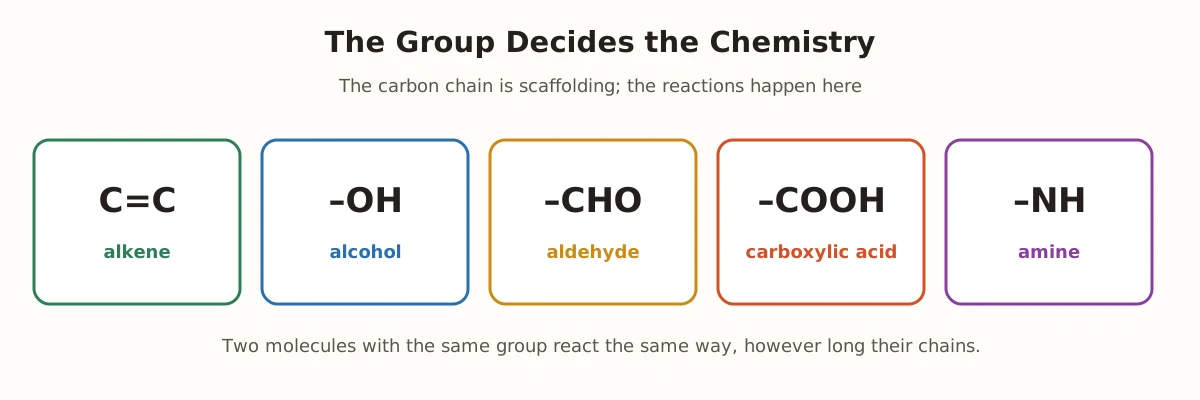
This functional groups worksheet with answers gives 24 questions on the ten families met in a first year of organic chemistry, with a full key in the printable PDF.
Why organic chemistry is organised this way
There are millions of organic compounds and only a handful of ways they react. That is possible because reactions happen at the functional group, not along the carbon chain. The chain is scaffolding: it changes the boiling point and the solubility, but it mostly watches while the group does the chemistry.
The practical consequence is that learning ten groups covers an enormous amount of ground. Ethanol and decanol differ by eight carbons and behave almost identically in a reaction, because both carry an –OH. Recognise the group and you can predict the behaviour without knowing the molecule.
Naming works the same way. The ending of an IUPAC name states the group: anything finishing in -ol is an alcohol, -al is an aldehyde, -one is a ketone and -oic acid is a carboxylic acid. Reading the ending tells you the chemistry before you have drawn anything.
What this functional groups worksheet with answers covers
Part A asks for the group itself and its name ending across all ten families. Part B works the other way, giving a compound and asking which family it belongs to and what its formula is. Part C asks why the groups produce the properties they do.
Part C matters more than its length suggests. Being able to name a group is recall; being able to say why that group makes a molecule soluble, or acidic, or high-boiling, is the part that transfers to a compound you have never seen before.
The distinctions that get missed
Aldehydes and ketones both contain C=O, and telling them apart is a matter of position. An aldehyde has the carbonyl at the end of the chain with a hydrogen attached; a ketone has it somewhere in the middle, with carbons on both sides. The group is the same atoms in a different place.
Esters and carboxylic acids are the other common mix-up. An acid ends in –COOH with that hydrogen available to come off, which is what makes it acidic. An ester has that hydrogen replaced by a carbon chain, so it is not acidic at all, and it usually smells pleasant rather than sharp.
Hydrogen bonding explains most of the physical differences. Groups with –OH or –NH can hydrogen bond, raising boiling points and improving solubility in water. Groups without them cannot, which is why an ether of similar mass to an alcohol boils far lower.
The formal definition sits in the IUPAC Gold Book. The naming alkanes worksheet covers the chains these groups attach to, and the alkenes and alkynes worksheet covers the first two families in more depth.
Try a few before you print
Type the family name or the name ending.
Questions students ask
How do I tell an aldehyde from a ketone? Position. The aldehyde carbonyl is at the end of the chain; the ketone carbonyl is in the middle.
Why are alcohols soluble but alkanes are not? The –OH hydrogen bonds with water. A hydrocarbon has nothing to bond with.
What makes an ester from an acid? Reaction with an alcohol replaces the acidic hydrogen with a carbon chain, and water is released.
Is an answer key included? Yes. The final pages give every group, its ending, a worked example and a model answer for each explanation.