Dilution Worksheet
A free dilution worksheet with answers covering C1V1 = C2V2, the equation behind every dilution calculation.
This dilution worksheet with answers gives 18 questions on C1V1 = C2V2, the single equation behind every dilution calculation in a first full year of high school chemistry. The printable PDF carries a complete worked solution for all of them, so it can be set as homework, used in class, or worked through alone.
What the dilution equation actually says
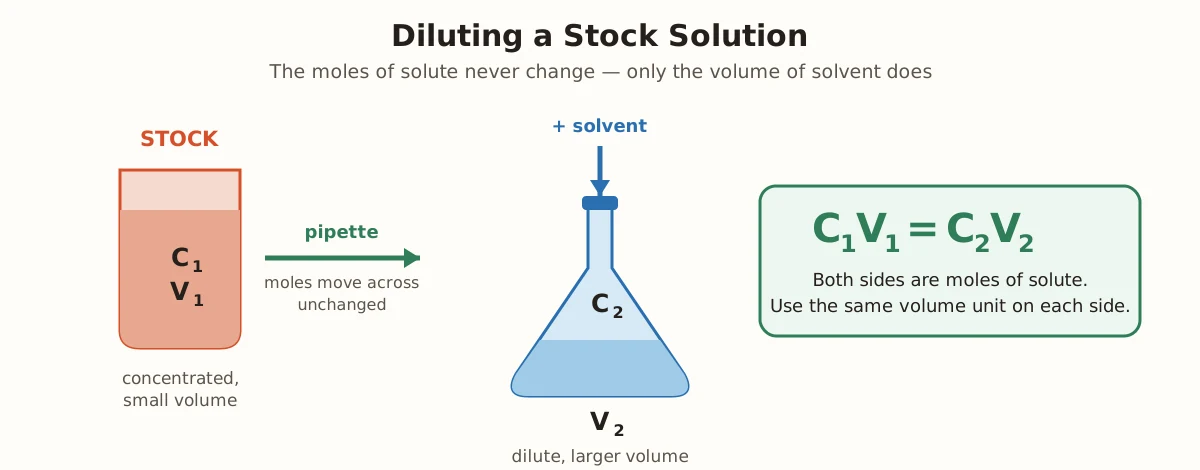
Adding solvent to a solution does not create or destroy solute. The number of moles sitting in the flask before you add water is the same number sitting there afterwards. All that changes is how much liquid those moles are spread through, and therefore the concentration.
Write the moles two ways and set them equal. Before dilution the amount is the concentration times the volume, C1V1. After dilution it is C2V2. Because the amount is unchanged, those two products are equal, which is the whole of C1V1 = C2V2. Everything else is rearranging for whichever quantity the question leaves out.
That reasoning explains why the units work the way they do. The equation compares a quantity on the left with the same quantity on the right, so any volume unit is fine as long as both sides use it. Millilitres on one side and litres on the other is the single most common way to get a wrong answer here, which is why several questions on this sheet mix the two deliberately.
What this dilution worksheet with answers covers
Part A checks that the idea has landed before any arithmetic starts. Part B solves for the diluted concentration, the most familiar direction. Part C turns the question round and asks how much stock solution to measure out, which is what you actually do at the bench. Part D asks for the final volume and then for the volume of solvent added, a step students routinely skip because the equation does not ask for it directly.
Part E removes the stock concentration and asks you to recover it from the diluted solution. That is the version that appears on tests, because it cannot be answered by pattern-matching the numbers into a familiar slot.
Working through a dilution worksheet with answers in that order matters more than the number of questions. Each part changes which symbol is missing, so the equation has to be rearranged rather than recalled in one fixed shape.
Working the questions without slips
Write the four symbols down and label the three you were given before touching a calculator. Most errors on this topic are bookkeeping errors rather than algebra: a volume assigned to the wrong subscript, or a millilitre treated as a litre. Converting first and substituting second removes both.
When a question asks how much solvent to add, remember that the equation gives the final volume, not the added volume. Subtract the starting volume from the final volume to get the amount of water. A flask filled to a graduation mark reaches a total volume, so the water added is always less than the final reading.
The formal definition of amount concentration is set out in the IUPAC Gold Book if you want the exact wording. For more practice with the concentration itself before diluting it, the molarity worksheet covers mol/L calculations from first principles, and the titration worksheet applies the same concentration-and-volume reasoning to neutralisation.
Try a few before you print
Work these out and type the answer. Give three significant figures, and watch for the questions whose two volumes are in different units.
Questions students ask about dilution
Does the volume unit matter? Only that both volumes use the same one. The equation compares moles with moles, so the unit cancels — but only if it is the same on both sides.
Is the added volume the same as the final volume? No. The equation gives the final volume. Subtract the starting volume to get how much solvent you added.
Why does the concentration always go down? Because the moles stay fixed while the volume increases. If a calculation gives a higher final concentration, something has been substituted into the wrong slot.
Is an answer key included? Yes. The final pages give a worked solution for all 18 questions, with the substitution written out and the solvent added stated where it applies.