Stoichiometry Worksheet with Answers
A free stoichiometry worksheet with answers, covering mole ratios and the mole-to-mole, mass-to-mole and mass-to-mass calculations that follow from a balanced equation.
This stoichiometry worksheet with answers gives high school chemistry students 24 graded questions on the single idea that makes quantitative chemistry work: the coefficients of a balanced equation are a ratio of moles, and that ratio is the only bridge between one substance in a reaction and another. Every question comes with a full worked solution rather than just a final number.
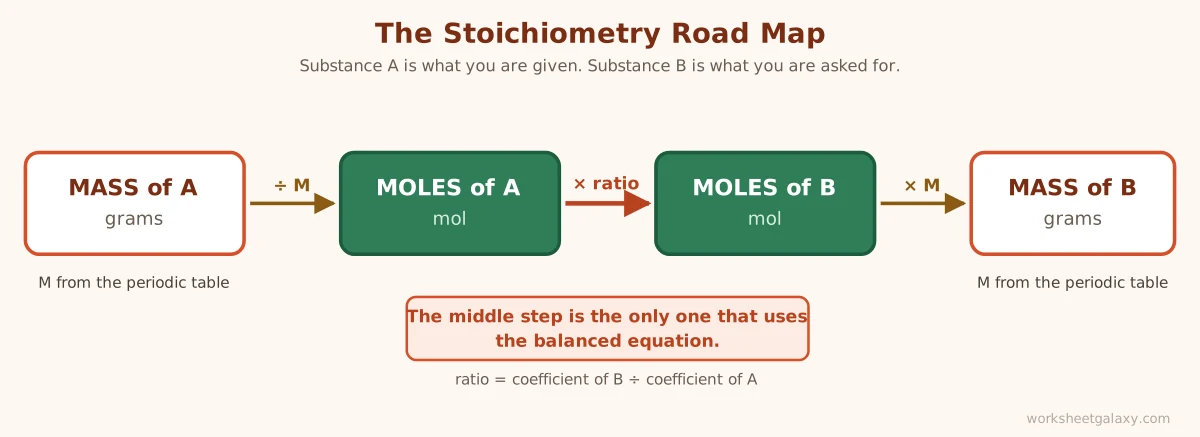
It suits a student's first full year of chemistry — Grade 11 in North America, Year 11 or 12 in the UK and Australia, Class 11 in India — and the same road map carries straight into IB, AP and A-level work on limiting reactants and percentage yield.
What the stoichiometry worksheet with answers covers
Part A asks only for mole ratios, read straight off the coefficients with no calculator. The ratios are deliberately not all one to one: a student who has only ever seen 1 : 1 reactions will write the right answer for the wrong reason, and then fail the moment a 3 : 2 appears. Part B turns those ratios into mole-to-mole calculations, which is a single multiplication.
Part C introduces mass on one side of the problem only, so a student has to notice whether the conversion to moles belongs at the start or the end. Part D is the full three-step chain, mass to mass, where most marks are lost. There is no shortcut from grams of one substance to grams of another; the two molar masses are different numbers and the ratio sits between them.
Part E runs the road map backwards. One question gives the mass of a product and asks what mass of reactant is needed, which is the form every real laboratory question takes. Another asks for a product from a reactant that is not the first one listed. The third is a written explanation: a student claims a coefficient of 3 means three moles are produced per mole of reactant, and the task is to say why that is wrong before calculating the right value.
Try ten questions before you print
These come straight from the worksheet. Give ratios as a single number (3 : 2 is 1.5), and all other answers to three significant digits.
- N2 + 3H2 → 2NH3 — moles of NH3 per mole of N2
- N2 + 3H2 → 2NH3 — moles of H2 per mole of NH3
- CH4 + 2O2 → CO2 + 2H2O — moles of H2O per mole of CH4
- C3H8 + 5O2 → 3CO2 + 4H2O — moles of O2 per mole of C3H8
- N2 + 3H2 → 2NH3 — moles of NH3 from 4.00 mol of N2
- 2H2 + O2 → 2H2O — moles of H2O from 6.00 mol of H2
- CH4 + 2O2 → CO2 + 2H2O — moles of O2 from 2.50 mol of CH4
- N2 + 3H2 → 2NH3 — grams of NH3 from 28.0 g of N2
- CH4 + 2O2 → CO2 + 2H2O — grams of H2O from 8.00 g of CH4
- 4Fe + 3O2 → 2Fe2O3 — grams of Fe2O3 from 44.7 g of Fe
Why students lose marks on stoichiometry
The most common error is inverting the ratio. A student converts correctly to moles, then multiplies when they should divide, and the answer comes out wrong by exactly the ratio. The fix is a habit rather than a formula: write the wanted substance on top every time, so the ratio is built the same way in every question regardless of which direction the problem runs.
The second is using the ratio on grams. Coefficients count particles, not mass, so applying a 2 : 1 ratio to a mass gives a number that means nothing. This is why the road map has grams at both ends and moles in the middle, and why the middle step is the only one that touches the balanced equation.
The third is trusting an unbalanced equation. If the coefficients are wrong, every answer downstream is wrong, and the arithmetic gives no warning at all. Checking that each element appears in equal numbers on both sides takes a few seconds and protects the whole question.
How to use it in class
Parts A and B work as a single lesson once balancing is secure. Parts C and D suit the following day, and Part E is a review task or a short assessment. The answer key prints on its own pages at the back, so it can be used as a self-check station or kept back for marking. Each worked solution rounds at the same points a student would, so the arithmetic in the key can be reproduced exactly on a calculator rather than coming out slightly different.
Molar masses are taken from the IUPAC standard atomic weights and rounded to two decimal places. Students should be comfortable with mole conversions and with balancing chemical equations before starting this sheet, since every question here assumes both.
Frequently asked questions
Do the equations need balancing first? No. Every equation on the worksheet is already balanced, so the practice stays on the ratio work rather than turning into a balancing exercise.
Does this cover limiting reactants? Not here. Every question gives one reactant and assumes it reacts completely, which is the right first step. Limiting reactants and percentage yield build directly on this sheet and are worth doing straight afterwards.
Is an answer key included? Yes. The final pages give a full worked solution for all 24 questions, showing the ratio used at each step rather than only the final value.