Significant Figures Worksheet
A free significant figures worksheet with answers covering which zeros count, how to round to a stated number of figures, and the two different rules that apply to multiplication and to addition.
This significant figures worksheet with answers gives 24 questions on counting, rounding and carrying precision through a calculation, with the reasoning spelled out in the printable key.
Significant figures are a claim about the measurement
Writing 2.5 grams rather than 2.50 grams is not a stylistic choice. It says the balance could resolve tenths, not hundredths. The digits you write are a statement about how good the instrument was, which is why adding digits a calculator produced is misleading rather than merely untidy.
That is also why the zeros are fiddly. A zero can be a measured digit or it can be a placeholder holding the decimal point in position, and the notation does not always distinguish them.
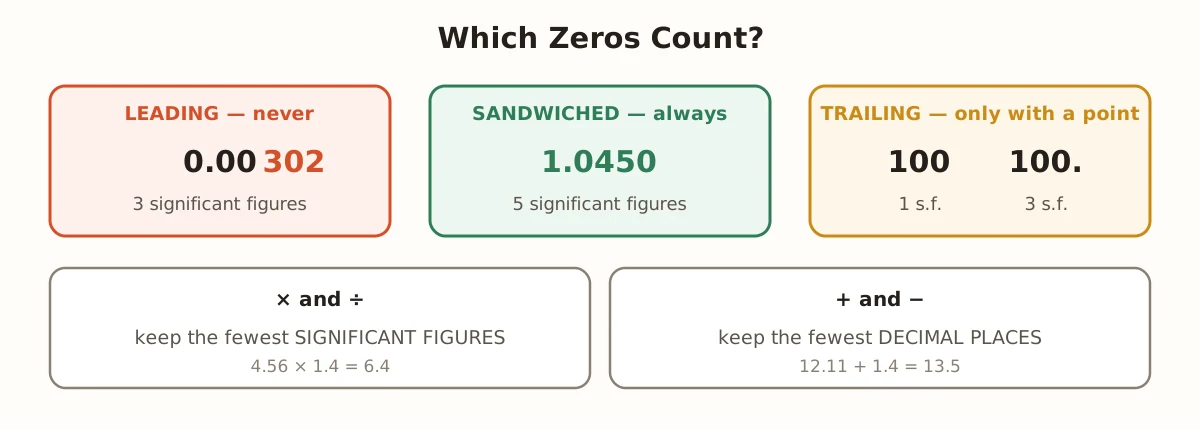
Leading zeros are always placeholders, so 0.00302 has three significant figures. Zeros between other digits are always measured, so 1.0450 has five. Trailing zeros are the ambiguous case: 100 could be one figure or three, and writing 100. with the point makes it unambiguous at three.
What this significant figures worksheet with answers covers
Part A is counting, including the awkward cases. Part B rounds to a stated number of figures, where the trap is dropping a trailing zero that the rounding was supposed to produce. Parts C and D apply the two arithmetic rules, which are deliberately separated because they are different.
Where the digits come from
Every measured value carries one uncertain digit at the end. Reading a burette marked every 0.1 mL, you record the marks you can see and then estimate one more place between them. That estimated digit is significant, even though it is a judgement, because it carries real information about where the meniscus sat.
Exact numbers are the exception and they never limit an answer. Counting twelve test tubes gives exactly twelve, not twelve to two significant figures. Defined conversions behave the same way: there are exactly 1000 millilitres in a litre, so that factor never forces a result to be rounded.
Two rules, and they are not the same rule
Multiplication and division keep the fewest significant figures. 4.56 times 1.4 is 6.384 on a calculator, but 1.4 only has two significant figures, so the answer is 6.4.
Addition and subtraction keep the fewest decimal places instead. 12.11 plus 1.4 is 13.51, but 1.4 is only known to one decimal place, so the answer is 13.5. Applying the multiplication rule here would give 13, which throws away a digit that was actually measured.
The reason they differ is worth a moment. When you multiply, the relative uncertainties combine, and significant figures track relative precision. When you add, the absolute uncertainties combine, and decimal places track absolute precision. The rules are different because the question is different.
The formal definition is in the IUPAC Gold Book. These rules apply to everything that follows, so the mole conversions worksheet and the stoichiometry worksheet both assume answers are rounded correctly.
Try a few before you print
Type the count, or the correctly rounded answer with its trailing zeros.
Questions students ask
Is 100 one significant figure or three? As written, one. Add a decimal point, 100., to make it three, or write it in scientific notation to be unambiguous.
Do I round at every step? No. Carry extra digits through the working and round once at the end, otherwise rounding errors accumulate.
What about exact numbers? Counted objects and defined conversions have unlimited significant figures and never limit an answer.
Is an answer key included? Yes. The final pages give every count with the reason, every rounded value, and which rule decided each arithmetic answer.