Mole Conversions Worksheet with Answers
A free mole conversions worksheet with answers, covering molar mass, the Avogadro constant and the two-step conversions between mass and particles.
This mole conversions worksheet with answers gives high school chemistry students 24 graded questions on the three quantities every quantitative chemistry problem moves between: mass in grams, amount in moles, and the number of particles. Every question comes with a full worked solution, not just a final number, so students can find the exact step where their own work went wrong.
It suits a student's first full year of chemistry — Grade 11 in North America, Year 11 or 12 in the UK and Australia, Class 11 in India — and it is standard groundwork for IB, AP, GCSE and A-level chemistry, all of which build stoichiometry on top of these three conversions.
What the mole conversions worksheet with answers covers
The worksheet is built in five parts that get harder in a deliberate order. Part A asks only for molar mass, including compounds with brackets such as calcium nitrate and ammonium sulfate, because students who cannot read a bracketed formula will fail every later question for a reason that has nothing to do with the mole. Part B runs both directions between mass and moles.
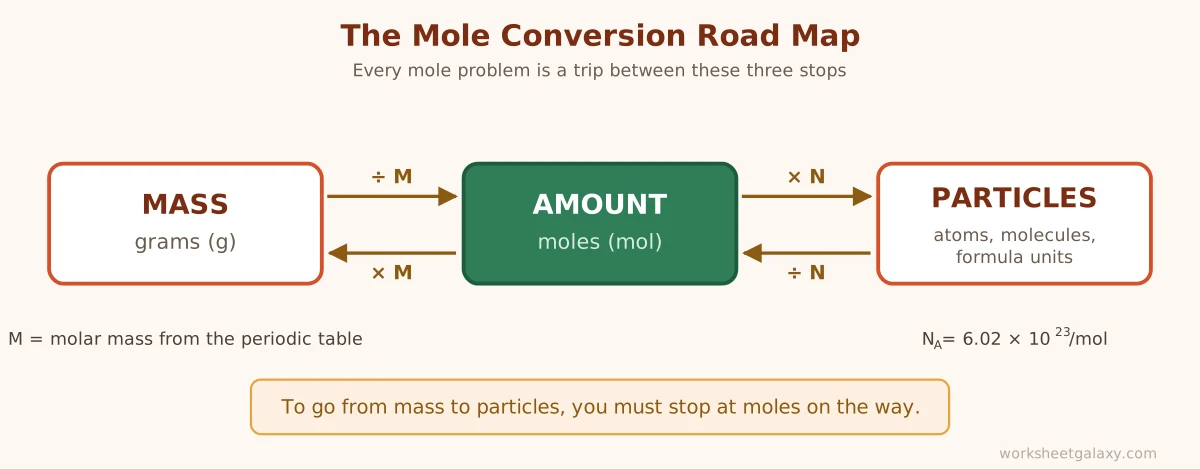
Part C does the same between moles and particles, and deliberately mixes atoms, molecules and formula units so students have to decide which word applies to the substance in front of them. Part D is the two-step conversion that most students get wrong: mass to particles, or particles back to mass. Neither is a single calculation. The printed road map makes the reason visible — moles sit in the middle, and no arrow skips over them.
Part E is three challenge questions aimed at the errors that survive routine practice. One asks for hydrogen atoms rather than water molecules, so the subscript has to be used. One gives a count of nitrogen atoms inside a compound and asks for the mass of the whole sample. The last compares equal masses of two noble gases and asks which holds more atoms, which only makes sense once a student has stopped treating mass and amount as the same idea.
Try ten questions before you print
These come straight from the worksheet. Use NA = 6.02 × 10²³/mol and give answers to three significant digits. Scientific notation can be typed as 6.02e23.
- Molar mass of H2O in g/mol
- Molar mass of NaCl in g/mol
- Molar mass of CO2 in g/mol
- Moles in 25.0 g of NaCl
- Moles in 88.0 g of CO2
- Mass of 2.50 mol of CaCO3 in g
- Mass of 0.750 mol of NH3 in g
- Moles in 3.01 × 10²³ molecules of O2
- Moles in 9.03 × 10²³ formula units of MgCl2
- Mass of 1.20 × 1024 molecules of CH4 in g
Why students lose marks on mole problems
Three errors account for most of the lost marks, and the worksheet is ordered to surface each one. The first is reaching for the wrong relationship: students who have memorised a single formula tend to divide by the Avogadro constant when they should divide by molar mass. The road map fixes this by making the two conversions visibly different steps on different arrows.
The second is skipping the middle. A student asked for the number of molecules in a mass of water will sometimes multiply the mass straight by the Avogadro constant. The answer comes out roughly eighteen times too large, and because the number is already enormous the mistake does not look wrong.
The third is ignoring subscripts. A question about hydrogen atoms in water is not a question about water molecules, and the factor of two is the entire point of asking. Part E targets this directly, twice.
How to use it in class
Parts A to C work as independent practice after the first lesson on molar mass. Parts D and E suit a second day, or a review before a unit test. The answer key prints on its own pages at the back, so it can be handed out as a self-check station or kept back for marking. Every numeric answer is given to three significant digits, and each worked solution rounds at the same points a student would, so the arithmetic in the key can be reproduced exactly on a calculator.
Molar masses are taken from the IUPAC standard atomic weights and rounded to two decimal places, so the figures match whichever periodic table a student has in front of them. It pairs naturally with practice on electron configuration earlier in the course, and it is the prerequisite for naming ionic compounds by mass and for every stoichiometry problem that follows.
Frequently asked questions
What value of the Avogadro constant does the worksheet use? 6.02 × 10²³ per mole, the three-significant-digit value used in almost every introductory chemistry course.
Is an answer key included? Yes. The last two pages are a full worked solution for all 24 questions, showing each conversion step rather than only the final value.
Can I print it double-sided? Yes. The student pages and the key start on separate sheets, so printing double-sided keeps the key off the back of a question page.