Predicting Products Worksheet
A free predicting products worksheet with answers covering the five reaction patterns: synthesis, decomposition, single and double displacement, and complete combustion.
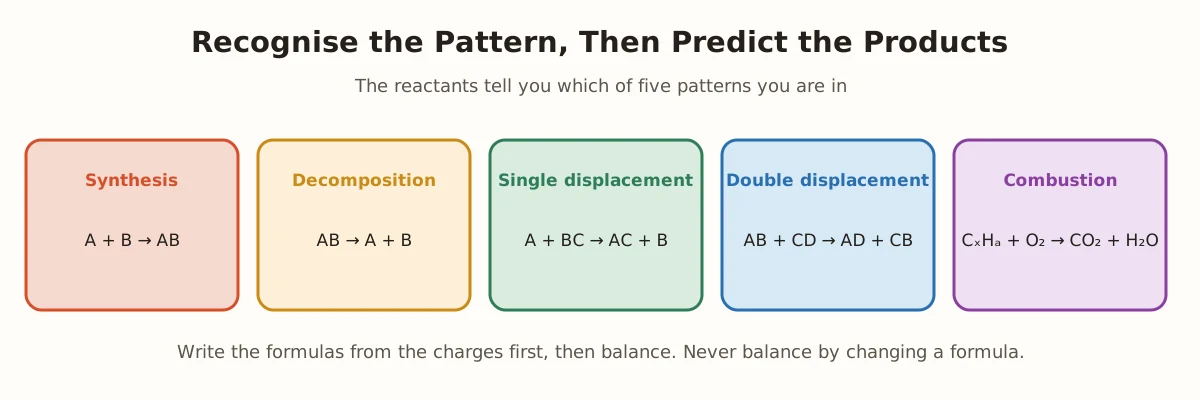
This predicting products worksheet with answers gives 18 questions that supply only the reactants and ask what comes out, with every equation balanced in the printable answer key.
Predicting is pattern recognition, then bookkeeping
Given a set of reactants, the products are not a matter of guesswork. Almost every reaction met in a first full year of chemistry follows one of five patterns, and identifying which one you are in determines the products before any balancing starts.
Two elements combining can only make a compound, which is synthesis. One compound breaking apart is decomposition. An element meeting a compound and taking a partner is single displacement. Two solutions swapping partners is double displacement. A hydrocarbon meeting oxygen is combustion, and complete combustion always gives carbon dioxide and water.
Once the pattern is identified, writing the products is mechanical. Work out each formula from the ion charges, then balance. The order matters: a formula derived from charges is fixed, and balancing may only change the numbers in front.
What this predicting products worksheet with answers covers
Part A mixes synthesis and decomposition, so the first decision is which direction the reaction runs. Part B is complete combustion of four hydrocarbons, which looks routine until butane needs thirteen oxygen molecules and the coefficients stop being small.
Part C is single displacement, where a metal takes the place of another cation. Part D is double displacement in solution, and asks not just for the equation but for which product comes out as a precipitate — the part that needs the solubility rules rather than the pattern.
The mistake that costs the most marks
Changing a subscript to make an equation balance. Writing H2O as H2O2 balances the oxygen and turns water into hydrogen peroxide, which is a different substance. If an equation will not balance with coefficients alone, the error is in a formula, not in the balancing.
The second most costly is forgetting that a double displacement only happens if something leaves solution. If both products are soluble, the ions stay mixed and nothing has reacted. Checking the solubility rules is part of predicting the products, not an afterthought.
The formal definition of a chemical reaction is in the IUPAC Gold Book. For the supporting skills, the naming ionic compounds worksheet covers building formulas from charges, the solubility rules worksheet decides what precipitates, and the types of chemical reactions worksheet drills recognising the five patterns.
Try a few before you print
Name the reaction type, give the precipitate formula, or type the coefficient asked for.
Questions students ask
How do I know which pattern I am in? Count the reactants and look at what they are. Two elements means synthesis. One compound alone means decomposition. An element plus a compound means single displacement. Two compounds in solution means double displacement.
What if nothing precipitates? Then no reaction occurs. The ions remain dissolved and mixed, and the honest answer is "no reaction".
Can I change a subscript to balance? Never. Subscripts come from the charges and define the substance. Only coefficients change.
Is an answer key included? Yes. The final pages give every balanced equation, its reaction type, and the precipitate for each double displacement.