Solubility Rules and Precipitation Worksheet
A free solubility rules worksheet with answers, covering which compounds dissolve, how to predict the precipitate when two solutions are mixed, and how to write the balanced equation for it.
This solubility rules worksheet with answers gives high school chemistry students 24 graded questions on which ionic compounds dissolve in water and what happens when two solutions are poured together. The rules look like a list to memorise, but they work as a decision procedure: go down them in order and stop at the first one that applies.
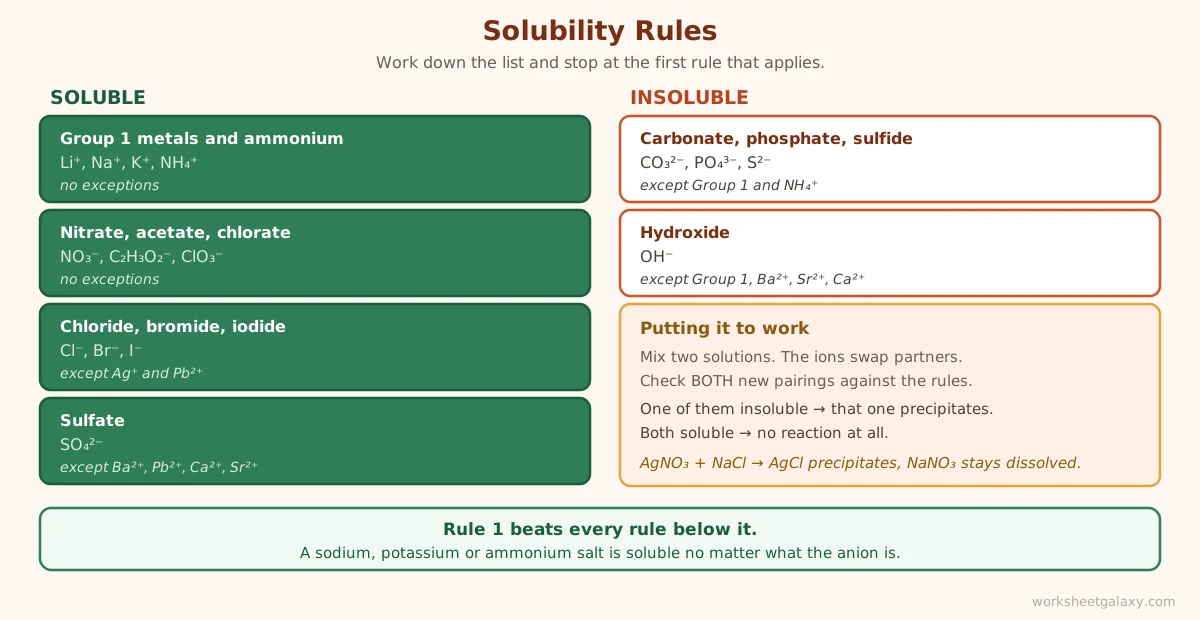
It suits a student's first full year of chemistry — Grade 11 in North America, Year 11 or 12 in the UK and Australia, Class 11 in India — and the same table is used unchanged for net ionic equations and qualitative analysis later on.
What the solubility rules worksheet with answers covers
Part A is eight compounds to classify, chosen so that a different rule decides each one, including the exceptions for silver, lead and barium. The answer key names the rule used rather than just stating the verdict, because a student who gets the right answer from the wrong rule will fail the next question.
Part B mixes pairs of solutions and asks which compound comes out as a solid. This is where the method matters: the ions swap partners, and both new pairings have to be checked against the rules, not just the one that looks more interesting. Part C asks for the balanced equation for four of those mixtures, with states written on every substance.
Part D is the part most worksheets leave out. Three mixtures are given and only one of them reacts. If both possible products are soluble, every ion stays dissolved and nothing has changed — there is no equation to write at all. Students who have only ever seen reactions that work will write one anyway.
Part E has the harder work. One question gives three solubility tests on an unknown solution and asks which cations remain possible, and whether three tests are enough to identify it. They are not, which is the point: the tests narrow the field but cannot separate calcium, strontium and barium, because the rules treat all three identically. Another asks for a net ionic equation and the spectator ions, and the last asks why a mixture that looks like it should react does nothing.
The rules, in the order to use them
Group 1 and ammonium salts are soluble, whatever the anion — this rule overrides everything below it. Nitrates, acetates and chlorates are soluble with no exceptions. Chlorides, bromides and iodides are soluble except with silver and lead. Sulfates are soluble except with barium, lead, calcium and strontium. Carbonates, phosphates and sulfides are insoluble except with Group 1 and ammonium. Hydroxides are insoluble except Group 1, barium, strontium and calcium.
Order matters more than it looks. Sodium carbonate is soluble even though carbonates are listed as insoluble, because the Group 1 rule is reached first and stops the search. A student working up the list from the bottom gets that one wrong every time.
Try ten questions before you print
Eight want "soluble" or "insoluble". The last two want the formula of a precipitate — type it plainly, like BaSO4.
- Is NaCl soluble or insoluble?
- Is AgCl soluble or insoluble?
- Is BaSO4 soluble or insoluble?
- Is KNO3 soluble or insoluble?
- Is CaCO3 soluble or insoluble?
- Is (NH4)2S soluble or insoluble?
- Is PbI2 soluble or insoluble?
- Is Mg(OH)2 soluble or insoluble?
- Precipitate formed when AgNO3(aq) meets NaCl(aq)
- Precipitate formed when BaCl2(aq) meets Na2SO4(aq)
How to use it in class
Part A works as a starter once the table has been handed out, and is short enough to repeat on several days until the exceptions stick. Parts B and C are one lesson together. Part D is worth its own discussion, because "no reaction" feels like a wrong answer to students until they have met it a few times. Part E suits review or a short assessment.
Element symbols follow the IUPAC periodic table. Students should be able to name ionic compounds and should have met the types of chemical reactions, since every precipitation here is a double displacement. The natural next step is net ionic equations, which strip these equations down to the ions that actually change.
Frequently asked questions
What if two rules seem to disagree? Use the first one that applies. Group 1 and ammonium salts are soluble regardless, so that rule is always checked before any other.
What does "no reaction" mean here? That both possible products are soluble, so no solid forms. The ions are still in the beaker, still dissolved, exactly as they were before mixing.
Is an answer key included? Yes. The final pages give a worked solution for all 24 questions, naming the rule used for each solubility decision and giving balanced equations with states.