Types of Chemical Reactions Worksheet
A free types of chemical reactions worksheet with answers, covering synthesis, decomposition, single displacement, double displacement and combustion.
This types of chemical reactions worksheet with answers gives high school chemistry students 24 graded questions on the five patterns that almost every reaction in an introductory course falls into. Recognising the pattern is what lets a student predict products for a reaction they have never seen, which is the whole reason the classification is taught.
It suits a student's first full year of chemistry — Grade 11 in North America, Year 11 or 12 in the UK and Australia, Class 11 in India — and the same five categories are assumed in IB, AP and A-level work.
The five types
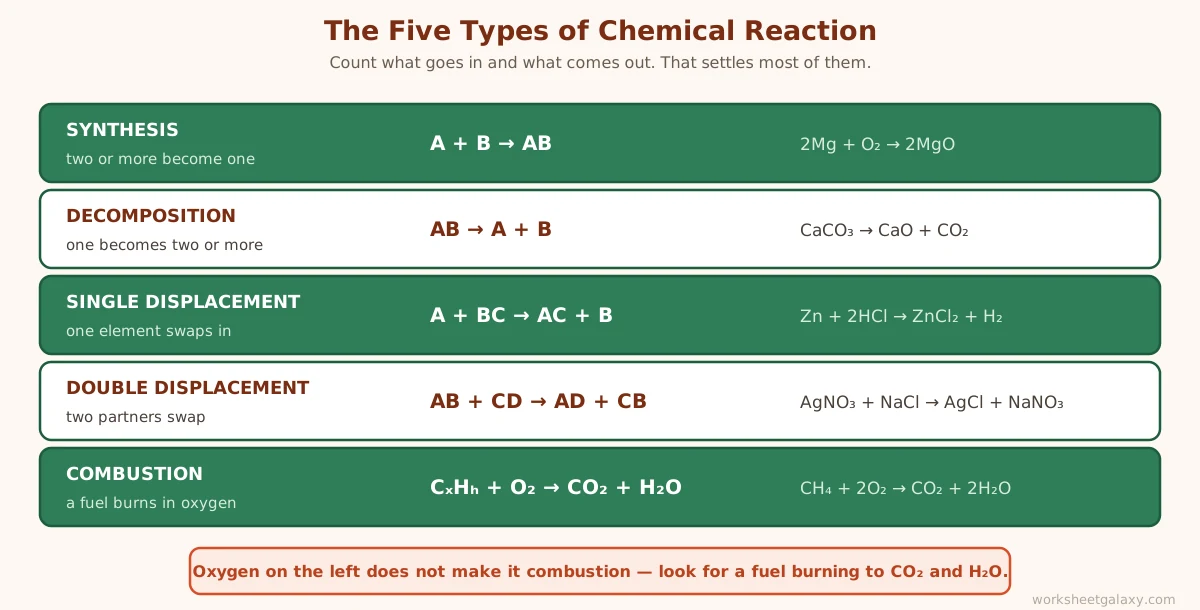
Synthesis puts two or more reactants together into one product. Decomposition does the reverse, breaking one compound into two or more. Single displacement has an element trading places with one in a compound. Double displacement has two compounds swapping partners. Combustion has a fuel burning in oxygen to give carbon dioxide and water.
Most of them can be settled by counting what goes in and what comes out. One reactant means decomposition; one product means synthesis. The two displacement types are told apart by whether a lone element appears on each side, and combustion is recognised by its products rather than by the presence of oxygen.
What the types of chemical reactions worksheet with answers covers
Part A is eight equations to classify, with all five types represented and the confusable ones repeated. Part B gives the reactants and the type and asks for the products, which is the skill that matters: a student who can only classify a finished equation has learnt to sort, not to predict.
Part C gives unbalanced skeletons to balance and then classify, so the two skills are used together. Part D is three reactions that have been classified wrongly, each in a different way, and asks for the correct type and the reason.
Part E has the harder work. One question uses the activity series printed on the sheet to decide which single displacement reactions actually happen, including two that do not. One asks for the balanced combustion of butane, where the oxygen coefficient comes out fractional and everything has to be doubled. The last is the trap this topic is known for: hydrogen peroxide decomposing to water and oxygen, which students call combustion because oxygen appears, when in fact the oxygen is a product rather than a fuel's partner.
Try ten questions before you print
Eight want a reaction type — type it plainly, like "single displacement". The last two want the coefficients of a balanced equation, left to right, separated by spaces.
- Type of reaction: 2Mg + O2 → 2MgO
- Type of reaction: CaCO3 → CaO + CO2
- Type of reaction: Zn + 2HCl → ZnCl2 + H2
- Type of reaction: AgNO3 + NaCl → AgCl + NaNO3
- Type of reaction: CH4 + 2O2 → CO2 + 2H2O
- Type of reaction: 2KClO3 → 2KCl + 3O2
- Type of reaction: Cl2 + 2NaBr → 2NaCl + Br2
- Type of reaction: N2 + 3H2 → 2NH3
- Coefficients, left to right: Al + O2 → Al2O3
- Coefficients, left to right: C2H6 + O2 → CO2 + H2O
Why students lose marks here
The commonest error is calling anything with oxygen a combustion reaction. Magnesium burning in oxygen produces a single product and is a synthesis; hydrogen peroxide breaking down produces oxygen rather than consuming it and is a decomposition. Combustion means a fuel burning to carbon dioxide and water, and the products are what give it away.
The second is confusing the two displacement types. A single displacement always has a lone element on both sides of the arrow, because an element goes in and a different element comes out. A double displacement has compounds on both sides and no lone element anywhere.
The third is assuming every single displacement actually happens. A metal only displaces one that is less reactive, so copper will not displace zinc however the equation is written. Checking the activity series first saves a whole wrong answer.
How to use it in class
Parts A and B work as one lesson once balancing is secure. Part C needs balancing to be fluent, so it suits the following day. Part D is good paired work, and Part E is the assessment question, particularly the peroxide one.
Element symbols follow the IUPAC periodic table. Students should be able to balance chemical equations before starting. This sheet leads naturally into net ionic equations, which take the double displacement reactions further, and into stoichiometry, which puts quantities on the equations classified here.
Frequently asked questions
Is burning magnesium a combustion reaction? In everyday terms yes, but in this classification it is a synthesis, because two reactants make a single product. Combustion in this unit means a fuel burning to carbon dioxide and water.
How do I know if a single displacement will happen? Check the activity series. A metal displaces only metals below it, and only metals above hydrogen displace hydrogen from an acid.
Is an answer key included? Yes. The final pages give the answer to all 24 questions, including balanced equations for every prediction and the reason each wrong classification is wrong.