Ideal Gas Law Worksheet
A free ideal gas law worksheet with answers, covering PV = nRT, finding the molar mass of an unknown gas, gas density and gas stoichiometry.
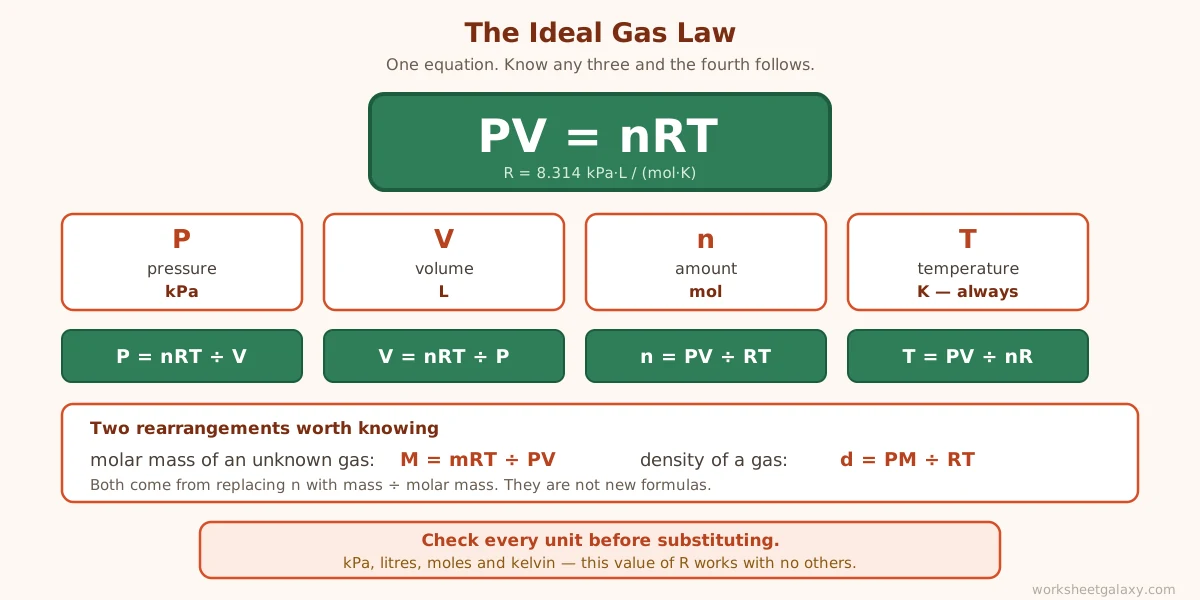
This ideal gas law worksheet with answers gives high school chemistry students 24 graded questions on PV = nRT, the one equation that replaces all four of the separate gas laws. It does something none of them can: it brings in the amount of gas, so a single calculation can move between pressure, volume, temperature and moles.
It suits a student's first full year of chemistry — Grade 11 in North America, Year 11 or 12 in the UK and Australia, Class 11 in India — and the same equation carries unchanged into IB, AP and A-level work.
What the ideal gas law worksheet with answers covers
Part A is seven rows with one value missing from each, already in the right units, so the only work is rearranging. Every variable is the unknown at least once, including temperature, which textbooks tend to leave out. One row is one mole at 101.3 kPa and 273.15 K, and the answer comes out at 22.4 litres — the molar volume at standard conditions, derived rather than memorised.
Part B is where marks are actually lost. Each of its five questions gives at least one quantity in the wrong unit: a temperature in degrees Celsius, a volume in millilitres, a pressure in atmospheres, an amount given as a mass. The value of R used here only works with kilopascals, litres, moles and kelvin, so every one of those has to be converted before the equation is touched.
Molar mass and density from gas data
Part C finds the molar mass of an unknown gas from its mass, volume, pressure and temperature. The method is not a new formula — it is PV = nRT used to find the amount, then the mass divided by it. One of the four comes out at 44.0 g/mol, which is carbon dioxide, and identifying it is a satisfying end to the question.
Part D does the same for density. Because one mole of any gas has a mass of M grams, density works out as PM divided by RT, and the worksheet runs the calculation in both directions: three questions find a density from a known gas, and one works backwards from a measured density to a molar mass.
Part E has four harder questions. One is gas stoichiometry: a mass of hydrogen reacts, and the volume of oxygen needed has to be found at stated conditions, which joins this topic to the mole work. One asks what the word ideal is actually doing in the name, and when a real gas stops obeying the law. One derives the combined gas law from PV = nRT in three lines. The last compares equal masses of helium and argon in the same container, where the pressure falls roughly tenfold — because pressure depends on how many particles there are, not on how heavy each one is.
Try ten questions before you print
All ten want a number to three significant digits. Check the units in each question before you substitute.
- V = 10.0 L, n = 2.00 mol, T = 300.0 K → find pressure in kPa
- P = 101.3 kPa, n = 1.00 mol, T = 273.15 K → find volume in L
- P = 200.0 kPa, V = 5.00 L, T = 298.15 K → find amount in mol
- P = 150.0 kPa, V = 8.00 L, n = 0.500 mol → find temperature in K
- What amount of gas occupies 4.00 L at 101.0 kPa and 25.0 degrees C? (in mol)
- What amount of gas occupies 500.0 mL at 120.0 kPa and 300.0 K? (in mol)
- Molar mass of 2.00 g of gas filling 1.50 L at 100.0 kPa and 300.0 K, in g/mol
- Molar mass of 4.40 g of gas filling 2.24 L at 101.3 kPa and 273.15 K, in g/mol
- Density of O2 at 100.0 kPa and 300.0 K, in g/L
- Density of CO2 at 101.3 kPa and 273.15 K, in g/L
Why students lose marks here
Units account for most of it. R = 8.314 kPa·L/(mol·K) is tied to one particular set of units, and a pressure in atmospheres or a volume in millilitres will give an answer that is wrong by a clean factor and looks perfectly reasonable. Converting first, every time, removes the whole problem.
The second is treating molar mass and density as separate formulas to learn. They are PV = nRT with the amount written as mass divided by molar mass. A student who sees that has one equation to remember instead of three.
The third is forgetting that this law needs no before-and-after. The combined gas law compares two states; the ideal gas law describes one. If a question gives a single set of conditions, this is the equation to reach for.
How to use it in class
Part A works as a single lesson once the equation has been introduced, and Part B is worth its own, because unit conversion deserves to be the explicit subject of a lesson rather than an aside. Parts C and D go together. Part E suits review, and the helium and argon question makes a good discussion starter because the answer surprises people.
Students should be comfortable with mole conversions and should have met the gas laws first, since Part E asks them to derive one from the other. The stoichiometry question builds directly on stoichiometry. Molar masses follow the IUPAC standard atomic weights.
Frequently asked questions
Which value of R should I use? 8.314 kPa·L/(mol·K) with pressure in kilopascals and volume in litres. If a question uses atmospheres, either convert the pressure or use R = 0.08206 L·atm/(mol·K) instead — but never mix the two.
When do I use PV = nRT instead of the combined gas law? When the question describes one set of conditions rather than a change from one to another, or when the amount of gas is involved.
Why is 22.4 L worth remembering? It is the volume of one mole of any gas at 101.3 kPa and 273.15 K. It is not a separate fact — it falls straight out of PV = nRT, as Part A shows.
Is an answer key included? Yes. The final pages give a worked solution for all 24 questions, showing the rearrangement used and every unit conversion.