Gas Stoichiometry Worksheet
A free gas stoichiometry worksheet with answers covering the routes between mass, moles and gas volume.
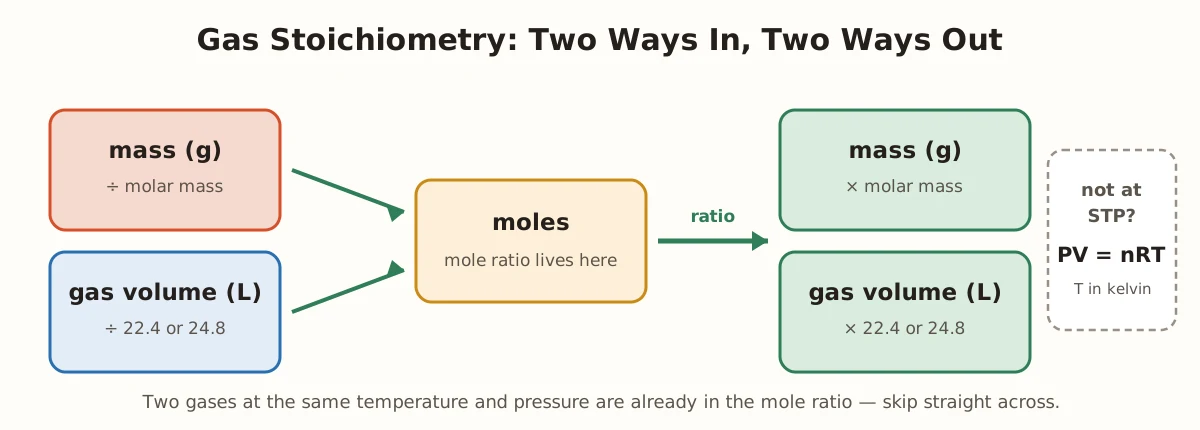
This gas stoichiometry worksheet with answers gives 18 questions that connect a measured gas volume to the rest of a reaction, with a worked solution for every one in the printable PDF.
Why gases get their own method
A mass tells you the amount of substance once you divide by the molar mass. A gas volume does the same job, but the conversion factor depends on the temperature and pressure rather than on which gas it is. That is the whole reason gases are treated separately.
At standard temperature and pressure one mole of any gas occupies 22.4 litres. At the slightly warmer standard ambient conditions it occupies 24.8 litres. The identity of the gas does not enter into it, which surprises students the first time they meet it: a litre of hydrogen and a litre of carbon dioxide at the same conditions contain the same number of molecules.
That fact has a useful consequence. If two gases in the same equation are measured at the same temperature and pressure, their volumes are already in the mole ratio, so you can go straight across without converting to moles at all. Part D of this sheet is built entirely on that shortcut.
What this gas stoichiometry worksheet with answers covers
Part A checks the two molar volumes and the volume-ratio idea. Part B starts from a mass and asks for a gas volume, which is the ordinary route with one extra step at the end. Part C reverses it, starting from a measured volume of gas and asking for the mass of a product.
Part D uses the gas-to-gas shortcut. Part E takes the conditions away from both standards, so the molar volume no longer applies and the ideal gas law has to do the final conversion instead.
Choosing the right conversion
Before calculating, decide which of three situations you are in. If the question states STP or SATP, use the matching molar volume. If both substances are gases at the same conditions, use the volume ratio directly. If neither holds, use the ideal gas law with temperature in kelvin.
Converting temperature is where this topic bites. Celsius has to become kelvin before it multiplies anything, and the conversion is additive rather than multiplicative, so it cannot be fixed afterwards by scaling. Add 273.15 first, then substitute.
The formal definition of standard conditions is set out in the IUPAC Gold Book. For the steps either side, the stoichiometry worksheet covers mass-to-mass problems, the gas laws worksheet covers how a fixed sample responds to changing conditions, and the ideal gas law worksheet drills PV = nRT on its own.
Try a few before you print
Work these out and type the answer. Three significant figures, and check which conditions each question is using.
12.3 g KClO3 at STP → L O2
25.0 g CaCO3 at STP → L CO2
5.40 g Al at SATP → L H2
67.2 L H2 at STP → g NH3
11.2 L O2 at STP → g MgO
30.0 L H2, same T and P → L NH3
48.0 L CO, same T and P → L CO2
15.0 L CH4, same T and P → L O2
Questions students ask
Does molar volume depend on the gas? No. At a given temperature and pressure, one mole of any gas occupies the same volume.
When can I skip the moles? Only when both substances are gases at the same temperature and pressure. Then the volumes are already in the mole ratio.
STP or SATP? STP is 0 degrees Celsius and 100 kPa, giving 22.4 L/mol. SATP is 25 degrees Celsius and 100 kPa, giving 24.8 L/mol. The question always says which.
Is an answer key included? Yes. The final pages work through all 18 questions, showing the moles at each stage and every kelvin conversion.