Enthalpy Worksheet
A free enthalpy worksheet with answers covering calorimetry and the sign convention that trips most students up.
This enthalpy worksheet with answers gives 19 questions on energy changes in reactions, with full worked solutions in the printable PDF.
The sign convention, and why it feels backwards
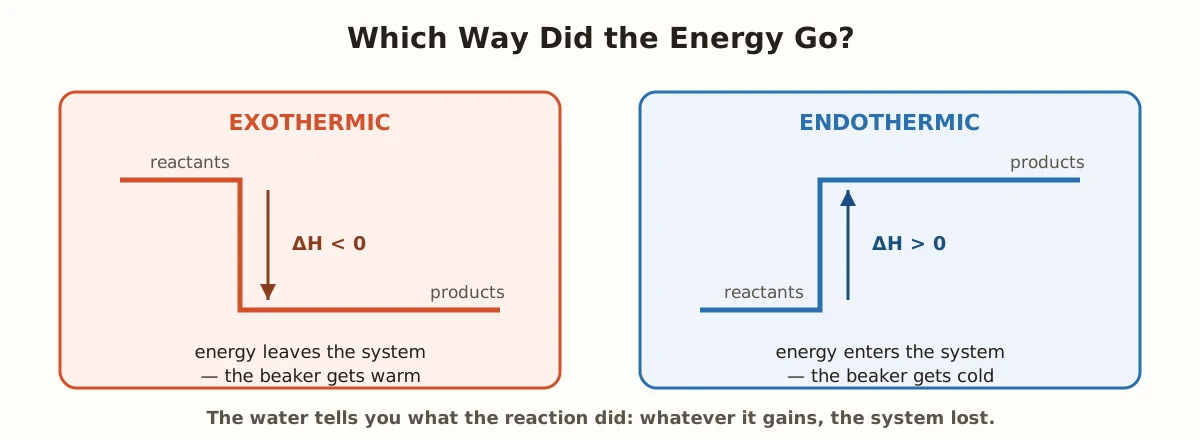
In a calorimetry experiment you never measure the reaction. You measure the water. The thermometer tells you what happened to the surroundings, and the reaction gets the opposite.
So a solution that warms up has absorbed energy, which means the reaction released it, which makes the enthalpy change negative. The reaction lost what the water gained. Students lose marks here more often than anywhere else in thermochemistry, because the temperature went up and a positive number feels right.
Writing the minus sign into the formula rather than remembering to add it afterwards is the reliable fix. Work out the heat the water absorbed, then divide by the moles and negate in the same line.
What this enthalpy worksheet with answers covers
Part A classifies six everyday situations and asks for the sign, with no arithmetic, so the convention is settled before numbers arrive. Part B is pure calorimetry: how much heat did this mass of water absorb for this temperature change.
Part C combines the two, converting a measured temperature rise into a molar enthalpy with the correct sign. Part D works the other way, taking a published enthalpy change and scaling it to the amount actually reacting.
Getting the units right
The specific heat capacity of water is 4.18 joules per gram per kelvin, so q comes out in joules. Molar enthalpy is quoted in kilojoules per mole, which means dividing by a thousand somewhere. Doing that conversion immediately after calculating q, rather than at the end, keeps the numbers small enough to sanity-check.
Temperature change is the one quantity that does not need converting. A change of one degree Celsius is a change of one kelvin, so the difference can go straight in. That is only true for a difference — an absolute temperature still needs the 273.15.
The formal definition of enthalpy is in the IUPAC Gold Book. For the supporting skills, the mole conversions worksheet covers getting the amount in moles and the stoichiometry worksheet covers scaling a reaction to the quantity you actually have.
Try a few before you print
Type the answer to three significant figures, and include the minus sign where there is one.
Questions students ask
The water got hotter, so why is ΔH negative? Because ΔH describes the reaction, not the water. The water gained the energy the reaction lost.
Do I use Celsius or kelvin? For a temperature change, either — a change of one degree is the same size in both. For an absolute temperature, kelvin.
Why is the mass of water used and not the mass of reactant? Because q = mcΔT describes what the water absorbed, and the water is what you measured the temperature of.
Is an answer key included? Yes. The final pages work through all 19 questions, showing q before the conversion to kJ/mol and stating whether each change is exothermic or endothermic.