Grade 3 Multiplication Worksheets: Free Printable Practice
Grade 3 is where multiplication starts, and it starts as a picture rather than a list of facts. Children meet equal groups, then arrays, then skip counting, and only then the times tables themselves. The grade 3 multiplication worksheets on this page follow that order — all free, A4, no login.
What Grade 3 multiplication actually covers
It is worth knowing the bar before you start printing. Ontario's mathematics curriculum for Grades 1–8 introduces multiplication in Grade 3 as an area of rows and columns, with students working with numbers up to 1,000 and learning the facts for multiplying by 2, 5 and 10 together with the related division facts.
That is a narrower target than most parents expect. Grade 3 is not the year a child has to know all 100 facts. It is the year they have to understand what multiplication is, and own three tables cold.
For comparison, England pushes the full set later: the Year 4 multiplication tables check assesses recall of the tables up to 12, a year after this one. So if your Grade 3 child is secure with the 2s, 5s and 10s and can explain why 4 × 6 and 6 × 4 give the same answer, they are where they need to be. Everything past that is a bonus.
Start with equal groups and arrays
An array is just objects in equal rows. It is the single most useful picture in Grade 3 maths, because the same drawing can be read three different ways — and seeing that those three readings are the same thing is the whole idea.
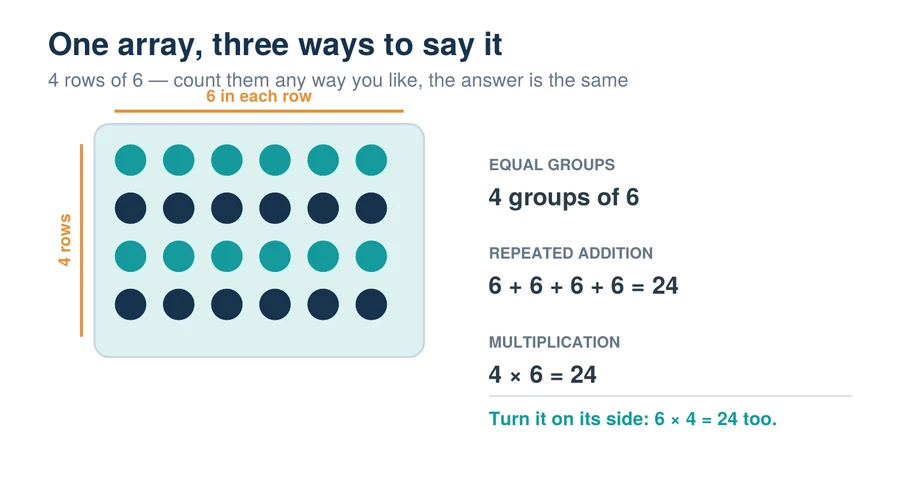
Ask a child to count the dots any way they like. Some count one at a time, some count the rows, some already say "four sixes". All three arrive at 24, and that is the point worth making out loud: multiplication is a faster way to do a count you could do the long way.
The sideways reading matters too. Turn the array a quarter turn and 4 rows of 6 becomes 6 rows of 4 — same dots, same 24. That is the commutative property, and it halves how much there is to learn. A child who knows 3 × 8 gets 8 × 3 free.
If arrays are new, the equal groups and arrays worksheets start more gently with pictures to circle and count before any symbols appear.
Skip counting is the bridge
Skip counting is the step between "I can work it out" and "I just know it". Counting 3, 6, 9, 12 is the 3 times table said out loud, and a number line makes that visible.
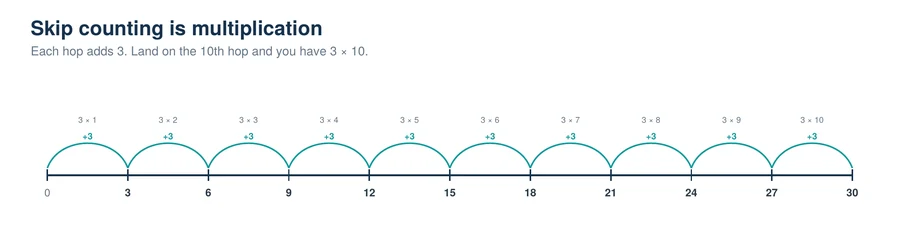
Each hop adds 3. Land on the fourth hop and you are at 12, which is 3 × 4. Children who can skip count a table fluently are usually only a few weeks away from recalling it, because they already have the answers — they are just arriving at them in order.
Skip Counting Quest is a browser game for practising this by 2s, 5s and 10s, which happen to be exactly the three tables Grade 3 is meant to secure.
Which facts to learn, and in what order
Order matters more than volume. Taught in the right sequence, each table makes the next one easier; taught in numerical order, a child hits the 6s and 7s while still shaky on everything else.
Each sheet below is a two-page A4 set: a reference chart and 24 practice problems on page one, five word problems and a bonus challenge on page two. The rows are in teaching order, not numerical order.
| Worksheet | The pattern to point out |
|---|---|
| × 1 worksheetPDF | any number × 1 stays the same |
| × 2 worksheetPDF | just double it |
| × 5 worksheetPDF | every answer ends in 0 or 5 |
| × 3 worksheetPDF | the digits of every answer add to 3, 6 or 9 |
| × 4 worksheetPDF | double, then double again |
| × 6 worksheetPDF | even × 6 ends in that same even digit |
| × 7 worksheetPDF | ones digits run 7, 4, 1, 8, 5, 2, 9, 6, 3, 0 |
| × 8 worksheetPDF | double three times |
| × 9 worksheetPDF | the finger trick — fold down the matching finger |
The 1s and 2s are nearly free, and the 5s are the first table with a pattern worth naming. Those plus the 10s are the Grade 3 requirement — and the 10s need no worksheet at all, because the rule is to write the number and put a zero after it. Check it on the chart and move on.
The 3s and 4s come next because they lean on doubling, which children already have. The last four are the ones every teacher knows are hard — and they shrink a lot once the rest are automatic, because the commutative property means most of their facts have already been met from the other side.
For a reference chart to keep on the desk through all of this, the printable multiplication charts covers the full grid, including a blank version for self-testing.
Word problems
A Grade 3 word problem is usually one sentence hiding an array. "There are 4 shelves with 6 books on each shelf" is the same picture as above, in words.
The skill being tested is not the arithmetic, it is noticing that equal groups means multiply. Children who are shaky here are often fine at 4 × 6 but cannot tell whether a problem wants 4 × 6 or 4 + 6. The fix is to have them draw the groups before writing any numbers — if the drawing has equal rows, it is multiplication.
The Grade 3 multiplication word problems set gives a full set at this level, with space to show working.
Practice, and checking it is sticking
The grade 3 multiplication worksheets above build the facts; something else has to tell you whether they stuck. These are quick ways to check without it feeling like a test:
- Grade 3 multiplication quiz — 20 questions, auto-marked, instant feedback
- Missing factor practice — fills the gap the other way round: __ × 7 = 42
- Times tables jigsaw — pattern practice that does not look like practice
- Multiplication flashcards — printable cards for the car or the kitchen table
When a child has met the facts but needs volume, the multiplication worksheet generator and the math fact generator both produce unlimited fresh sheets, so you are not reprinting the same twenty questions.
Division is the same facts read backwards, so it is worth introducing early rather than treating it as a separate topic later — the Grade 3 division quiz uses the same number range.
A four-week plan that works
If you want a structure rather than a pile of grade 3 multiplication worksheets, this is the sequence most classrooms use, compressed for home:
- Week 1 — the idea. Arrays and equal groups only. No times tables yet. The child should be able to draw 3 × 5 and explain it before memorising anything.
- Week 2 — the easy three. 2s, 5s and 10s, one per two days, with skip counting out loud before the written practice.
- Week 3 — build on doubling. 3s and 4s. Point out that the 4s are the 2s doubled; that one observation does most of the work.
- Week 4 — mixed retrieval. No new tables. Five minutes a day of mixed questions from everything so far, because recall under mixed conditions is the thing that actually transfers to a test.
Five to ten minutes a day. Longer sessions feel more productive and are not.
Three mistakes worth avoiding
Starting with the facts. A child who memorises 7 × 8 = 56 without knowing what it means cannot tell when to use it. The picture comes first.
Teaching in numerical order. Going 1, 2, 3, 4, 5, 6 means meeting the 6s while the 5s are still wobbly. The order in the table above exists for a reason.
Treating the chart as cheating. Used during practice it lowers the load so the child can think about the question. Remove it per fact as each becomes automatic, rather than all at once.
Frequently asked questions
What multiplication should a Grade 3 student know?
In Ontario, Grade 3 introduces multiplication as rows and columns and expects the facts for 2, 5 and 10 along with the related division facts — not all 100 facts. Many other curricula set a similar bar at this stage, so a child who is secure with the 2s, 5s and 10s and understands what multiplication means is where they should be.
In what order should the times tables be taught?
Start with 2s, 5s and 10s, because they have the clearest patterns and cover a large share of the grid. Then 3s and 4s, which build on doubling and skip counting. Leave 6s, 7s, 8s and 9s until last — they are the genuinely hard ones and they are much easier once the rest are automatic.
What is the difference between an array and repeated addition?
They are the same idea shown two ways. An array of 4 rows of 6 is a picture; 6 + 6 + 6 + 6 is that picture written as a sum; 4 × 6 is the shorthand. Showing all three against one array is what makes multiplication click, rather than becoming a list of facts to memorise.
How long should a Grade 3 child practise multiplication each day?
Five to ten minutes daily beats half an hour once a week. Short, frequent retrieval is what moves facts into long-term memory, and it is short enough that a tired eight-year-old will actually do it.
Is it cheating to let a child use a multiplication chart?
No. A chart during practice reduces the mental load so the child can concentrate on what the question is asking. Take it away for the facts they already know and leave it for the ones they do not — that is scaffolding, not a shortcut.
Are these grade 3 multiplication worksheets free?
Yes. Every worksheet, chart and quiz linked on this page is free, prints on A4, and needs no account or login.
Everything linked on this page
Last updated: October 2026 · Written for Grade 3 teachers, parents and homeschoolers. Every resource linked here is free and needs no account.