How to Read the Periodic Table: Groups, Periods and Symbols
The periodic table is not a list — it is a map. Where an element sits tells you how many protons it has, how many outer electrons, and therefore roughly how it will behave. Learn to read a position and you stop having to memorise individual elements.
What the table actually is
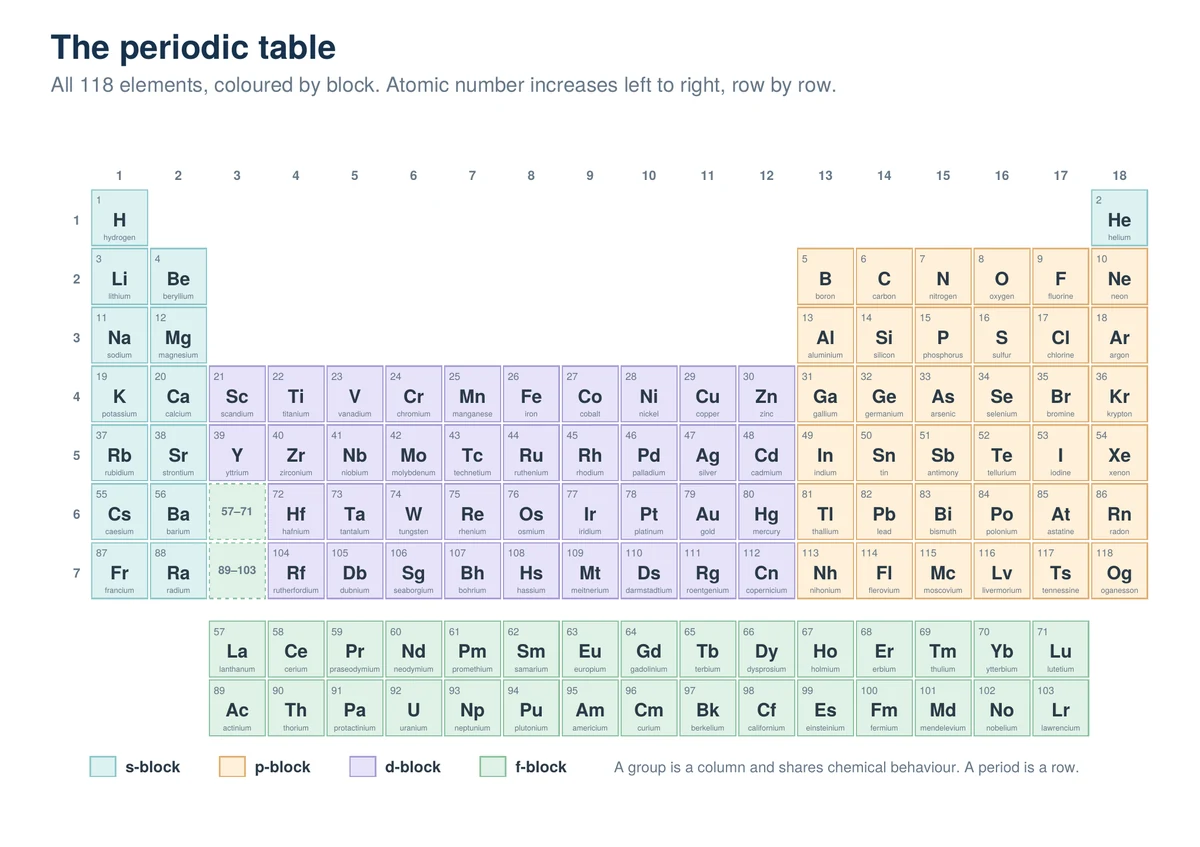
Elements are arranged in order of atomic number, left to right and then down to the next row. That ordering is not arbitrary: it means elements with similar chemistry end up stacked in the same column, which is what makes the layout worth having.
The arrangement is maintained by IUPAC, which is also what settles naming disputes and approves new elements. There are 118 confirmed, of which the first 94 occur naturally.
Reading one element
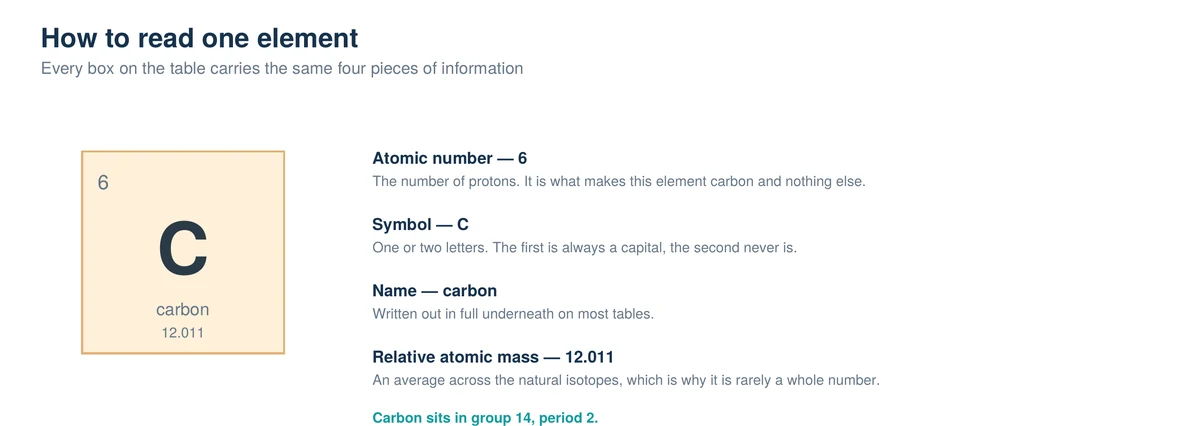
Every box carries the same information. The atomic number is the count of protons, and it is what makes the element what it is — change it and you have a different element entirely. The symbol is one or two letters, with only the first capitalised; Co is cobalt, CO is carbon monoxide, and that distinction has cost many marks.
The element symbols worksheet and the element names worksheet drill the symbol-to-name link both ways, which is worth doing early because everything else assumes it.
The symbols that do not match the name
Most symbols are the first letter or two of the English name, which makes the handful that are not look arbitrary. They are not — they come from the Latin names the elements were known by long before English chemistry existed. There are about ten in regular school use, and meeting them as a short list is much faster than being ambushed by them one at a time.
| Symbol | Element | From |
|---|---|---|
| Na | Sodium | natrium |
| K | Potassium | kalium |
| Fe | Iron | ferrum |
| Cu | Copper | cuprum |
| Ag | Silver | argentum |
| Sn | Tin | stannum |
| Sb | Antimony | stibium |
| Au | Gold | aurum |
| Hg | Mercury | hydrargyrum |
| Pb | Lead | plumbum |
Tungsten is the other one worth knowing: W, from the German Wolfram. The rest of the table follows the English name closely enough to guess.
Groups: the columns
A group is a vertical column, numbered 1 to 18. Everything in a group has the same number of electrons in its outer shell, and since chemical behaviour is decided almost entirely by those outer electrons, a group behaves as a family.
- Group 1, the alkali metals. One outer electron, lost easily. All react with water, more violently as you go down.
- Group 2, the alkaline earth metals. Two outer electrons. Reactive, but less so than group 1.
- Group 17, the halogens. Seven outer electrons, one short of full, so they grab one. Very reactive non-metals.
- Group 18, the noble gases. Full outer shell, nothing to gain or lose, so they hardly react at all.
The pattern worth stating out loud. Reactivity is not random. It follows from how far an element is from a full outer shell — which is exactly what its group number tells you. A student who sees that stops memorising reactivity lists.
Periods: the rows
A period is a horizontal row, numbered 1 to 7, and it tells you which electron shell is being filled. Period 1 has just two elements because the first shell holds two electrons. Periods 2 and 3 have eight. The later rows are longer because more sub-shells become available.
Going across a period, elements shift from metals on the left to non-metals on the right. The group and period worksheet gives practice at naming both coordinates from a position, which is the skill most directly tested.
Metals, non-metals and the staircase between them
Draw a rough staircase down the right-hand side of the table, starting beside boron and descending to astatine. Everything to the left of it is a metal: shiny, conducts heat and electricity, bends rather than shatters. Everything to the right is a non-metal: dull, insulating, brittle when solid. The elements sitting on the line itself — boron, silicon, germanium, arsenic, antimony and tellurium — are the metalloids, and they behave somewhere in between.
That middle group is why computers exist. Silicon conducts just badly enough to be switched on and off, which a true metal cannot do and a true insulator cannot do either. The properties of matter worksheet and the types of matter pack both work on telling these categories apart from observable properties rather than from position.
Blocks, and the two rows underneath
The colours in the diagram above mark the blocks — which sub-shell is filling. The s-block is groups 1 and 2, the p-block is groups 13 to 18, the d-block is the transition metals in the middle, and the f-block is the two rows printed separately below.
Those two rows are not a different kind of element. The lanthanides and actinides belong in the main body between groups 2 and 4; they are lifted out so the table fits on a page. The dashed boxes in the diagram mark where they came from.
Why the relative atomic mass is almost never a whole number
If an atom is made of whole protons and whole neutrons, a decimal mass looks like a mistake. It is not. The figure printed is an average across the isotopes of that element as they occur in nature, weighted by how common each one is.
Chlorine is the standard example: about 35.45, which is no chlorine atom at all. Natural chlorine is roughly three parts chlorine-35 to one part chlorine-37, and 35.45 is where that mixture averages out. The atoms and elements worksheet covers isotopes alongside atomic structure.
What gets asked at each grade
| Level | Usually expected | Practice |
|---|---|---|
| Grades 7–8 | Elements have symbols and atomic numbers; the table is ordered; metals sit on the left and non-metals on the right. | Periodic table quiz |
| Grades 9–10 | Groups and periods by number, why a group behaves alike, atomic structure and isotopes, reading mass and atomic number. | Periodic table basics |
| Grades 11–12 | Electron configuration, periodic trends in radius and electronegativity, and how position predicts bonding. | Chemical bonding quiz |
From here the table becomes a tool rather than a topic: the chemical reactions quiz and the article on mixtures both assume you can look up an element and know roughly what it will do. The chemistry calculators handles the arithmetic once the chemistry is settled.
Four mistakes that cost marks
Capitalising both letters of a symbol. CO and Co are different things. Only the first letter is ever a capital.
Confusing atomic number with mass number. Atomic number is protons and is always a whole number. Relative atomic mass is an isotope average and usually is not.
Reading the group as the number of electrons. It is the number of outer electrons, and only straightforwardly so for the main groups.
Treating the lanthanides as a footnote. They are part of the table and sit in period 6. Being printed below is a typesetting decision, not a chemical one.
Frequently asked questions
What do the numbers on the periodic table mean?
The whole number, usually at the top of the box, is the atomic number — the count of protons, which is what identifies the element. The decimal number underneath is the relative atomic mass, an average across the element’s natural isotopes. Atomic number is always a whole number; relative atomic mass almost never is.
What is the difference between a group and a period?
A group is a column and a period is a row. Elements in the same group have the same number of outer electrons, which is why they react in similar ways — group 1 metals all react with water, group 18 gases barely react at all. A period just tells you which electron shell is being filled.
Why are elements in the same group similar?
Because chemical behaviour is decided almost entirely by the outer electrons, and every element in a column has the same number of them. Lithium, sodium and potassium all have one outer electron, so all three lose it readily and behave alike.
Why is the relative atomic mass not a whole number?
It is a weighted average over the isotopes of that element as they occur naturally. Chlorine is listed as about 35.45 not because any chlorine atom weighs that, but because natural chlorine is a mixture of chlorine-35 and chlorine-37, with more of the lighter one.
Why are two rows printed separately underneath?
Those are the lanthanides and actinides, elements 57–71 and 89–103. They belong in the body of the table between groups 2 and 4, but printing them there would make it about fifteen columns wider than a page. They are pulled out purely to fit.
How do I remember element symbols that do not match the name?
Most of the odd ones come from Latin: iron is Fe from ferrum, lead is Pb from plumbum, sodium is Na from natrium, potassium is K from kalium, gold is Au from aurum. There are about ten in common use, and learning them as a short list is faster than meeting them one at a time.
How many elements are on the periodic table?
There are 118 confirmed elements. The first 94 occur naturally; the rest have only ever been made in laboratories, and the heaviest exist for fractions of a second.
Free periodic table worksheets and quizzes
Last updated: October 2026 · Written for Grades 7–12 chemistry students, teachers and homeschoolers. Every worksheet and quiz linked here is free and needs no account.