DNA to Protein: Transcription and Translation, Worked Through
A gene is a set of instructions for building a protein, but DNA cannot build anything itself. Getting from one to the other takes two steps: transcription copies the gene into messenger RNA, and translation reads that copy three bases at a time and assembles the amino acid chain. This page follows a single real sequence through both.
The central dogma
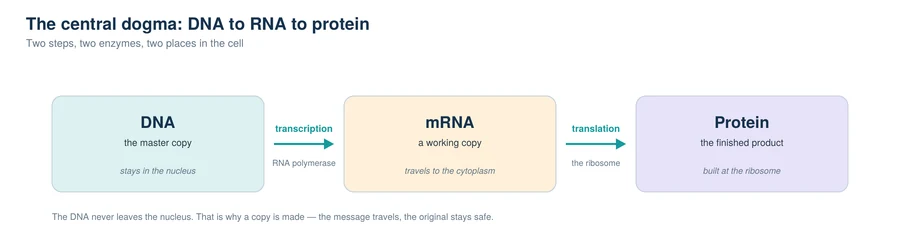
The National Human Genome Research Institute defines it as a theory stating that genetic information flows only in one direction, from DNA, to RNA, to protein. Information goes one way. A protein cannot write itself back into the genome.
Transcription and translation are those two steps, and that frame is worth establishing before any detail — because almost every exam question on this topic is really asking which step, which enzyme or which compartment.
Replication comes first, and is a different thing
Before a cell divides it copies its entire genome. The two strands separate, and each acts as a template for a new partner strand, so every daughter molecule ends up with one old strand and one new one. That is what semi-conservative means, and it is the detail most often asked for.
Replication is frequently confused with transcription because both involve reading a template. The difference is purpose: replication makes another complete DNA molecule for a new cell; transcription makes a short, disposable RNA copy of one gene. The DNA replication worksheet and the mitosis worksheet cover the process and the division it serves.
Transcription: DNA to mRNA
RNA polymerase binds near the start of a gene, separates the two strands, and reads the template strand. As it moves it builds a complementary RNA strand, pairing each base — with one change from DNA: wherever the template has adenine, RNA uses uracil rather than thymine.
The consequence is worth stating explicitly, because it is the step students get lost on: the finished mRNA is identical to the other strand, the coding strand, with U substituted for T. So if you are given the coding strand, you can write the mRNA directly. If you are given the template, you have to complement it first.
Translation: mRNA to protein
The mRNA travels to a ribosome. There it is read in groups of three bases — codons — and each codon calls in a tRNA carrying the matching amino acid. The ribosome joins each new amino acid to the growing chain and moves on three bases.
AUG both codes for methionine and marks where to start, which is why nearly every chain begins with it. Three codons — UAA, UAG and UGA — match no amino acid and end the process instead.
One sequence, all the way through
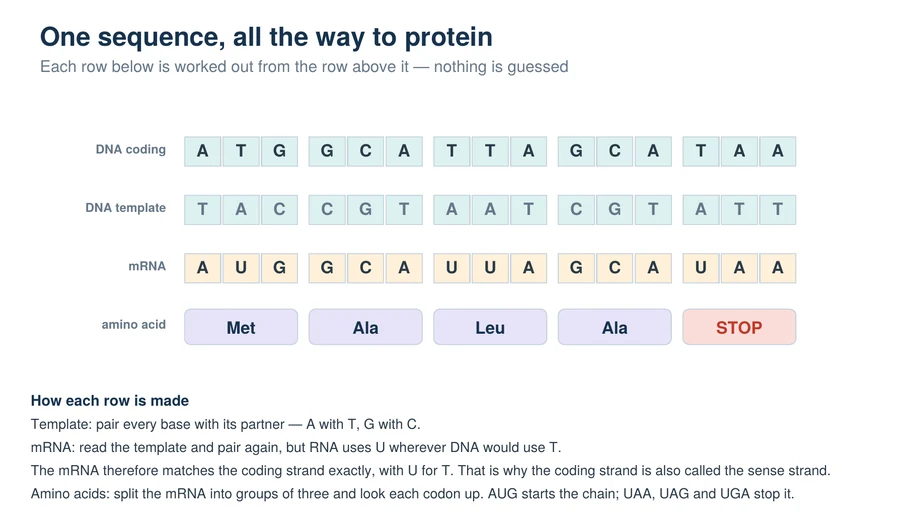
Work down the rows rather than memorising them. Starting from the coding strand ATGGCATTAGCATAA, the template is its complement, the mRNA is the complement of the template with U for T, and each group of three in that mRNA names one amino acid. The result is Met — Ala — Leu — Ala — STOP.
Notice that the mRNA, AUGGCAUUAGCAUAA, is the coding strand with every T replaced by U. If your mRNA does not match the coding strand that way, you have complemented one time too many — the single most common arithmetic slip on this topic.
The transcription and translation worksheet and the protein synthesis worksheet give more sequences to work through in the same format, and the protein synthesis quiz checks it under exam conditions.
When it goes wrong
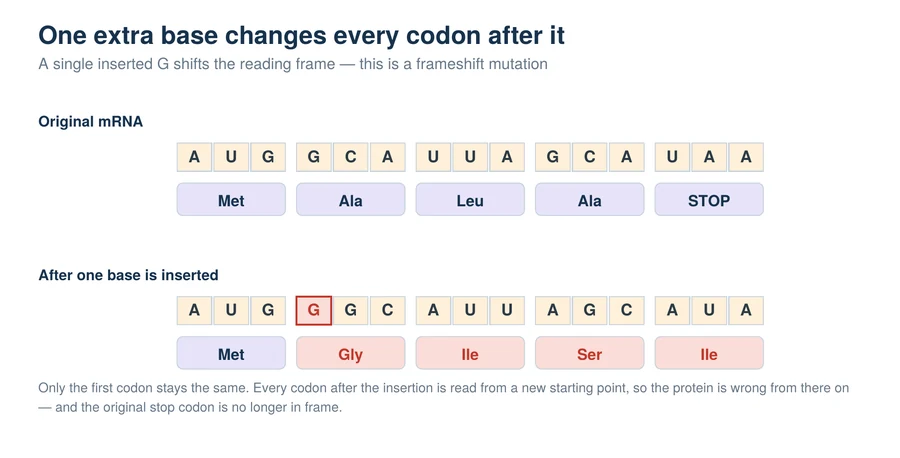
A substitution swaps one base for another, and often does very little — because the code is degenerate, a change in the third base of a codon frequently gives the same amino acid. An insertion or deletion is a different matter.
The ribosome has no way of knowing a base was added. It keeps reading in threes from where it started, so every codon after the insertion is read from the wrong position. In the example above a single extra base changes the chain from Met — Ala — Leu — Ala — STOP to a completely different sequence, and the stop codon that used to end it is no longer in frame at all.
That is why frameshifts are usually far more serious than substitutions, and it is the reasoning behind a large share of Grade 12 mutation questions. The mutations and genetic variation worksheet works through the types; the cell cycle and cancer worksheet covers what happens when the damage affects genes controlling cell division.
What changes between Grade 11 and Grade 12
| Level | Usually expected | Practice |
|---|---|---|
| Grade 9–10 | DNA structure, base pairing, that genes code for proteins. Mechanism not required. | DNA basics worksheet |
| Grade 11 | Transcription and translation by name, where each happens, reading a codon chart, and the difference between replication and transcription. | Transcription & translation |
| Grade 12 | Mechanism and consequence: RNA processing, mutation types and effects, and how gene expression is regulated. | Gene expression & regulation |
From here the topic branches. Inheritance patterns build on it — Mendelian genetics made easy and the non-Mendelian genetics quiz — while the evolution worksheet and the population genetics worksheet take the same mutations and follow them through a population. The biotechnology worksheet covers what happens once you can edit the sequence deliberately.
Four mistakes that cost marks
Complementing twice. Given the coding strand, the mRNA is that strand with U for T — no complementing at all. Complement only when you are handed the template.
Using T in RNA. It never appears. Uracil replaces it everywhere.
Confusing replication with transcription. Both read a template. Only replication produces a second complete DNA molecule.
Saying a frameshift changes one amino acid. It changes every amino acid after the insertion point, which is the whole reason it matters.
Frequently asked questions
What is the difference between transcription and translation?
Transcription copies a gene from DNA into messenger RNA, and happens in the nucleus. Translation reads that mRNA three bases at a time and assembles the matching amino acids into a protein, and happens at a ribosome in the cytoplasm. One changes the language from DNA to RNA; the other changes it from RNA to protein.
Why does the cell make an mRNA copy instead of using the DNA directly?
Because the DNA never leaves the nucleus. A protein is built at a ribosome in the cytoplasm, so a disposable working copy is sent out while the original stays protected. That also lets the cell make many copies of one gene at once without risking the master.
Which DNA strand is read during transcription?
The template strand, sometimes called the antisense strand. RNA polymerase reads it and builds a complementary RNA molecule — which means the finished mRNA matches the other strand, the coding strand, with uracil everywhere the DNA had thymine. That is why the coding strand is also called the sense strand.
What is a codon?
A codon is a group of three bases in mRNA that specifies one amino acid. There are 64 possible codons. AUG codes for methionine and also starts the chain, and three codons — UAA, UAG and UGA — code for no amino acid at all and stop translation.
What does a frameshift mutation do?
Inserting or deleting a base shifts every codon after that point, because the ribosome still reads in groups of three from where it started. Almost every amino acid downstream changes, and the original stop codon is usually no longer in frame. That is why frameshifts are generally far more damaging than a single base substitution.
Is RNA different from DNA?
In three ways that matter here. RNA uses the base uracil where DNA uses thymine, its sugar is ribose rather than deoxyribose, and it is usually single-stranded. Those differences are what make it suitable as a short-lived working copy rather than long-term storage.
How many amino acids does the genetic code specify?
Twenty amino acids are specified by 64 codons, so most amino acids have more than one codon. The code is described as degenerate for that reason — and it is a useful safeguard, because a mutation in the third base of a codon often produces the same amino acid anyway.
Free genetics worksheets and quizzes
For the other great energy-and-information process on the syllabus, photosynthesis explained works the same way — one diagram per idea, nothing asserted without being shown.
Last updated: October 2026 · Written for Grade 11 and 12 biology students, teachers and homeschoolers. Every worksheet and quiz linked here is free and needs no account.