Types of Matter Grade 9 | Chemistry Worksheets and Activities
Help students understand fundamental chemistry concepts with Types of Matter Worksheets for Grade 9.
This types of matter worksheet lists thirty substances and asks for one word each: solid, liquid or gas, at room temperature.
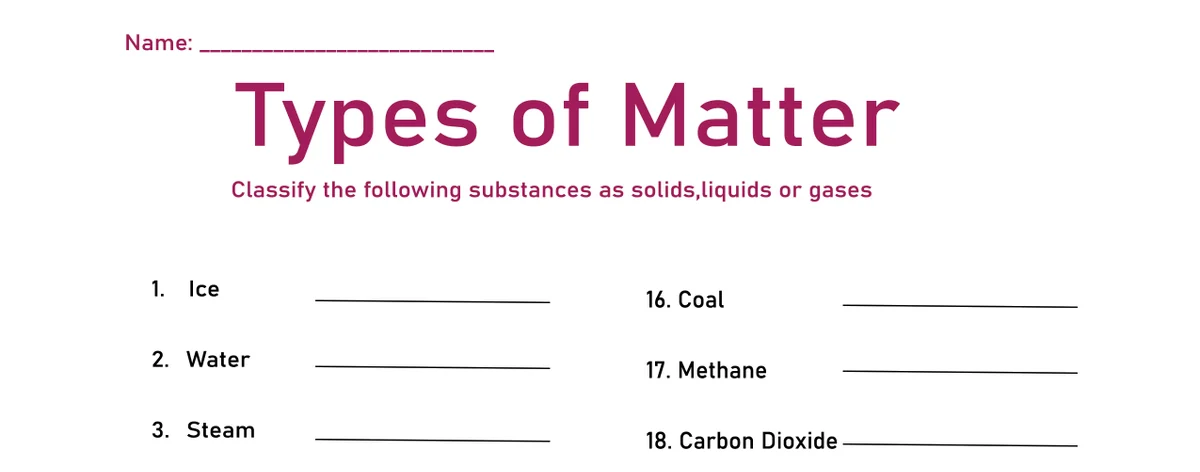
What the types of matter worksheet asks
Thirty substances in two columns, each with a line to write solid, liquid or gas. Ice, water, steam, metal, alcohol, milk, helium, diamond, salt, mercury, oil, honey, wood, glass, brick, coal, methane, carbon dioxide, blood, mouthwash, soap, gold, clay, smoke, plastic, propane, soda, bromine, sugar and gasoline.
Thirty is more than it needs for the straightforward cases, and that is deliberate: the length is what gets the unusual ones onto the same page as the obvious ones.
At room temperature, unless you say otherwise
The first three entries are ice, water and steam — the same substance in three states. That is the whole idea of the sheet stated in its opening lines: state is a condition, not a property of the material.
Everything after that is judged at room temperature, and it is worth saying so before students start. Otherwise gold is a liquid if you heat it enough and the exercise falls apart.
The two liquid elements
Mercury and bromine are both on this sheet, and they are the only two elements that are liquid at room temperature. Students who know mercury is a metal often write solid on that basis, because metal is the fourth item on the list and it is a solid.
Meeting both of them on one page is worth pointing out. It is a fact students remember, and it comes back when they meet the periodic table properly.
What decides the state
The three states differ in how tightly the particles are held. A solid keeps both its shape and its volume; a liquid keeps its volume but takes the shape of its container; a gas keeps neither and fills whatever it is in.
That pair of questions — does it hold its shape, does it hold its volume — settles almost every item on the sheet without any knowledge of the substance itself, which is the point of learning it as a test rather than as a list of thirty answers.
Smoke, glass and honey
Smoke is the hardest item here and the answer is not simply gas. It is solid particles suspended in gas — which is why you can see it, and gases you can see are rare. Accept gas with a good reason, but the discussion is better than the mark.
Glass is a solid, despite the familiar claim that it flows slowly. It does not, at any timescale that matters, and the claim is a myth worth correcting when a student raises it.
Honey is a liquid, just a very viscous one. Thickness is not the test; holding its own shape is.
How to use it
Fifteen to twenty minutes. The first twenty answers go quickly and the last ten are where the lesson is, so it is worth keeping time for the discussion rather than letting the sheet fill the period.
Mark the unusual ones generously if the reasoning is sound. A student who writes gas for smoke and can say why is further along than one who writes the expected answer without a reason.
For more, our science worksheets cover mixtures and physical and chemical change at the same level, and the guide to mixtures is the natural next step. The American Chemical Society publishes related classroom material.
Try a few before you print
Four of the substances from this sheet.
- Mercury at room temperature: solid, liquid or gas?
- Helium: solid, liquid or gas?
- Bromine at room temperature: solid, liquid or gas?
- Diamond: solid, liquid or gas?