Photosynthesis Explained: the Equation, the Two Stages, and Free Worksheets
Photosynthesis is how a plant turns light energy into chemical energy it can store. It takes in carbon dioxide and water, uses light captured by chlorophyll, and builds glucose, releasing oxygen as a by-product. Two stages do the work: one captures the light, the other spends what it captured on building sugar.
What photosynthesis actually is
Most definitions stop at "plants make their own food", which is true and not very useful. The sharper version: photosynthesis is an energy conversion. Light energy arrives, and leaves again as chemical energy locked in the bonds of a glucose molecule.
That matters because it tells you what to look for. Every stage below is either capturing energy or spending it, and once a student sees that, the two stages stop being two lists to memorise.
Where a plant’s mass comes from. Ask a class where the wood in a tree came from and most will say the soil. It did not. NASA’s Earth Observatory puts it plainly: plants absorb carbon dioxide and sunlight to create fuel — glucose and other sugars — for building plant structures. The carbon in a tree was a gas before the tree caught it.
Soil supplies water and minerals. The bulk of the dry mass arrives through the leaves.
The equation, and why it balances
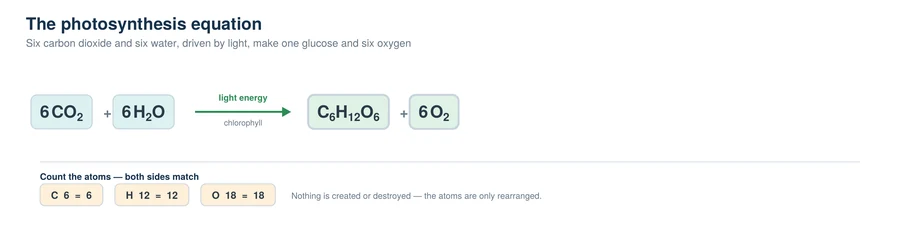
Students are usually asked to recall this equation. The more useful exercise is to count the atoms on each side, because that is where the idea lives: six carbon dioxide molecules carry six carbon atoms, and the glucose on the right contains exactly those six. Nothing is created. The atoms are rearranged into a molecule that holds more energy.
The oxygen is worth a second look. There are 18 oxygen atoms on each side, but the O2 released does not come from the carbon dioxide — it comes from splitting water. That is a standard Grade 11 and 12 follow-up question and it catches people who learned the equation without the mechanism.
Where it happens
Photosynthesis takes place in chloroplasts, which is why only plant cells (and algae) can do it. Inside a chloroplast there are two distinct environments, and each stage belongs to one of them: the stacked thylakoid membranes, and the fluid stroma around them.
If chloroplasts and the rest of the organelles are not yet secure, the plant vs animal cells worksheet and the cell structure worksheet cover the structures first — the stages below are much easier once a student can picture where they happen.
Stage one: the light-dependent reactions
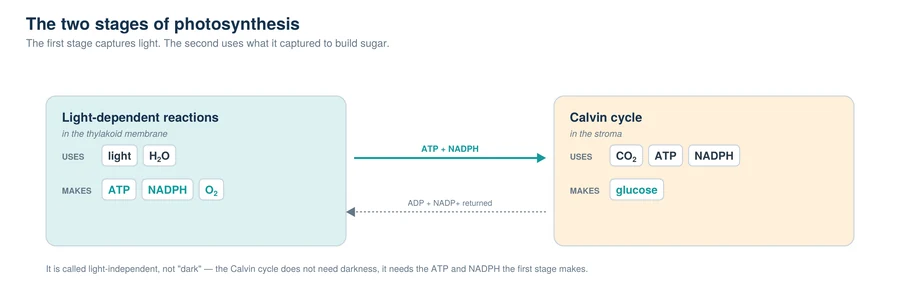
In the thylakoid membranes, chlorophyll absorbs light. That energy is used to split water molecules, which does three things at once: it releases oxygen as waste, it provides electrons to replace the ones chlorophyll lost, and it drives the production of ATP and NADPH.
ATP and NADPH are the point. They are the portable energy and reducing power that the second stage will spend. The oxygen you breathe is, in this sense, a by-product of a plant getting hold of some electrons.
What to remember
- Needs light directly — stops in darkness
- Happens in the thylakoid membrane
- Splits water, releases oxygen
- Produces ATP and NADPH for stage two
Stage two: the Calvin cycle
In the stroma, carbon dioxide is fixed into an organic molecule and, using the ATP and NADPH from stage one, built up into glucose. The spent ADP and NADP+ return to the thylakoid to be recharged, which is why the diagram above has an arrow going back.
It is not the dark reaction. The Calvin cycle is called light-independent because it does not use light directly — not because it happens at night. It needs the ATP and NADPH that only the light-dependent stage makes, so in practice it runs during the day, alongside stage one. Students who learn it as "the dark reaction" almost always conclude a plant photosynthesises at night.
The Grade 9 photosynthesis worksheet works through both stages with the terms blanked out, which is a better test of recall than re-reading. The photosynthesis quiz then checks it with 20 auto-marked questions.
Photosynthesis and respiration are two halves of one story
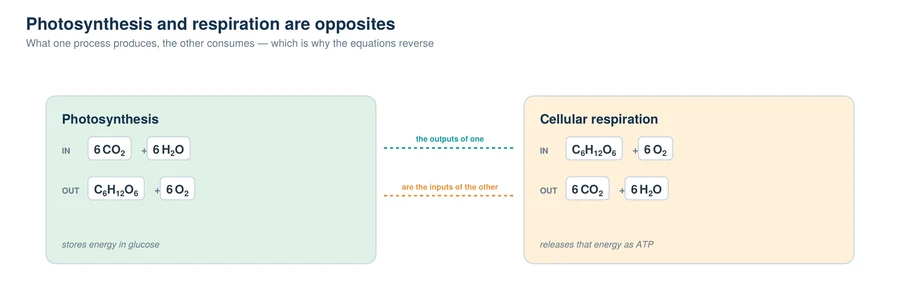
Set the two equations side by side and they reverse. That is not a coincidence — photosynthesis stores energy in the bonds of glucose, and cellular respiration releases it again as ATP. One builds the fuel, the other burns it.
Two points students regularly get wrong. First, plants respire too, constantly, day and night — every living cell needs ATP. Second, in good light a plant photosynthesises faster than it respires, which is why there is a net release of oxygen; in darkness only respiration continues and the net flow reverses.
The cellular respiration worksheet and its quiz cover the other half in the same format. Taught together, they take less time than taught apart.
What gets asked at each grade
| Level | What is usually expected | Practice |
|---|---|---|
| Grades 6–8 | Plants make their own food using light, water and carbon dioxide; chloroplasts are where it happens; oxygen is released. | Cells quiz, Grades 6–8 |
| Grades 9–10 | The balanced equation, the role of chlorophyll, the two stages by name and location, and the link to respiration. | Photosynthesis worksheet |
| Grades 11–12 | Mechanism: photosystems, the electron transport chain, where the released oxygen comes from, and the Calvin cycle in detail. | Photosynthesis quiz |
Photosynthesis also sits underneath two topics that come later: it is the first step of almost every food chain, and it is the process that moves carbon out of the atmosphere. The ecosystems and food chains worksheet and the climate change quiz pick up those threads.
Four mistakes that cost marks
Calling the Calvin cycle the dark reaction. It leads straight to the belief that plants photosynthesise at night. Use light-independent.
Saying the oxygen comes from carbon dioxide. It comes from water. The equation alone will not tell you this, which is exactly why examiners ask it.
Forgetting that plants respire. A common exam question gives a plant in darkness and asks what gas it releases. The answer is carbon dioxide.
Writing the equation unbalanced. Dropping a coefficient is the easiest mark to lose. Count carbon first — six on each side — and the rest usually follows.
Frequently asked questions
What is the equation for photosynthesis?
The balanced equation is 6CO2 + 6H2O, driven by light energy, giving C6H12O6 + 6O2. Count the atoms and both sides match: 6 carbon, 12 hydrogen and 18 oxygen. Nothing is created or destroyed — the atoms in the carbon dioxide and water are rearranged into glucose and oxygen.
What are the two stages of photosynthesis?
The light-dependent reactions happen in the thylakoid membranes and use light and water to make ATP, NADPH and oxygen. The Calvin cycle happens in the stroma and uses that ATP and NADPH, plus carbon dioxide, to build glucose. The first stage captures energy; the second spends it.
Why is the second stage called light-independent rather than the dark reaction?
Because it does not require darkness — it requires the ATP and NADPH that the light-dependent stage produces. In a real plant both stages run at the same time in the light. Calling it the dark reaction suggests it happens at night, which is the single most common misunderstanding at this level.
Where does a plant get the material it is built from?
Mostly from the air, not the soil. The carbon in a plant comes from carbon dioxide pulled out of the atmosphere during photosynthesis. Soil supplies water and mineral nutrients, but the bulk of a plant’s dry mass is carbon that was a gas before the plant captured it.
How are photosynthesis and cellular respiration related?
They are near opposites. Photosynthesis uses carbon dioxide and water to make glucose and oxygen; respiration uses glucose and oxygen to release energy, giving back carbon dioxide and water. One stores energy in a chemical bond, the other releases it. Plants do both.
Do plants carry out respiration as well as photosynthesis?
Yes. Plants respire constantly, day and night, because every living cell needs ATP. In good light a plant photosynthesises faster than it respires, so there is a net release of oxygen. In darkness only respiration continues, so a plant takes in oxygen and releases carbon dioxide.
What is chlorophyll and why are plants green?
Chlorophyll is the pigment in chloroplasts that absorbs light energy for the first stage. It absorbs red and blue light strongly but reflects green, and the light it reflects is the light that reaches your eye — which is why leaves look green.
Free photosynthesis worksheets and quizzes
Studying genetics next? DNA to protein, explained follows the same approach — one worked example carried all the way through, rather than a list of terms.
Last updated: October 2026 · Written for Grades 7–12 science students, teachers and homeschoolers. Every worksheet and quiz linked here is free and needs no account.