Significant Figures in Chemistry
This significant figures chemistry worksheet gives Grade 11 and Grade 12 students 26 marks of practice on the places the rules actually decide marks: mole calculations, dilutions, percent yield and percent error, and the logarithm rule that governs pH.
This significant figures chemistry worksheet gives Grade 11 and Grade 12 students 26 marks of practice on the places the rules actually decide marks: exact values, percent error, and the logarithm rule behind every pH.
What the significant figures chemistry worksheet covers
In a chemistry calculation the significant figure rules stop being an exercise and start costing marks. Three situations come up constantly, and each one catches students for a different reason.
The first is knowing what counts as exact. Mole ratios from a balanced equation, the 1000 mL in a litre, the 100 in a percentage and the 273.15 added for kelvin are definitions rather than measurements, so they never limit an answer. Molar masses are quoted to enough figures that they will not limit it either, provided enough of them are used. Students who treat a counted 4 as one significant figure lose two figures they were entitled to, and Part C asks them to explain exactly that case.
Percent error loses figures before it starts
The second is percent error, which nearly always ends up with fewer figures than the measurements behind it. A measured density of 1.28 g/mL against an accepted 1.36 g/mL differs by 0.08, and that difference carries one significant figure, not three. The two values agree in their leading digits and those digits cancel in the subtraction.
So the percent error is 6%, not 5.88%. Students almost always report the calculator output, and this is worth showing once with the arithmetic in front of them, because the rule on its own never sounds convincing.
The logarithm rule, which pH depends on
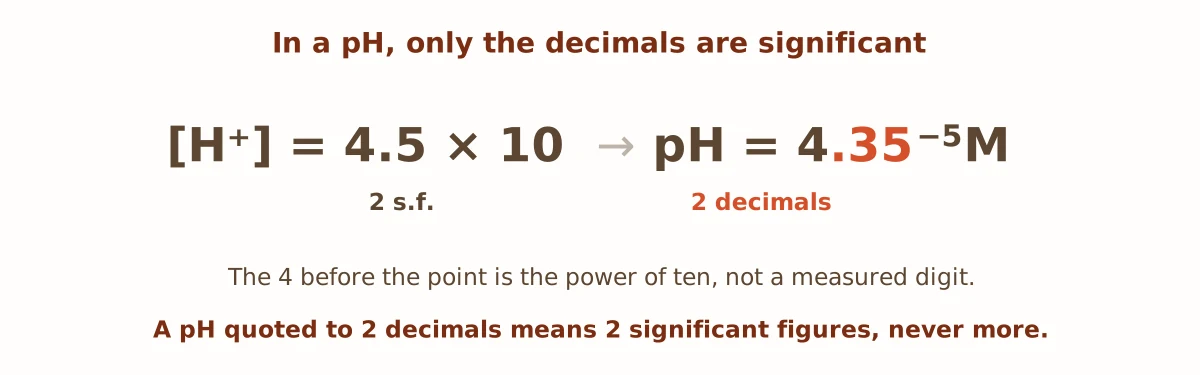
The third is logarithms. In a pH only the digits after the decimal point are significant, because the part before the point carries the power of ten rather than a measured quantity. A concentration of 2.50 × 10⁻⁴ M has three significant figures, so its pH is quoted to three decimal places: 3.602.
The rule runs backwards as well. A pH of 4.35 has two decimal places, so the hydrogen ion concentration it gives has two significant figures: 4.5 × 10⁻⁵ M, not 4.47 × 10⁻⁵ M. And a solution measured at 1.0 × 10⁻⁷ M has a pH of 7.00, not 7, because writing a bare 7 claims nothing more than an order of magnitude.
What is on the sheet
Part A covers six calculations across moles, dilution, percent yield, percent error and the ideal gas law, each with the working shown in the key rather than only an answer. Part B is four pH conversions, two in each direction. Part C asks students to find and explain three specific errors, which is the part that transfers to an exam.
How to use this worksheet
The sheet prints on standard letter paper and runs about forty minutes. It assumes the counting and rounding rules are already secure and spends its time on applying them, so it works best as review before a quantitative unit test or a lab report.
Our significant figures calculator handles logarithms and exact values directly, so a pH conversion can be checked with its reasoning shown. For the chemistry itself, our pH and pOH calculator and the rest of the science worksheets cover the surrounding material, and NIST documents how measured values should be reported.
Practise significant figures in chemistry online
Answer these five questions and check them instantly. They use the same rules as the printable sheet.
- 2.50 g of NaCl (58.44 g/mol) is how many moles, to the right precision?
- [H+] = 2.50 x 10^-4 M. What is the pH?
- pH = 4.35. How many significant figures does [H+] get?
- 36.0 g shared between 4 counted flasks gives what mass each, in g?
- Measured 1.28 g/mL against accepted 1.36 g/mL. Percent error, to 1 s.f.?