Scientific Notation and Significant Figures
This scientific notation and significant figures worksheet gives Grade 10 and Grade 11 students 26 marks of practice.
This scientific notation and significant figures worksheet gives Grade 10 and Grade 11 students 26 marks of practice on converting in both directions, calculating, and using the notation to say exactly how precise a number is.
What the scientific notation and significant figures worksheet covers
Scientific notation writes a number as m × 10ⁿ with the mantissa between 1 and 10. It is usually introduced as a way to avoid long strings of zeros, which is true but is not the main reason it exists. The main reason is precision.
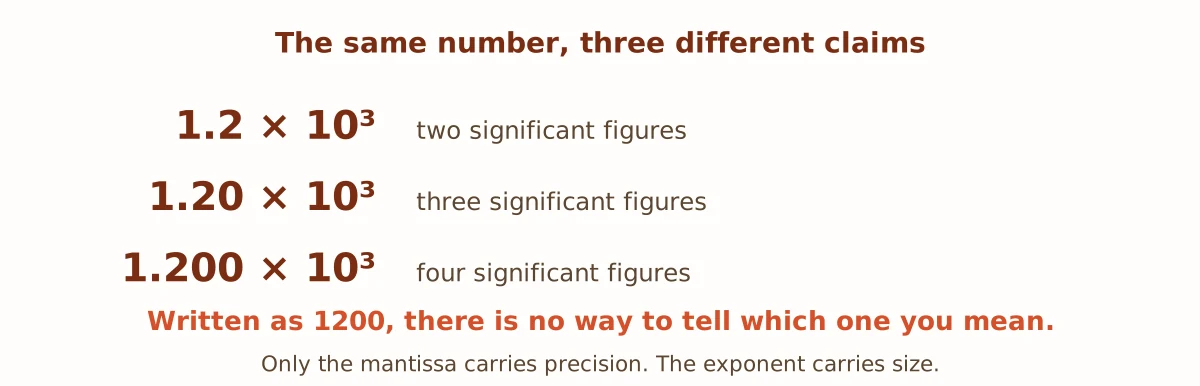
Written plainly, 1200 could carry two, three or four significant figures, and nothing in the notation says which. Written as 1.2 × 10³, 1.20 × 10³ or 1.200 × 10³, the claim is exact every time. Students who meet scientific notation only as a space-saving device never see this, and the ambiguity goes on confusing them for years.
Only the mantissa counts
The exponent records how large a number is, not how well it was measured. So 6.022 × 10²³ has four significant figures, not twenty-four. Part D asks students to explain this directly, because it is a mistake that survives being told once: the written number really is twenty-four digits long, and the reasoning has to be understood rather than memorised.
The same idea runs the other way. Converting 4.50 × 10⁻³ to 0.00450 keeps three significant figures, and the two leading zeros that appear are not new information. Converting never changes the figure count, which is why Parts A and B ask for the count alongside every conversion.
Calculating without leaving the notation
Part C multiplies and divides directly in scientific notation: multiply the mantissas and add the exponents, or divide and subtract. The significant figure rule is the ordinary multiplication rule applied to the mantissas, so (5.0 × 10⁶) ÷ (4.00 × 10²) gives 1.3 × 10⁴, limited to two figures by the 5.0.
Keeping the work in scientific notation avoids a specific trap. An answer of 20000 from a two-figure calculation is ambiguous as written, while 2.0 × 10⁴ is not. Chemistry and physics problems produce numbers at this scale constantly, which is why the notation becomes the default rather than an occasional convenience.
Where marks get lost
Three errors account for most of them. Counting the exponent as though it carried precision. Dropping a trailing zero from the mantissa, turning 1.20 × 10³ into 1.2 × 10³ and quietly discarding a figure. And getting the sign of the exponent backwards when converting a small number, since moving the point right makes the exponent smaller. Parts A and B include several of each.
How to use this worksheet
The sheet prints on standard letter paper and runs about thirty minutes, and it works well straight after the counting and rounding sheets, since it resolves the ambiguous trailing zeros those sheets raise but cannot fix.
Our significant figures calculator shows every answer in decimal, scientific and E notation at once, which makes the relationship between the three concrete. The rest of our science worksheets cover measurement and the chemistry calculations that use this notation throughout, and NIST sets out the conventions for writing measured values.
Practise scientific notation online
Answer these five questions and check them instantly. They use the same rules as the printable sheet.
- How many significant figures does 6.022 x 10^23 have?
- Write 45600 in scientific notation: 4.56 x 10 to what power?
- Write 0.000375 in scientific notation: 3.75 x 10 to what power?
- How many significant figures does 1.0 x 10^3 have?
- (3.0 x 10^4) x (2.0 x 10^3) = 6.0 x 10 to what power?