Rounding to Significant Figures
This rounding to significant figures worksheet gives Grade 9 and Grade 10 students 26 marks of practice.
This rounding to significant figures worksheet gives Grade 9 and Grade 10 students 26 marks of practice, including the carries that shift the place value and the trailing zeros most students throw away.
What the rounding to significant figures worksheet covers
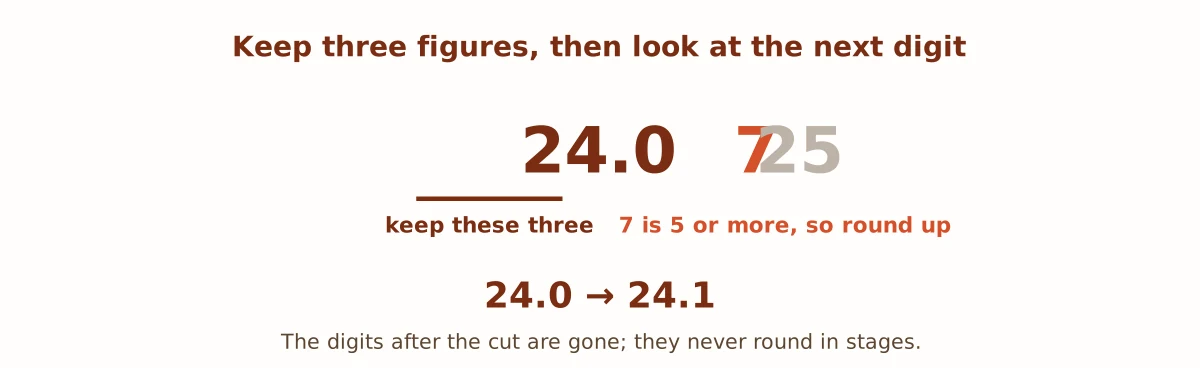
Rounding a measurement is not tidying it up. It is a statement about how much of the number you are prepared to stand behind. Writing 24.1 says the 1 is the last digit you trust; writing 24.0725 says you trust all six. Students who read rounding that way stop making the two mistakes this sheet is built around.
The first is rounding in stages. Asked for 2.449 to two significant figures, a student rounds to 2.45 and then to 2.5. The correct answer is 2.4. Only the first digit being dropped decides anything, and here that is the 4 in the hundredths place. The 9 at the end is evidence about the thousandths and says nothing about the tenths.
Trailing zeros are not optional
The second mistake is dropping a trailing zero. If a calculation justifies three figures and the third is a zero, 2.0999 rounds to 2.10 and not 2.1. The two are different claims: 2.10 says the hundredths digit is known to be zero, while 2.1 makes no claim about the hundredths at all. Writing the shorter one reports less precision than the measurement earned, and in a marked answer it costs the figure.
Part A includes several numbers where the kept digit is a zero, so this comes up repeatedly rather than once.
Carries that move the place value
Rounding 9.9949 to three significant figures gives 9.99, but rounding 999.6 to two gives 1000, and rounding 0.0099 to three gives 0.00990. These carries catch people out because the number of digits appears to change. Part B includes four of them, and the working column asks which digit the student looked at, which is where the error shows up if there is one.
Figures are not decimal places
Part C puts the two side by side. 3.14159 is 3.14 to three significant figures and 3.142 to three decimal places; 0.04567 is 0.0457 to three figures and 0.046 to three places. Significant figures count from the first non-zero digit wherever the point falls, while decimal places count only what comes after it. Students who confuse the two usually do so under exam pressure, and seeing both answers for the same number fixes it faster than a definition does.
How to use this worksheet
In a classroom, Part B rewards marking the working column rather than the answers. A student who writes down which digit they looked at has either applied the rule or has not, and that is visible at a glance in a way a wrong final answer is not.
The sheet prints on standard letter paper and runs about twenty-five minutes. The rules are printed on it, so it works without a textbook. The answer key gives the reason for each of the two written questions rather than just the answer.
To check an answer or try a number that is not on the sheet, our significant figures calculator rounds to figures or decimal places and shows both. It rounds from the digits you type rather than from a floating point value, so it gives 2.68 for 2.675 where many calculators give 2.67. Counting comes first, and the rest of our science worksheets cover applying the rules to calculations. NIST documents how measured values should be written.
Practise rounding to significant figures online
Answer these five questions and check them instantly. They use the same rules as the printable sheet.
- Round 24.0725 to 3 significant figures.
- Round 2648 to 3 significant figures.
- Round 0.004562 to 2 significant figures.
- Round 2.449 to 2 significant figures.
- Round 999.6 to 2 significant figures.