Biotic and Abiotic Factors Worksheet — Grade 9 Ecology Practice
A four-page biotic and abiotic factors worksheet for Grade 9, with 36 questions and an answer key.
This biotic and abiotic factors worksheet starts with straightforward sorting, then the once-living cases students get wrong, then short explanations and limiting factors.
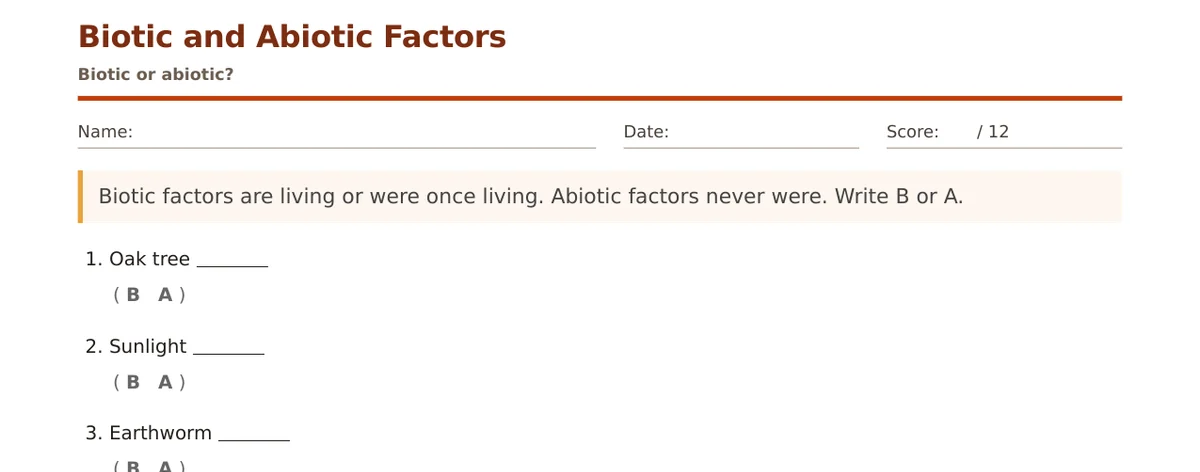
What is on this biotic and abiotic factors worksheet
Four pages. Twelve items to sort as biotic or abiotic, twelve harder ones where the answer is not obvious, six short written explanations linking an abiotic factor to a living thing, and six questions on limiting factors. An answer key is included.
The definition that causes the trouble
Biotic factors are living or were once living. That second half is where most marks are lost.
A fallen log is biotic. So are dead leaves, a seashell, animal droppings and coal. Students who have learnt "biotic means alive" classify all of those as abiotic, and they are consistent and wrong, which is harder to unpick than a random error.
Page two is the real test
Page one is deliberately easy — oak tree, sunlight, earthworm, rainfall. Almost everyone scores well, and that is the point: it establishes the pattern before the pattern is broken.
Page two then gives the once-living cases. A student who scores twelve on page one and five on page two has not learnt the definition, they have learnt to ask whether something moves.
Sand, coal and the origin question
Sand is abiotic because it is ground-up rock. Coal is biotic because it is compressed plant material. Neither is alive now, and the question is not whether it is alive but where it came from.
Teaching students to ask "was this ever part of a living thing?" rather than "is this alive?" settles every item on page two, including the awkward ones like a bird’s nest.
Limiting factors
Page four introduces the idea that a population is capped by whatever is in shortest supply, not by the total resources available.
A pond with abundant food, light and warmth but low dissolved oxygen supports few fish, and adding more food changes nothing. That is the insight, and it is the one that carries into population ecology later.
Written answers, not just sorting
Page three asks for one sentence linking an abiotic factor to an organism. Sorting can be done by pattern matching; explaining cannot.
"How does temperature affect a frog?" needs the student to know frogs are ectotherms and reason from there. Those are the questions that appear on an exam, and a worksheet that only sorts never reaches them.
How to use it
Thirty to forty minutes for all four pages, or page one and two as a recap and three and four as the lesson.
Biotic factors act on each other
Abiotic factors get most of the attention, but the biotic ones matter as much. Predation, competition for food, disease and the presence of a pollinator all cap populations.
Page four asks for one biotic and one abiotic limiting factor side by side for that reason. A student who can only name abiotic ones has half the picture, and exam questions rarely specify which kind they want.
Where this leads
Biotic and abiotic sorting is the vocabulary layer under food webs, energy pyramids and carrying capacity. None of those make sense until a student can say reliably what is part of the living community and what is the physical setting it sits in.
It is worth getting fully secure for that reason rather than treating it as an easy opening topic. The once-living cases in particular keep coming back.
For more, our science worksheets cover ecology, cells and chemistry, and the ecosystems and food chains worksheet is the natural next step. The Nature Education library has further reading on ecosystem ecology.
Try a few before you print
Four from this pack.
- Oak tree — biotic or abiotic?
- A fallen log — biotic or abiotic?
- Sand on a beach — biotic or abiotic?
- A pond has food and light but little oxygen. Limiting factor?