Naming Acids Worksheet
A free naming acids worksheet with answers, covering binary acids, oxyacids, and the endings that turn an -ate anion into an -ic acid and an -ite anion into an -ous acid.
This naming acids worksheet with answers gives high school chemistry students 24 graded questions on acid nomenclature. The system looks fiddly until one thing becomes clear: the name of an acid is decided entirely by its anion, and the hydrogen plays no part in choosing it. Every question comes with the answer and the rule behind it.
It suits a student's first full year of chemistry — Grade 11 in North America, Year 11 or 12 in the UK and Australia, Class 11 in India — and the same rules are assumed without comment in IB, AP and A-level work on acids and bases.
The three rules this naming acids worksheet with answers drills
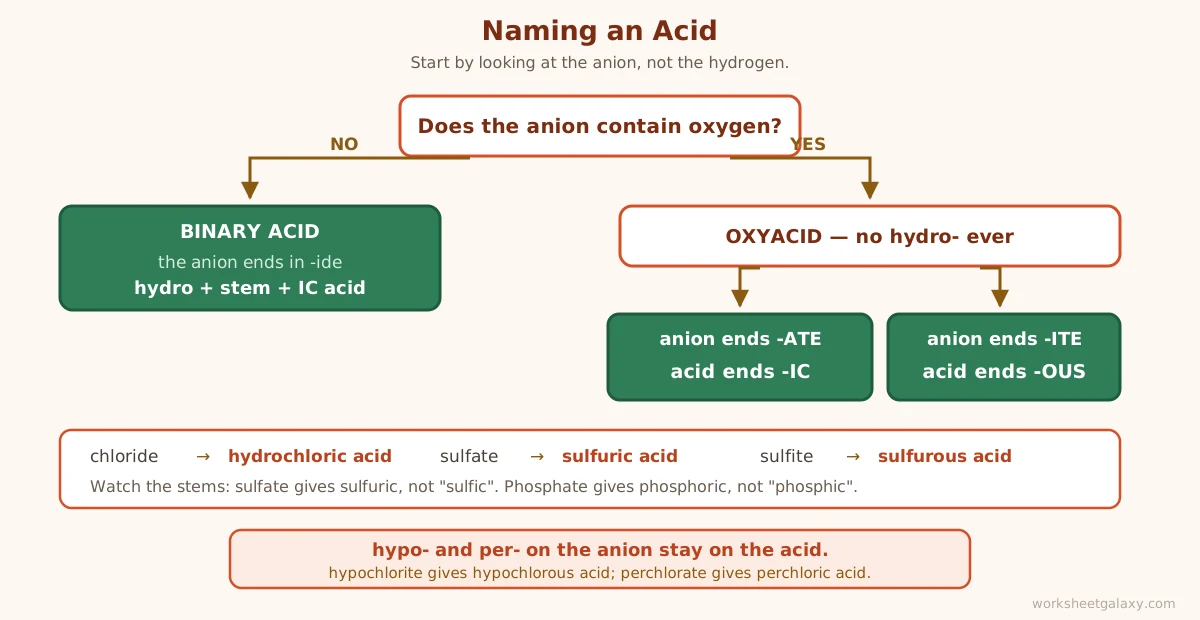
There are only three. An anion ending in -ide gives a binary acid, named hydro- plus the stem plus -ic acid: chloride gives hydrochloric acid. An anion ending in -ate gives an acid ending in -ic: sulfate gives sulfuric acid. An anion ending in -ite gives an acid ending in -ous: sulfite gives sulfurous acid. Any hypo- or per- already on the anion stays on the acid.
The rules are short, which is why students assume they are easy and then lose marks. Two traps account for most of the damage. The first is attaching hydro- to an oxyacid, producing a name that claims the anion both does and does not contain oxygen. The second is the stems: sulfate gives sulfuric, not "sulfic", and phosphate gives phosphoric, not "phosphic". Both irregular stems appear repeatedly on this sheet rather than once in passing.
What is on the worksheet
Part A gives the anion and asks only for the acid name, so the rule is applied with nothing else in the way. Part B works from formulas, with the anion named alongside so the question stays about nomenclature rather than about recalling ion formulas. Part C reverses it and asks for formulas from names, which is where charge balancing has to be right: phosphorous acid needs three hydrogens because phosphite carries a 3- charge.
Part D is four wrong names, each breaking a different rule. Part E is the extension. One question names all four chlorine oxyacids and asks how the name tracks the oxygen count. The last gives the bromine series, which most students have never seen, and asks them to derive the names from the rules alone — which is the real test of whether the system has been understood or memorised.
A polyatomic ion table is printed on the worksheet itself, so it can be used without a data booklet to hand.
Try ten questions before you print
Six want an acid name and four want a formula. Capitals and spacing do not matter, and the sulphur spelling is accepted.
- The acid formed from chloride
- The acid formed from sulfate
- The acid formed from nitrite
- The acid formed from carbonate
- The acid formed from phosphate
- The acid formed from hypochlorite
- Formula for hydrofluoric acid
- Formula for chloric acid
- Formula for phosphorous acid
- Formula for carbonic acid
How to use it in class
Parts A and B work as one lesson immediately after polyatomic ions have been introduced. Part C is better the following day, because it needs charge balancing as well as naming and the two skills interfere when they are new. Part D suits paired discussion, and Part E works as an assessment question precisely because the bromine series cannot be answered from memory.
Element symbols follow the IUPAC periodic table. This sheet completes binary nomenclature alongside naming ionic compounds and naming covalent compounds, and it is the natural preparation for pH calculations, where these acids appear by name throughout.
Frequently asked questions
When do I use hydro-? Only when the anion contains no oxygen, which in practice means only when its name ends in -ide. Every oxyacid goes without it.
Why is it sulfuric and not sulfic? The stem keeps the full element name, sulfur, rather than the shortened form used in the anion. Phosphorus behaves the same way, giving phosphoric and phosphorous.
How do I know how many hydrogens to write? Enough to cancel the anion's charge. A 1- anion takes one hydrogen, a 2- anion takes two, a 3- anion takes three.
Is an answer key included? Yes. The final pages give the answer to all 24 questions, including which rule each wrong name breaks.