Naming Covalent Compounds Worksheet
A free naming covalent compounds worksheet with answers, covering the Greek prefixes from mono to deca, names written from formulas and formulas written from names.
This naming covalent compounds worksheet with answers gives high school chemistry students 24 graded questions on the system used for compounds made of two nonmetals. Unlike ionic compounds, where the charges fix a single possible ratio, two nonmetals can combine in several proportions — so the name has to say how many atoms of each are present.
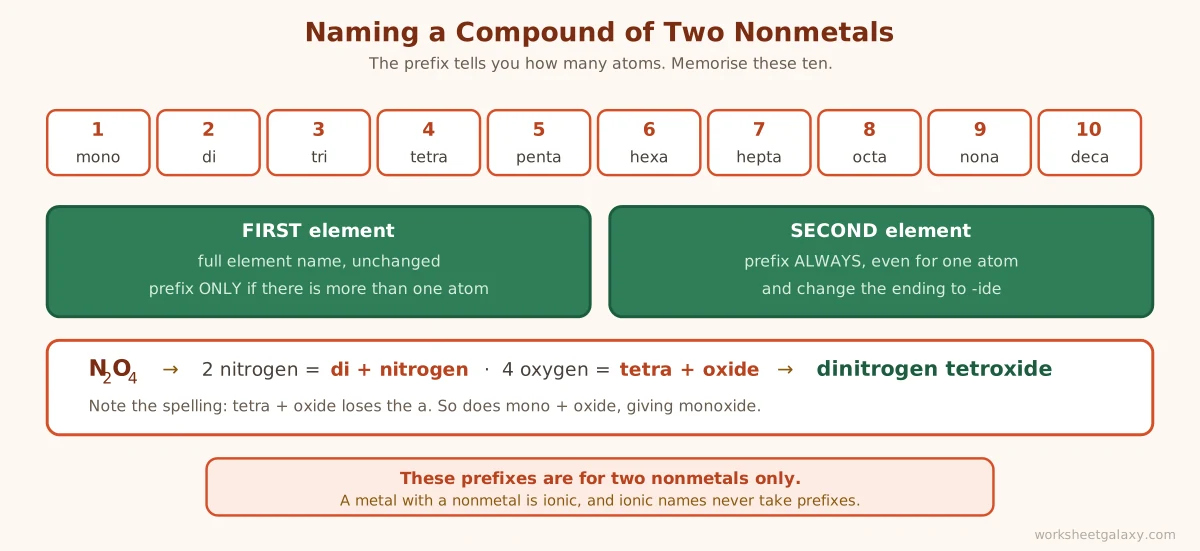
It suits a student's first full year of chemistry — Grade 11 in North America, Year 11 or 12 in the UK and Australia, Class 11 in India — and the same rules carry into IB, AP and A-level courses without change. Some textbooks call these molecular compounds rather than covalent compounds; the naming system is identical.
What the naming covalent compounds worksheet with answers covers
Part A gives names and asks for formulas. Part B runs the other way. Both directions are needed, because a student can often recognise a name without being able to produce one, and the gap only shows up when the question is reversed.
Part C mixes the two directions row by row, so the first thing to work out is what is actually being asked. Part D is four names that are wrong, each breaking a different rule: mono used on the first element, prefixes left off altogether, the second element not changed to -ide, and an English number used in place of a Greek prefix. Naming an error is a harder skill than following a rule, and it is the one that survives into a test.
Part E is about the boundary. Prefixes belong to covalent compounds and nowhere else, so the first question mixes ionic and covalent formulas and asks for only the covalent ones to be named. The others ask why magnesium chloride needs no prefix while "nitrogen oxide" is ambiguous, and give six different compounds of nitrogen and oxygen to name in one go.
The prefixes, and the spelling trap
The ten prefixes are mono, di, tri, tetra, penta, hexa, hepta, octa, nona and deca. Two rules cause most of the lost marks. The first is that mono is dropped on the first element but never on the second: carbon monoxide, not monocarbon monoxide.
The second is a spelling rule rather than a chemistry one. When a prefix ending in a or o meets oxide, that final vowel disappears: tetra becomes tetroxide, mono becomes monoxide, penta becomes pentoxide. Prefixes ending in i keep both vowels, which is why dioxide and trioxide look different from tetroxide. The worksheet includes several of each so the pattern has to be noticed rather than guessed.
Try ten questions before you print
Six want a name and four want a formula. Type answers plainly — capitals, spacing and the sulfur or sulphur spelling all make no difference.
- Name of CO
- Name of SO3
- Name of PBr3
- Name of N2O
- Name of Cl2O7
- Name of CS2
- Formula for carbon dioxide
- Formula for dinitrogen tetroxide
- Formula for phosphorus pentachloride
- Formula for sulfur hexafluoride
How to use it in class
Parts A to C work as a single lesson once the prefixes have been introduced, and they are short enough to use as a starter on several consecutive days instead. Part D suits paired work, because arguing about which rule was broken is more useful than silently correcting the name. Part E is the review question, and it is worth setting after ionic naming has been covered so the contrast is available.
Element symbols follow the IUPAC periodic table. This sheet is the companion to naming ionic compounds, which covers the other half of binary nomenclature, and it pairs naturally with Lewis structures, where the same molecules are drawn out.
Frequently asked questions
When do I use prefixes and when do I not? Prefixes are for two nonmetals. If the compound contains a metal it is ionic, and ionic names never take prefixes because the charges allow only one ratio.
Is it pentoxide or pentaoxide? Pentoxide is the usual form, because the a is dropped before oxide. Some courses accept pentaoxide; both are marked correct in the practice above.
Is an answer key included? Yes. The final pages give the answer to all 24 questions, including which rule each of the four wrong names breaks.