Multiplying and Dividing with Significant Figures
This multiplying and dividing significant figures worksheet gives Grade 10 and Grade 11 students 26 marks of practice on the rule that an answer keeps the smallest significant-figure count of its inputs.
This multiplying and dividing significant figures worksheet gives Grade 10 and Grade 11 students 26 marks of practice on the smallest-count rule, including exact numbers, powers and roots.
What the multiplying and dividing significant figures worksheet covers
When measurements are multiplied or divided, the answer keeps as many significant figures as the input that has the fewest. The reason is straightforward: an answer cannot be more trustworthy than the weakest measurement that went into it. A length known to two figures limits everything it touches.
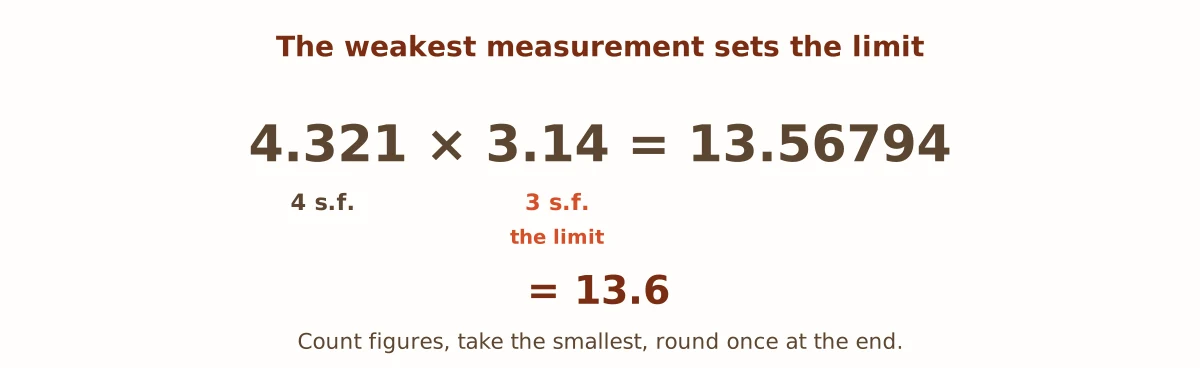
Part A gives ten calculations, and the working column asks which value set the limit rather than just the answer. That is the part worth marking. A student who writes "3.14, three figures" has understood the rule; a student who produces 13.6 with no reasoning may have rounded to a remembered number of decimal places and got lucky.
The rule students import by mistake
The common error is applying the addition rule here. Decimal places have nothing to do with multiplication. In 4.321 × 3.14 the answer carries three significant figures because 3.14 has three — not because something has two decimal places. The two rules look similar on the page and behave completely differently, which is why this sheet and the addition sheet are separate.
A second error is dropping a trailing zero from the answer. 0.0450 × 12.0 comes to 0.540, and writing 0.54 reports two figures where the measurements justified three.
Exact numbers, powers and roots
Counted quantities and defined conversions carry no uncertainty, so they are skipped when deciding the limit. The last word problem turns on this: 36.0 g shared between four dishes gives 9.00 g, not 9, because the four dishes were counted rather than measured. Students who treat that 4 as one significant figure lose two figures they were entitled to.
Powers and roots follow the same logic as multiplication, since a square is a number multiplied by itself. (3.0)² is 9.0 and √2.0 is 1.4, each keeping the two figures of the value it acts on. Both appear in Part A so the idea is practised rather than asserted.
Rounding once, at the end
Intermediate values are carried in full and rounded only when the final answer is written. Rounding at every step introduces an error that compounds, and over a long calculation it can move the last significant digit. The worked solutions show the unrounded intermediate so students can see what was carried forward.
Where marks get lost
Beyond importing the addition rule, two habits cost marks repeatedly. The first is rounding the intermediate value and then rounding again, which can shift the final digit. The second is writing an answer like 200 when the calculation justified two figures: as written that could be one, two or three figures, and 2.0 × 10² is the only way to say two without ambiguity. Part A includes exactly that case so it comes up before an exam does.
How to use this worksheet
The sheet prints on standard letter paper and runs about thirty minutes. The rules are printed on it. It pairs naturally with the addition and subtraction sheet, and giving both in the same lesson is the fastest way to stop the two rules blurring together.
To check an answer or test a calculation of your own, our significant figures calculator works through an expression and names the rule it applied at each step, including exact values written as exact(3). The rest of our science worksheets cover measurement and the chemistry calculations these rules feed into. NIST sets out how measured values should be reported.
Practise multiplying and dividing online
Answer these five questions and check them instantly. They use the same rule as the printable sheet.
- 4.321 x 3.14, to the correct number of significant figures
- 5.452 / 1.67, to the correct number of significant figures
- How many significant figures does 2.5 x 3.42 deserve?
- A mass of 24.52 g in 7.3 cm3. Density, to the right precision?
- 36.0 g shared between 4 counted dishes gives what mass each, in g?